DNA-4 vs DNA-8
DNA-8
A new genetic system with 8 building blocks
One of the main characteristics of life is that it can store and pass on genetic information. Nowadays, this is done by DNA using just 4 building blocks: guanine, cytosine, adenine and thymine (G, A, C and T). Pairs of DNA strands form a double helix with T bonding to A and C bonding to G.
Now, researchers have doubled the genetic code to 8 bases, thus doubling its information density. They called this 8-letter synthetic genetic system “hachimoji” DNA (“hachi” means 8 in Japanese and “moji” letter).
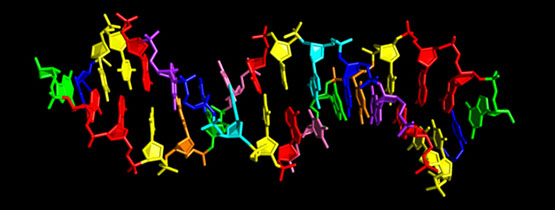
The crystaline structure of a hachimoji double helix is built from 4 naturally-occurring bases, G (green), A (red), C (blue), T (yellow), and 4 synthetic bases, B (cyan), S (pink), P (purple), and Z (orange). Notice the geometric regularity of the pairs, a requirement for evolution:

The system is made up of 4 natural nucleotides and 4 synthetic nucleotides. They all fit seamlessly into the DNA’s helical structure, maintaining its natural shape, and evolving just like natural DNA.
The new building blocks fit the size and shape of the G:C and A:T pairs and bind with them. They are P and B, analogues of purine, and Z and S, analogues of pyrimidine. These duplexes form P:Z and B:S pairs.


The 4 natural (left) DNA bases + 4 unnatural (right) bases
forming the 8 letter DNA.
The DNA-8 researchers decided to mimic nature and use hydrogen bonded base pairs, only altering the pattern of bond donors and acceptors. They added functionality by adding nitro groups to the translated RNA molecules. In order to avoid any bio-hazards, they designed the DNA-8 to be NOT self-sufficient.
Like natural DNA, hachimoji DNA supports life in that it pairs in a predictable way, and copies itself to make a hachimoji RNA. RNA is important for life since it is via this molecule that DNA transfers information before it is sent to proteins.
This 8-letter DNA has additional functionality and translates into RNA that behaves more like a protein, making life without them a possibility.
This new DNA also meets the “Schrödinger requirement” for a Darwinian system of molecular evolution, an important hallmark for supporting life. Erwin Schrödinger created quantum chemistry, and noted that to store information, a genetic material must have different building blocks, just like an alphabet must have different letters.
From a physics perspective, these building blocks must be able to replace each other without geometrically disrupting the size or shape of the double helix to support evolution. The extra nucleotide ‘letters’ are designed to do that.
Engineering enzymes to transcribe DNA into RNA will be important for future synthetic biology applications. It expands the scope of molecular structures that might be capable of supporting life, anywhere in the universe.

T7 Polymerase
To transcribe DNA-8 into RNA, scientists adapted a natural enzyme (T7 polymerase), so that it could accept unnatural genetic molecules, by changing amino acids in the protein, and finding ones that accept DNA-8 to make RNA-8.
T7 RNA Polymerase is an RNA polymerase from the T7 bacteriophage that catalyzes the formation of RNA from DNA in the 5’→ 3′ direction.
Enzymatic Reactions

T4 Bacteriophage
Bacteriophage T4 DNA polymerase is a DNA-directed 5′ to 3′ DNA polymerase. It is the product of gene 43 of the bacteriophage T4, and is therefore often referred to as T4 gp43 DNA Polymerase:

T4 DNA Replication
DNA-8 needs a steady supply of the lab-created building blocks and proteins, as none of these are available outside. Thus, DNA-8 can go nowhere if it escapes the laboratory.
DNA-8 could be used:
- in barcoding,
- in self-assembling nanostructures,
- in retrievable molecular information storage,
- to develop clean diagnostics for human diseases,
- to make proteins with extra amino acids as well as novel drugs.
The researchers, are engineering bacteria that accept these synthetic genetic systems.

All of natural biology boils down to the fact that
DNA (strings of Cs, Gs, As, and Ts) makes RNA,
which makes proteins,
which makes all living things you can see, smell, touch, and taste.
Now, scientists have expanded this code of life beyond these 4 letters provided by nature.
That could have immediate impacts on the DNA data storage industry and the creation of alternative life forms on Earth.
Life evolved from G, A, T, C, not because they were exactly the right raw materials, but because they were simply available. S, P, Z, B are, in terms of stability, in every way equivalent to nature’s 4 letters.
The expanded genetic alphabet shows how life could arise if organisms never evolved proteins but instead relied on RNA as their biomolecular workhorse.
Life on Earth is built around proteins: they catalyze biochemical reactions and provide cellular structural elements, whereby the DNA acts as the biological information storage unit, and the RNA provides a link between those two.
The artificial DNA has many of the characteristics that support evolution in natural DNA. Not only does it store information, it can also be translated into RNA using a mutated polymerase enzyme. They can be placed anywhere within a DNA strand without disrupting the double helix structure – a key aspect for evolution, which requires base pairs to be interchangeable.
Many unnatural base pairs created in the last decades stick together due to hydrophobic interactions. Without hydrogen bonds holding the pairs in an edge-on arrangement, they can slip on top of each other and collapse the double helix.

The DNA-8 molecule proves that proteins might not be the only possible building block for life. Any lifeform does not invent proteins, but could continue to improve RNA by making a longer alphabet with functional groups.
With DNA-8 having 8 letters instead of 4, a 5-base sequence has more than 32,000 possible variations instead of just 1024. This could be a boon for biomolecular data storage, and for diagnostic and therapeutic applications. DNA-8 was bound to breast cancer cells, liver cancer cells, and anthrax toxins.
The key next step is to engineer enzymes capable of replicating and mutating this synthetic DNA.