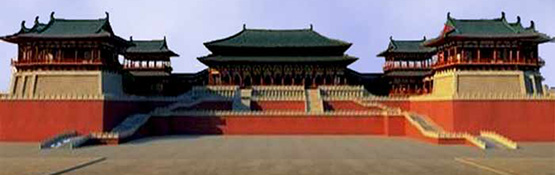
Chang’an
Chang’An (长安)
Chang’an, located near Xian in Shaanxi Province, was the capital of several dynasties of ancient China from the Zhou to the Tang and eventually became one of the world’s great metropolises. With tree-lined avenues, high walls, pleasure parks, and areas dedicated to specific functions:

Early Settlement & Geography
A settlement from Neolithic times, Chang’an was an ideal location for a capital as it was surrounded on all sides by mountains, providing a useful obstacle to invading armies, and was close to the Yellow and Wei Rivers. The advantages of the geographical location are described in the History of the Former Han Dynasty by Pan Ku:
"In abundance of flowering plants and fruits;
It is the most fertile of the Nine Provinces;
In natural barriers for protection and defence;
It is the most impregnable refuge in heaven & earth."
The name Chang’an translates as ‘Forever Peace’, and although not quite living up to its name, the city did remain important for over a millennium.

Jinsha Smiling Gold Mask (Shang Dynasty)

4 sunbirds + 12 sunrays cut out of gold foil (Shang Dynasty)
Chang’an was an important city in the Shang Dynasty (1600-1046 BC). It became a capital under the Western Zhou (1046-771 BC). When the Eastern Zhou dynasty (771-256 BC) arose, Luoyang became the capital. It replaced Chang’an as capital several times in Chinese history.

The Han Capital
After the turmoil of the Warring States period (481-221 BC), Chang’an was capital again during the Western Han dynasty between 206 BC and 9 CE. The city was given an armoury, a state-controlled market and a granary, projects supervised by Emperor Gaozu’s chief minister Xiao He, who was subsequently rebuked for his excessive spending.
The next emperor, Hui, saw the value to his reign of a capital that looked the part and ordered a new market, new walls, a mausoleum for Gaozu and an ice-house in the royal residence. The capital even had its own police force, headed by the superintendent of the capital, the Zhijinwu.
Emperor Wu, the fifth Han ruler, renovated two palaces and built three more. His most famous building project was the redevelopment of the Shanglin Park. Located to the south-west of the city, it had fallen into disrepair and Wu completely transformed it into a pleasure park with artificial water features, the Jianzhang Palace which became the royal residence, and many subsidiary structures.
The park contained many exotic flowers, tropical plants and trees. It had several statues including a whale and replica of the Milky Way. Its menagerie included exotic birds, a rhinoceros, and an elephant.
In this early period Chang’an was dominated by the Weiyang Palace which was built on cut terraces on the Dragon Head Hills above the city. The capital was significantly developed by the early 1st-century CE Han regent and usurper Wang Mang. Mang built an imperial ceremonial hall (piyong), hall of light (mingtang) where the change in seasons was observed, and spirit terrace (lingtai).
But even more celebrated were his nine temples (jiu miao), where the ancient kings of China were worshipped, the foundations of which still remain today. One such temple was a square structure with four doors set within a circular precinct with four gates. The city eventually reached an extent of around 84 square kilometers. In addition, to the north of the River Wei, whole towns sprang up around the sites of the Qin and Han Royal tombs. The whole valley was becoming a major concentration of people.

The Southern & Northern Dynasties
After Luoyang had served as the capital of the Later/Eastern Han (23-220), Chang’an returned as capital of many subsequent different dynastic states during the complex period of China’s history known as the Southern and Northern Dynasties: the Jin (311-316), the Zhao (319-329), Qin (351-385), Later Qin (386-417), Western Wei (535-554), and Northern Zhou (557-581). The city was the capital of the Sui Dynasty (581-618), which unified China once more, when it was redesigned by Emperor Wen Di.
The Tang Capital
During the Tang Dynasty (618-907) Chang’an was still the capital and became one of the great cities of the world and most important in East Asia. In the 8th century, at its peak, the city probably had the largest concentrated population on earth: close to 3 million inhabitants (one million inside the city walls and another 2 million in the surrounding suburbs.
These people were drawn from all over China and included many immigrants, lured by the great commerce of the city, positioned as it was at the end of the Silk Road which crossed Asia. All manner of goods from furniture to spices were traded in the city’s two great marketplaces.

The city now covered some 8,600 hectares. It was enclosed by 5.3m high walls of packed earth with gates on each side. The South Gate was the main gate. Outer walls stretching 9.5 kms long along the east-west axis and 8.4 kms along the north-south axis.
Laid out on a rectangular grid pattern with 114 individually walled blocks, there were wide avenues and streets – 11 running from north to south and 14 from east to west – which were tree-lined and had ditches along their sides for drainage. There were canals, too, to better facilitate the movement of goods across the city and to link it to the areas of Beijing in the north and the Yangtze Valley and Hangchow to the south. Certain areas of the city were dedicated to specific purposes such as manufacturing, commerce, and religion, as well as parks and private residential estates.
The tallest buildings were religious, with Buddhist temples and pagodas dotting the city. To better know what that looked like, you have to visit Japan where such temples as the Horyuji in Nara preserve the architectural plan and style of a typical Chinese temple of the 7th century.

Xi’an Stele: a tablet found in Chang’an, describing in Chinese and Syriac
life of Nestorian Christian communities living in N-China from 635 on,
under one of China’s greatest Emperors, Taizong of Tang.

Syriac text
The temples of Chang’an, besides offering regular religious spectacles, relics for worship such as four of the Buddha’s teeth, and artworks for the public’s pleasure, also provided help to the poor, public baths and medicine and treatment for the sick. Poet Lu Zhaolin wrote:
"Chang’An’s broad avenues link up with narrow lanes;
where one sees Black oxen and white horses;
coaches made of seven fragrant woods;
The emperor’s jade-fit palanquin sweeps past the mansions of princesses;
Gold riding whips in an unending train point toward marquises’ homes;
The dragon biting the jeweled canopy catches the morning sun;
The phoenix disgorging dangling fringes is draped with evening’s red clouds."
The government and palace buildings had their own walled compounds, and there were even areas for the use of visiting foreign embassies. Finally, in the south-east corner of the city was a huge pleasure garden with a lake, lotus ponds, flower gardens, and pavilions. There, people could enjoy the natural beauty, boat on the lake, and see festivals and shows put on by the Emperor or the only Empress Wu Zetian when colorful tents were set up for banquets and orchestras.

The city never stopped expanding or developing. In 634 Emperor Taizong established a new palace, the Great Luminous Palace (Daming gong) which was built in the great hunting park on the northern edge of the city. The palace, already grandiose, was further extended by Emperor Gaozong in 662 and included vast flower gardens and water features. The Hanlin Academy (Hanlin yuan) was founded in 725 by Emperor Xuanzong as a place of study for scholars, artists, writers, and astrologers. Meanwhile, the Pear Garden became a celebrated training school for actors, singers, and dancers.

Decline & Legacy
Chang’an’s glory days came to an abrupt end when it was sacked by Huang Chao in 880 who led a rebellion against the government which had already been weakened by years of warlords and bandits rampaging the countryside. Attacked again in 904-906 by the warlord Zhu Quanchong, Chang’an was replaced as capital by Luoyang once again.
As much of the city’s architecture was of wood, the more important buildings were dismantled and relocated while others were simply abandoned to decay. Eventually, the once great city became overgrown and the area was used for agriculture, just as it had been 2,000 years before.
The city’s complete ruin was eloquently described by the Tang poet Wei Chuang:
"Desolate city of Changan, what do you now contain?
Ruined bazaars, deserted streets where tender wheat-ears grow.
Collecting fuel, they cut down every flower in Almond Park.
For barricades they rooted out the willows of the Grand Canal.
Gay-painted coaches, patterned wheels, have scattered long ago.
Of splendid mansions, grand vermilion gates, not half remain!"
The city may have quickly disappeared physically, but it did leave a tangible legacy in other capitals of E-Asian states who were eager to be seen as civilized and advanced as China. Heiankyo (Kyoto) in Japan and Gyeongju in Korea, are prominent examples where the high walls, grid layout with wide avenues and segregated city districts of Chang’an were imitated; although Mohenjo-daro in the Indus valley was in 2600BC already a very structured township.

Lidar is a remote light detection technique that produces detailed models of any terrain, revealing sites hidden by tree canopy and forest, like ancient Incan & Mayan sites.
RADAR uses Radio-waves, while LIDAR uses much shorter wavelength Light-waves, and is therefore more accurate than RADAR. RADAR is used in applications where detection distance is important but not the exact size and shape of an object, like in military applications.