Ben Franking
Benjamin Franklin helped unify and liberate
the 13 States of America,
and saved its Postal System
On February 13, 1766, Franklin testified against the American Stamp Act before England’s House of Commons, answering Parliamentarians’ questions so deftly that the ill-advised nature of this legislation became obvious. The tax act was abolished one month later, mostly due to his persuasiveness.
Nowadays, despite many efforts to increase revenues and productivity, the US Postal Service fails to make a profit. It’s deficit is ≈$5 Billion. The difference is made up by the American taxpayer.
Benjamin Franklin faced a similar situation when he was made the 1st postmaster general in 1753. Within 4 years, he reformed the Crown’s mail service from an unreliable, expensive and unprofitable service to an efficient, dependable and rewarding operation. As such, he helped the 13 colonies come together as a nation. How?
- The colonial post office was run by the British Crown, which appointed local postmasters. The royal mail was expensive, slow, erratic and limited to major towns.
- It was discriminatory. Government officials like the Penns had the ‘franking privilege’ (free mailing service, still available to members of congress and former Presidents). So did the local printers like Franklin, who was appointed postmaster of Philadelphia in 1737. Their newspapers could be circulated for free.
- Mailing letters was expensive, limiting its use to the wealthy, businessmen and lawyers. Few colonists could afford to mail letters through the official royal mail.
- The delivery was slow. A letter from Boston to Philadelphia might take six weeks to arrive. There was no centralized network to transport mail.

How did Franklin transform the ‘franking services’ ?
- He lobbied for the job, and won it because for 16 years he ran the post office in Philadelphia.
- His first action was to make a grand tour of the postal service. Like a true crisis manager, he felt the need to better understand the workings of the current mail system. He went on a ten-week inspection tour from New Jersey to Massachusetts, to determine the problems facing the post office, such as poor roads, bad record keeping, etc. He talked to riders, postmasters, and postal workers, while responding to their suggestions for improvements.
- After his grand tour, he immediately initiated changes:
a. On the post roads, he had milestones erected to help riders pace themselves better. They still exist between Boston and New York.
b. He proposed new roads, fords and ferries to deliver the mail faster and more regularly. As a result, the travel time for mail between Boston and Philadelphia was reduced from 6 weeks to 3. Within a year, he had the delivery time of a letter between Philadelphia and New York reduced to 1 day.
c. Franklin insisted on precise record keeping. He furnished a uniform system of accounts to all postmasters throughout the colonies, and insisted that all postmasters keep precise accounts of their revenues and costs.
d. Too often, letters were allowed to lie around or read by friends. So, for years he printed in his own newspaper, the Gazette, the names of persons who had letters waiting for them. Thus, he introduced this practice in all other post offices.
e. He also introduced home delivery and the penny post. If individuals failed to pick up a letter after their names were published in the newspaper, letters would be delivered to them the next day for an additional fee. Franklin encouraged the same local delivery in other large towns. Unclaimed letters after three months were forwarded to the central office in Philadelphia. Thus, Franklin has another claim: inventor of the dead letter office!
f. Franklin also made the post office egalitarian. He reduced the price and expanded the service for all colonists, not just the wealthy or important people.
g. He abolished the monopolistic practice of allowing local postmasters to distribute newspapers for free, and opened the service to all papers for a small fee.

Although his improvements to the postal system cost him and his partner, a great deal, totaling £900, by the 4th year they collected more money in 12 months than they had in the previous 36, earning a profit of £600 in total. It remained profitable until the Revolutionary War broke out.
Franklin‘s experience paid off. Within 3 years, the colonial postal service was completely overhauled. Its faster speed and reliability made it profitable and popular. Biographer Carl Van Buren concluded, “No one man before him had ever done so much to draw the scattered colonies together.”


B.F. Coat of arms and playing his glass harmonica

Mozart, Beethoven, Haydn, Donizetti (Lucia "mad scene"),
composed music for BF’s glass harmonica
Franklin was a vegetarian, tofu-lover, music-composer, chess-player, and played the violin, harp, and guitar. He was a Freemason for most of his life, and did not like monopoly power. Therefore, he never trademarked his many inventions. He felt they should freely benefit everyone, whether it be the Franklin stove, the lightning rod, the glass harmonica, bi-focals, swim fins, library-chair/step-stool, 4-sided streetlight, urinary-cateder, DST, aurora borealis theory, and ideas about sea anchors, catamaran hulls, watertight compartments, Gulf Stream, science of demography, electro-therapy, etc.:


Gulf Stream in 1769 and now


BF in Europe at age 77
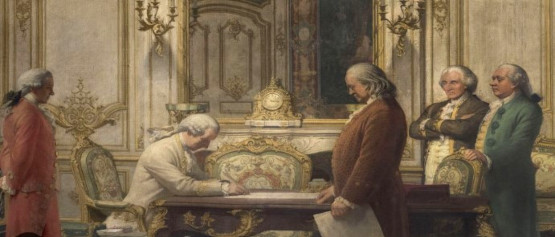
As a Freemason, Franklin became a Venerable Master of The Lodge of 9 Sisters in Paris, where he as America’s first diplomat, patiently worked his charm for 9 years to convince King Louis XVI to nearly bankrupt his own government, (which led to the French revolution soon thereafter), to ensure American independence from the British crown.


Although this 9 year mission had been the most taxing assignment of his life, Congress never offered a settling of expenses, a reward, or so much as a single syllable of thanks.

The above shown interior of a French Masonic lodge has a floor zodiac with the 12 images derived from the Egyptian zodiac which was formerly in the roof shrine on the Temple of Hathor at Denderah, Egypt. At the center is the 5-pointed star, within a triangle.

He is the only Founding Father who is a signatory of all four of the major documents of the founding of the United States:
- the Declaration of Independence,
- the Treaty of Alliance with France,
- the Treaty of Paris and
- the United States Constitution.
He also co-signed the United States Bill of Rights, which comprises the first ten amendments to the US Constitution.

Benjamin Franklin, Adams, and Jefferson
editing the US Declaration of Independence
Franklin proposed a broad Plan of Union for the colonies. While the plan was not adopted, elements of it found their way into the Articles of Confederation & the Constitution. He made several "small but important" changes to the draft sent to him by Thomas Jefferson:

D.o.I. draft edits by B. Franklin

The Declaration justified the independence of the United States by listing 27 colonial grievances against King George III and by asserting certain natural and legal rights, and a right of revolution.

Official 1776 Declaration of Independence
of 13 United States of America
The preamble to the Declaration of Independence begins with the famous sentence: “We hold these truths to be self-evident, that all men are created equal, that they are endowed by their Creator with certain unalienable Rights, that among these are Life, Liberty and the pursuit of Happiness.”

Franklin took the blame for not inoculating his 4 yr old son Franky in 1736. His public chivalry probably disguised his private beliefs. Whether he blamed his wife Deborah, or blamed himself for listening to her, the hard feelings relating to the death of their beloved son—“the DELIGHT of all that knew him,” according to the epitaph on his gravestone—appear to have ravaged their relationship. What followed was over 40 years of what he referred to as “perpetual blame”, until 1777 when his grandson W.T.Franklin, who was an (re-incarnate?) exact look-alike of Franky, came into the picture:

Voltaire blessing Ben’s grandson: "God & Liberty"
On February 22, 1730, Franklin’s son William was born. The mother’s identity is unknown. Exactly 30 years later, on February 22, 1760, William fathered a son, William Temple Franklin. The mother was never identified. Benjamin grandson was placed in foster care until Benjamin took him in 1777 to Europe as his personal secretary until 1785, when they both returned to Philadelphia, as America’s top diplomat, after Ben having created & signed the Treaty of Paris in 1783.

BF’s Embassy at the Hotel de Valentinois, Passy, in 1780
Our founding philanthropist left Boston and Philadelphia £1,000 each(equivalent to about $136,000 today, but then with a purchasing power of millions), to be lent in small amounts to help skilled workers open their own businesses.
Borrowers were to repay the loans within ten years, at a below-market annual interest rate of 5 percent. Although the term would not be coined for another two centuries, Franklin’s inventive scheme was a forerunner of microloans.
Franklin’s will stipulated that the remaining portion of his fund be loaned to tradesmen for yet another century. On the bicentennial of his death, he expected a jackpot running into the tens of millions, to be spent by the "1990" Americans.
He not only expected his borrowers to repay their loans in full, but he also ordered that the scheme be managed for free, by professionals eager to help “the rising generation.” This bequest showed an optimistic bent in the usually pragmatic founder. “Blessed is he that expects nothing,” said Poor Richard, “for he shall never be disappointed.”
Boston and Philadelphia adhered to and ignored Franklin’s vision against a backdrop of technological revolutions, civil and world wars, defaulting borrowers, market crashes, political venality, the invention of the investment bank, and the typical USA lawsuits.

“He who lives by Shifts, can seldom shift himself.”
By 1990, more than $2Mio had accumulated in his Philadelphia trust, and $5.5Mio in his Boston trust fund. The Franklin Institute of Boston, and the Franklin & Marshall College in Lancaster were established.
Although one city’s final sizable pay-out far outpaced the other’s, Franklin’s money remarkably remains in play today, funding skilled job training for young men and women. Most are minorities, or, like his own family, immigrants who bet that a better future awaited them in America.
Franklin’s likeness is ubiquitous. Since 1914, it has adorned American $100 bills. From 1948 to 1963, Franklin’s portrait was on the half-dollar. He has appeared on a $50 bill and on several varieties of the $100 bill from 1914 and 1918. Franklin also appears on the $1,000 Series EE savings bond:


Franklin loved words, so he would notice that the terms gig worker, self-employed, and independent contractor sound liberating but obfuscate the fact that these positions free employers from paying benefits. I doubt he would be thrilled.
He would be shocked to learn that the United States has an abundance of 4-year degree programs (and associated student debt) but an acute shortage of skilled workers.
Franklin proudly counted himself a tradesman, and would be shocked to hear that today, less than 2% of Congress members have ever held a working-class job.
Franklin sought to cultivate his character by a plan of 13 virtues, which he developed at age 20 (in 1726) and continued to practice in some form for the rest of his life.
His autobiography lists his 13 virtues as:
1. Temperance. Eat not to dullness; drink not to elevation."
2. Silence. Speak not but what may benefit others or yourself; avoid trifling conversation."
3. Order. Let all your things have their places; let each part of your business have its time.
4. Resolution. Resolve to perform what you ought; perform without fail what you resolve.
5. Frugality. Make no expense but to do good to others or yourself; i.e., waste nothing.
6. Industry. Lose no time; be always employ’d in something useful; cut off all unnecessary actions.
7. Sincerity. Use no hurtful deceit; think innocently and justly, and, if you speak, speak accordingly.
8. Justice. Wrong none by doing injuries, or omitting the benefits that are your duty.
9. Moderation. Avoid extremes; forbear resenting injuries so much as you think they deserve.
10. Cleanliness. Tolerate no uncleanliness in body, clothes, or habitation.
11. Tranquility. Be not disturbed at trifles, or at accidents common or unavoidable.
12. Chastity. Use venery only for health or offspring.
13. Humility. Imitate Jesus and Socrates.

One of his many home-comings from Europe
Franklin wrote several essays that stressed the importance of the abolition of slavery and of the integration of African Americans into American society.
He had a "passion for virtue". These Puritan values included his devotion to egalitarianism, education, industry, thrift, honesty, temperance, charity and community spirit.
His quintessentially American characteristics helped shape the character of the nation. His ethical writings are a culmination of the Protestant ethic, which ethic created the social conditions necessary for the birth of capitalism.
He helped create a new type of nation that would draw strength from its religious pluralism. Franklin’s rejection of dogma and doctrine and his stress on the God of ethics and morality and civic virtue made him the "prophet of tolerance.
As a young man he adopted the Enlightenment belief in deism, that God’s truths can be found entirely through nature and reason, by declaring, "I soon became a thorough Deist." In his later life he can be considered a non-denominational Christian, although he did not believe Christ was divine.
In 1732, Franklin began to print and publish the noted Poor Richard’s Almanack, full of folk-wisdom:

In 1751, Franklin and Thomas Bond obtained a charter from the Pennsylvania legislature to establish a hospital. Pennsylvania Hospital was the first hospital in the colonies.
In 1752, Franklin organized the Philadelphia Contributionship, the Colonies’ first homeowner’s insurance company.
He helped establish the University of Pennsylvania. The college was to become influential in guiding the founding documents of the United States: in the Continental Congress, over 1/3 of the college-affiliated men who contributed to the Declaration of Independence were affiliated with the college.

Painting in Capitol W-DC
He was also awarded an honorary doctorate by Oxford University in 1762. Because of these honors, he was often addressed as "Dr. Franklin. While living in London in 1768, he developed a phonetic alphabet.
In 1773, he published 2 of his most celebrated pro-American satirical essays: "Rules by Which a Great Empire May Be Reduced to a Small One," + "An Edict by the King of Prussia".

Lessons for Young & Old by B. Franklin
At age 84, Franklin died from a pleuritic attack at his home in Philadelphia on April 17, 1790. His last words were reportedly, "a dying man can do nothing easy,"
Approximately 20,000 people attended Franklin’s funeral after which he was interred in Christ Church Burial Ground in Philadelphia. Upon learning of his death, the Constitutional Assembly in Revolutionary France entered into a state of mourning for a period of three days, and memorial services were conducted in honor of Franklin throughout the country.
His pervasive influence in the early history of the nation has led to his being jocularly called "the only president of the United States who was never president of the United States.
Autobiography:… "Sunday being my studying day, I never was without some religious principles. I never doubted, for instance, the existence of the Deity; that He made the world, and governed it by His providence; that the most acceptable service of God was the doing good to man; that our souls are immortal; and that all crime will be punished, and virtue rewarded, either here or hereafter."


Founded in 1947, Franklin Templeton Inv. has 600 investment professionals, and employs 9,500 individuals in over 34 countries.
All Funds together manage over $750B worth of Assets. NYSE: BEN
His name appears on warships, many towns and counties, educational institutions and corporations, as well as in numerous cultural references and a portrait in the Oval Office:

His more than 30,000 letters and documents have been collected in "The Papers of Benjamin Franklin". "He snatched lightning from the sky and the scepter from tyrants".
Ben Franklin continues to contribute to our lives today. Not the least of which is that we can continue to be entertained by his deeds and served by his inventions.
