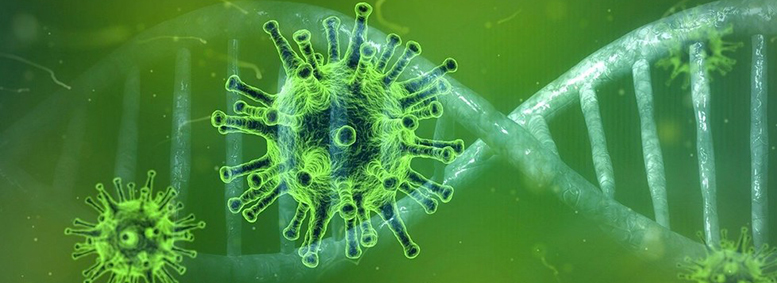
Corona Virus
DNA derived
RNA Corona Virus

Spikes on the outer surface look like a corona surrounding the virion.
Severe Acute Respiratory Syndrome Corona Virus (SARS-CoV)?
Dr. Michael Favorov, a world-renowned CDC epidemiologist stated the following:
“We are aware of at least 40 coronaviruses. Thus, a scary virus worrying millions of people around the globe is neither new nor unique. Many of the large family of coronaviruses co-exist with humans without giving any trouble.
Dozens of them can be contracted by humans and most of them cause only minimal symptoms and pose no threat, because they adapted to the human body and people developed immunity. A problem coronavirus is one that is only recently introduced to humans from another species, possibly a bat, via laboratory manipulations.
When the bats, which serve as a natural reservoir for the virus, have an epidemic of their own, their viruses develop billions of forms, one of which could be capable of cross-species transmission.
Such a virus is not adapted to the human body and could very well “destroy” the cells of the host, leading to a more severe form of disease and potentially life-threatening consequences. Yet, the virus adapts and those, who get infected later, could develop less severe symptoms.
The virus mimics a useful protein consumed by human cells. It seems that the cells of an older person’s organism require this “useful” substance in much larger quantities and thus fuse with the virus more actively.
In everyday life, we are not usually exposed to such a significant number of viruses, which can cause a particularly high number of infected medical specialists, who routinely come in contact with various diseases.
What makes any coronavirus dangerous is that if an infected person develops acute pneumonia it might be hard to treat.

Virus under electron microscope
The disease has 4 stages:
- The virus looks like a relatively harmless cold and lasts between 7-9 days. Although a coronavirus infection could well be limited to these light symptoms, some could develop viral and bacterial pneumonia if the disease breaks immune barriers and finds its way into a previously sterile environment like lungs.
- Should medics fail to contain the disease, it could further evolve acute respiratory distress syndrome, a life-threatening condition that can only be treated with the help of an artificial respiration unit. Even if patients survive through this stage, they could end up with their immune system suppressed to such an extent that another lung disease could kill them.
- Half of fatal coronavirus cases involved people, who remained on artificial respiration for a long time and their alveoli were eventually infected by fungi. There is still no effective treatment against a coronavirus itself while a standard anti-microbial treatment could be inefficient in case of pneumonia caused by this virus.
- Immune stimulants would likely be needed as well. Yet, it is still unclear which ones exactly we need to use. Such a situation elevates potential risks for people with chronic respiratory and lung diseases such as bullous emphysema regardless of their age as well as those suffering from diabetes or cancer.
Although a regular influenza has a mortality rate of only 0.5%, since it is much more contagious, it has killed many more people than a coronavirus over the same period of time.
It also depends on the particular strain of the virus a person gets infected with. Thus, coronavirus mortality rates are different in various countries.
Going through the test for coronavirus in advance is largely senseless, because the existing tests developed in various countries are ineffective since scientists simply lack the biological material to develop more precise algorithms.
These tests may fail to detect the virus in a human organism and could suggest someone is infected when he/she is not.”
“Therefore, testing only makes sense for those who display clinical symptoms.”
A "flexible restrictive strategy" rather than a total lock-down keeps the economy afloat and most people employed.
The deaths during a corona-pandemic will be far less than the deaths caused by societal lock-down when the economy is retracted, due to unemployment and all of its social problems. Such an economy will kill more people over time!
Mass immunization during a pandemic is the worst action a nation of people can undergo.