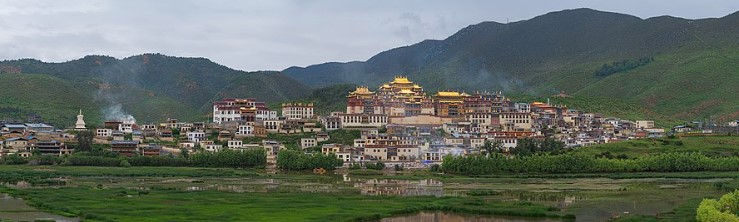
Shangri-La Monastery
Ganden Sumtseling Monastery,
Shangri-La, Tibet
.jpg)
The Sumtseling monastery, of the Gelug order of Tibetan Buddhism, was established in 1679 by its 5th Dalai Lama, during the reign of the Qing dynasty Kangxi Emperor.
He patronized the monastery’s development, and was involved in the protection & installation of the 7th Dalai Lama.
.jpg)
It is the largest Buddhist monastery in Yunnan, and is modeled after the Potola Palace in Lhasa.

With the monastery divided into houses, and each house supported by a group of villages, the institution truly resembles a microcosm of the community. Thus, ties between the surrounding communities and the monastery are strong:

.jpg)
Amazing Buddhist Art
Beautiful murals decorate the Monastery. It preserves ancient treasures of historical significance including scriptures written on palm leaves, gold-covered sculptures of Buddha Shakyamuni, and colorful murals painted by renowned Lamas depicting the life of the Buddha and other Buddhist deities:


.jpg)
.jpg)
Click image above
SHIVA & SHAKTI, different sides of the same coin.
SHIVA symbolizes consciousness, the masculine principle. SHAKTI symbolizes the feminine principle, the activating power and energy.
Whenever a power becomes active, and wherever energy exists, Shakti is working.
The Kundalini Shakti, present in every human, empowers one’s allure towards spiritual enlightenment. In the dormant state the Kundalini Shakti is a tightly coiled and lies at the base of the spine, in the Muladhara region.
When the power is unleashed, Kundalini Shakti rises up the spine, and clears the blockages in the chakras that lie along the Sushumna nadi. To be precise, there are two other nadis, Ida and Pingala, that run on either side of the Sushumna.
Once the power reaches the crown, it helps one to become a part of the highest consciousness. This action leads to all kinds of spiritual experiences.