Caserta Royal Palace
Royal Palace of Caserta
Built by architect Luigi Vanvitelli for Bourbon King Charles VII of Naples in 1751, this elaborate residence is the largest former royal palace in the world as lavish as Versailles.

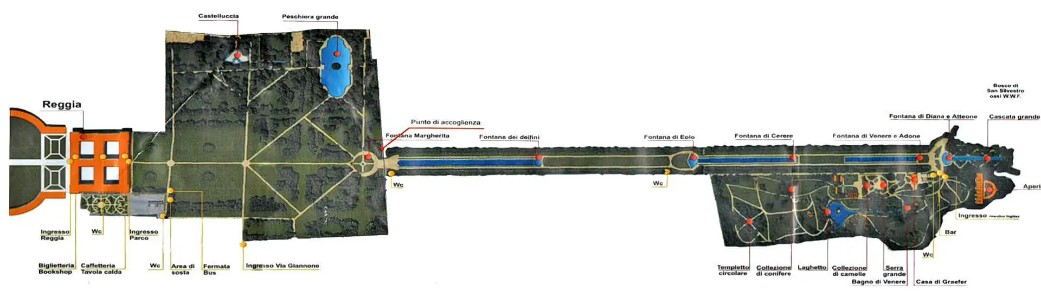
The 300-acre compound features Italian and English gardens, a waterfall, a vineyard, a silk factory, a flour mill, and a 38km aquaduct feeding water to the fountains of the property:

The 1,200 rooms housed staff and residents as well as government offices and elaborate spaces to house the many soldiers protecting the complex.
The Royal Palace of Madrid, where Charles VII had grown up, under the rule of his father, Philip V de Bourbon of Spain, and Charlottenburg Palace provided models:

In April 1945, the palace was the site of the signing of the unconditional surrender of German and Italian RSI forces in Italy. The first Allied war crimes trial took place there.
"The palace has five floors; 1,200 rooms, 1,742 windows; 34 staircases; 1,026 fireplaces; a large library; and a theater modelled after the Teatro San Carlo of Naples:

The floor space is 138,000 sqm. This royal palace has more than 40 monumental rooms completely decorated with frescoes when, in comparison, Versailles counts only 22:

It is "the swan song of the spectacular art of the Baroque, from which it adopted all the features needed to create the illusions of multidirectional space":

The site is featured in the Star Wars films Episode I: The Phantom Menace, and Episode II: Attack of the Clones. It has also been used in movies and tv series, such as The Great, Mission Impossible III, Angels & Demons, Kaos, a.o.
The palace has a rectangular plan of 247 × 184 m. The 4 sides are connected by two orthogonal arms, forming four inner courts. The park starts from the back of the palace, flanking a long alley with artificial fountains and cascades:

The fountains and cascades, each filling a basin, with architecture and hydraulics (by Luigi Vanvitelli) at intervals along a wide straight canal that runs to the horizon, rivalled those at Peterhof Palace outside St. Petersburg.
Experts noted that the Caserta surpassed all other European royal palaces, like Schönbrunn in Austria, in one particular aspect: the combination of completeness and stateliness:

This is attributed to the spacious oval piazza in front of the edifice’s South-side, a partial copy of St. Peter’s Square:
