Ancient Trade Routes
Ancient Trade Routes

The 50.000 mile Roman road system was vital to the maintenance and development of the Roman empire.

Trans-Saharan caravan routes (≈1400). Ghana Empire (13thC.) Mali Empire (13th-15thC.). Niger (yellow). Timbuktu.


The 25.000 mile Inca road system was the most extensive and advanced transportation system in South America.
(The first -very poor- Spanish conquistadores from Extremadura, happened to find 3 desperately weakened empires in the Americas: Aztecs, Mayas, Incas.)

The 4.000 mile Silk road system was a network of Asian trade routes active from the 2ndC BC, until the 15thC.

China’s current Belt & Road Initiative:

Cosco-Chancay Port-Peru
(Peru is Chinese for: fine mist on the coast of Peru in winter)
(Chancay in medieval Castilian:"City of Chinese silk")
(In 1420’s Chancay started to mass produce China-like pottery)

Song Dynasty maritime trade to W-Asia and Africa


.jpg)
Swahili Dynasty trading with Arabia, India, China


5000 year old world map drawn by whom?

Ancient African Seafarers and their ships:


Chinese Junk copied from African Ocean liners:

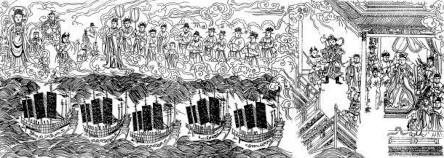
A Chinese treasure ship is a large wooden Chinese junk in the fleet of admiral Zheng He, who led seven voyages to over 300 countries during the early 15th-century of the Ming dynasty.

Admiral Zheng He
The largest ships in Zheng He’s fleet had the size of 44 zhang, which is over 130 mtrs in length, and up to 52 mtrs wide, providing living and working space to over 1000 people.
Ming records show the first voyage was with 62 treasure ships, built within 3 years, plus 190 smaller ones, crewed by 27,800 men. A Zheng He era inscription in the Jinghai Temple in Nanjing gave the size of Zheng He ships of about 500 tons.
From 1403 to 1419, 3488 ships were built, of which about 2700 war-ships with canons. Ropes were made of bamboo fibers, strengthened in boiling water.

The 2nd voyage of this city under sail consisted of 249 ships.
An anonymous annalistic account of the then-ruling RasÅ«lid dynasty of Yemen, compiled in the years 1439–1440, states:
Dragon-ships that arrived in the town of Aden, had envoys of the ruler of China on board who brought brilliant gifts for his Majesty, the Sultan al-Malik al-NÄsir in January of 1419:

Columbus vs Chinese boat size
Splendid Chinese silk cloth woven with gold, top quality musk, and different chinaware vessels, weighing 93.6 kg.

Hard sails, huge oars, many canons
On March 19, 1419, the Sultan ordered that the Envoy of the ruler of China returned with gifts, including many rare, with frankincense-wrapped coral trees, wild animals like oryx, wild ass, thousands of wild lions and tame cheetahs.

Niccolò de’ Conti (1395–1469), who sailed on the Chinese ships and brought their world-maps to the King of Portugal, claimed to have seen 5-mast Chinese junks of ≈1000 tons.


Prevailing winds and currents
The greater ships carry 12 sails, and the smaller ones only 3. The sails of these vessels are made of strips of bamboo, woven into the form of matting. The sailors never lower them while sailing, but simply change the direction according to where the wind is coming from. When the ships cast anchor, the sails with adjustable spars, are left standing in the wind.

The vessels have 4 decks, upon which there are cabins and saloons for merchants. Several of these contain cupboards and other conveniences. They have doors which can be locked, and keys for their occupiers. The merchants take with them their wives and concubines. It often happens that a man can be in his cabin without others on board realizing it, and they do not see him until the vessel has arrived in some port.

South Atlantic circulatory winds and currents
The sailors had their children with them. They had space to sow garden herbs, vegetables, and ginger in wooden tubs.

On 8 March 1421, the largest fleet the world had ever seen set sail from China. The ships, some nearly 500 feet long, were under the command of Emperor Zhu Di’s loyal eunuch admirals. Their mission was ‘to proceed all the way to the end of the earth to collect tribute from the barbarians beyond the seas’ and unite the world in Confucian harmony.

Zheng He’s fleet resembled a floating university and probably had more intellectual knowledge in its library (Yongle Encyclopedia) in every sphere of human activity than any university at that time.
Their 7th and last journey would last for over two years and take them around the globe. However, by the time they returned home, China was beginning its long, self-imposed isolation from the world it had so recently embraced.

Thus, the great ships were left to rot and the records of their journey were destroyed, and with that, the knowledge that the Chinese had circumnavigated the globe a century before Magellan, and that they reached America 70 years before Columbus, and Australia 350 years before Cook.

African Champa Oceanfarers 12th Century AD

Champa King accepting gifts/foods

Black dots are places with traces of ≈1421 Chinese settlements

The brilliance of the Renaissance laid the foundation of the modern world. Textbooks tell us that that was the result of a rediscovery of the ideas/ideals of classical Greece and Rome.
But in 1434, China—then the world’s most technologically advanced civilization— provided the spark that set the European Renaissance ablaze. Since that date, Europeans embraced Chinese intellectual ideas, discoveries, and inventions, all of which form the basis of western civilization.
In early 15th century Florence and Venice, traders from across the globe did business there. A Chinese fleet—official ambassadors of emperor Xuande— arrived in Tuscany in 1434, where they were received by Pope Eugenius IV.
The delegation presented him with a wealth of Chinese learning from a diverse range of fields: geography (including world maps + world globe, passed on to Columbus, Cook, and Magellan), astronomy, mathematics, printing, architecture, art, steel manufacturing, military weaponry, etc.
The great European explorers were brave and determined men. But they discovered nothing. Magellan was not the first to circumnavigate the globe nor was Columbus the first to discover the Americas.
This vast treasure trove of knowledge spread across Europe, igniting the legendary inventiveness of the Renaissance, including the works of da Vinci, Copernicus, Galileo, & others.
RUSSIA & HUAWEI+SMIC CHECKMATED ASML + TSMC
Is the same situation repeating itself in the 21st century, with China filing the most patent applications, having the largest and most modern & efficient manufacturing operations, road & rail & space infrastructure, BRI, and shipping all products across the world through their world’s largest boat company, COSCO, sailing over 1500 large carriers across all oceans?


Containership with 8 rail, fixed, or folding rotor sails

Dragon-Elephant Tango

The “5 Mutuals”:
respect, understanding, trust, accommodation, accomplishments.

“Two bodies with one spirit”

The new train route is a part of the 272km rail link that connects Kashmir with the rest of India’s railway network. The route involves 36 tunnels, totaling 119km, and 943 bridges, passing through rugged, seismically active mountains with peaks over 15,000 ft. The rail link is a US$5.5B engineering marvel, like the Chenab Bridge, 359 m. above the riverbed.
.jpg)
China’s Maritime route in 1421-1434 and 2024