Erased Civilizations
Civilizations,

cyclically erased by water, fire, sand, or sediment?
Global nuclear destruction in 1812
In Asia, records show catastrophic fires across major cities, in Delhi, Kolkata, Manila, all in 1812 or 1813, all described with the same impossible intensity. A worldwide catastrophe happening simultaneously across every continent. And the only explanation that fits is coordinated destruction.
Systematic annihilation. A war not between nations but against a civilization. The Tartarian Empire? The greatest empire history refuses to acknowledge? A global civilization with advanced technology, unified architecture, and continental infrastructure.
A civilization so advanced, so entrenched that the only way to defeat it was total destruction. Nuclear destruction. The technology existed. The ancient Mahabharata describes weapons that sound exactly like nuclear devices. A single projectile charged with all the power of the universe. An incandescent column of smoke and flame as bright as 10,000 suns. That’s not mythology. That’s technical documentation.
Ancient sites around the world show evidence of vitrification. Stone turned to glass. Mohenjodaro in Pakistan. Glass covered ruins. Radiation signatures above normal background levels. Dated to thousands of years ago, but also present in ruins from 1812.
The War of 1812 was the cover story. Napoleon’s invasion was the distraction. While the world watched armies march, something else was happening. The systematic nuclear bombardment of every major Tartar-civilized city: Moscow, St. Petersburg, New York, Philadelphia, Washington, Caracas, Delhi. Simultaneous strikes, coordinated destruction, a reset of global civilization.
And when it was over, when the radiation cooled, when the fires died, they rewrote history, blamed Napoleon, blamed accidents, blamed anything except the truth, that humanity was reset, that an advanced civilization was incinerated, that we’re living in the aftermath of nuclear war from 1812.
And beneath the rubble we find foundations, magnificent foundations of buildings far greater than what now stands. As if we are rebuilding poorly on the bones of giants.
That is inferior replacement. Then they buried the evidence. Blamed conventional war, blamed weather, blamed anything but the truth that humanity has been here before, that we were more advanced before, that we were destroyed before, and that the civilization we’re living in now is not the first. It’s the remnant, the survivors, the children of catastrophe who forgot their own history because someone made sure we would forget. The paintings remember, the scorch marks remember, the glass layers and the radiation signatures remind us of all of it.
Global deluge
For centuries, stories of a great deluge have appeared in every corner of the world. Perhaps they echo real events, sometimes hundreds of meters high floods that swallowed coastlines, lands like Doggerland and Sundaland.
Among the ruins of places such as Göbekli Tepe, Nan Madol, or Mesopotamia raise questions we cannot easily answer.
Some scientists speak of the Younger Dryas, a time when fire from the sky and sudden cold reshaped the earth. Ancient scribes wrote of kings who ruled before the waters rose, as referred to by Noach or Atra-hasis.
Scattered artifacts, from Moai statues to Olmec heads, from submerged cities to strange objects that defy explanation, hint at a chapter of history we barely remember.
The Younger Dryas was a period of rapid cooling that occurred roughly 12,900 to 11,700 years ago, causing Northern Hemisphere temperatures to revert to near-glacial conditions during the last deglaciation.
This event was showed abrupt climate changes, a decline in megafauna, human population disturbances, and the rapid collapse of ice sheets and sea level rise. The Younger Dryas ended with a similarly swift and dramatic warming period, marking the transition to the Holocene epoch.
Sub-sea Pyramid complex:

Guanahacabibes Peninsula, Cuba
Using sonar equipment, the view resembled an underwater city, 650 meters deep, complete with roads, buildings, and pyramids. They bear a remarkable resemblance to the pyramidal design of Mayan and Aztec temples in Mexico.
It could date back from 4,000 to 50,000 BC. Some pyramidal structures may be about 400 m. wide and 40 m. high.
In Japan, lies, at 25 m. deep, a subsea rock pyramid, known as the Yonaguni Monument:

It is part of a man-made complex, comprising of a massive network of buildings, monuments, castles, a stadium, and other buildings, all connected by an extensive system of waterways and roads, est. 3000 to 10.000 years old:

Göbekli Tepe

More than 20 light-colored limestone structures climb the hill of Göbekli Tepe, a 45-foot-high rise on a rolling plateau in southeastern Turkey. Some of these structures are round or oval spaces enclosed by sturdy walls.
Many of them have large T-shaped pillars standing just off-center in the middle and around the edges, incorporated into the walls or into raised stone benches. On a sunny day, the stones are a uniform, dusty brown. At night, they disappear into the landscape.

The settlement was part of a large network of sites, inhabited from around 11600 BCE to at least 8000 BCE, during the Pre-Pottery Neolithic. Multi-spectral imaging, invisible to the naked eye, reveals unique mathematical, like numeric, symbols on pillars, thousands of years before the Greeks:

Nan Madol

800 years ago
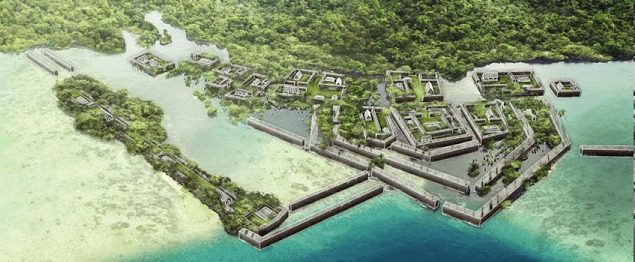
Nan Madol, often called the Atlantis or Venice of the Pacific, lies off the coast of the island of Pohnpei in Micronesia. It is the only ancient city in the world built on top of a coral reef. See also page header.

Around 1200 AD, on about 90 man-made islands, the small population mined, moved and maneuvered about 750,000 basalt rocks that were precisely pieced together to create tight joints that stay connected even without a binding agent, seemingly without pulleys, levels, metal tools or wheels:

Atlantis sinking

Plato’s tale of Atlantis, from his dialogues of Timaeus and Critias

Sundaland, below the surface of the Sth-China sea

Sundaland includes Bali, Borneo, Java, and Sumatra in Indonesia, and their surrounding small islands, as well as the Malay Peninsula on Mainland Southeast Asia.
Lost City of Khambhat, India

The Lost City of Khambhat, an ancient, pre-Harappan, settlement sank into the sea ≈9,500 years ago. The bay, also known as the Gulf of Cambay, lies along the Arabian Sea in Gujarat, just north of Mumbai and Diu Island.
Lost land of the Hyperboreans

This mysterious landmass ties in with the Greek mythological account of the Hyperboreans, and pages in the Mahabharata vedas, a race of giants who lived beyond the North Wind. Their land was supposed to be perfect, with the sun shining 24 hours a day, thus probably within the Arctic Circle.
Amazon Geoglyphs

The Amazon geoglyphs are large, geometric earthen enclosures discovered in the Amazon rainforest, primarily in Brazil’s Acre state, which reveal a complex pre-Columbian past marked by landscape management and settled communities, overturning previous notions of an untouched Amazon. These monumental earthworks, including circles, squares, and hexagons, were built between the 1st and 15th centuries CE, and their purpose remains a mystery.
AI Translated Ancient Sumerian Texts
The main tomb of the 1st Emperor Qin Shi Huang, and its Terracotta Army. Non-invasive tech was used to peek inside, and the data was chilling. The complex is alive with chemical signals. The legends spoke of mechanical defenses and rivers of quicksilver, and the science just confirmed it.
This is the biggest archaeological mystery on Earth, but the doors remain shut. The experts went silent because they found something that suggests the ancient legends were not myths—they were warnings: