Hot Boiling Sun?
HOT BOILING SUN ?
Is the Sun made of liquid red-hot boiling magma?
Stars are not just twinkling lights, they are massive nuclear fusion reactors, made of 98% Hydrogen and Helium, burning for billions of years. Their color reveales their temperature. Blue are the hottest. Red are the coolest.
Copernicus created a revolution in scientific and philosophical thinking by switching the position of the Sun and the Earth. Now, Mitic proposes a new physicochemical structure of the Sun and the processes by which it produces energy.
This will totally revolutionize scientific and philosophical thinking; not only does it create a new physics, but the ramifications will inevitably cause a rethinking of other sciences and philosophy.
EVIDENCE FOR THIS PRESUMPTION:
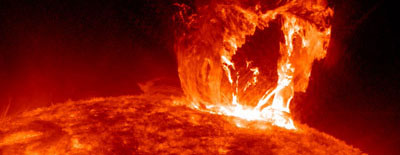
- The latest images of the Sun made by NASA, SOHO, etc. clearly show what the Sun actually looks like in a never before sharper focus. These photos very clearly show whether the Sun is in a gaseous state of matter, or liquid red-hot boiling magma. No math or calculations are necessary. Look at the above NASA video and decide for yourself.
-
In the Universe, planetary systems circling around a star are the rule, not the exception.
-
How can planets come into being from heavy dust condensation from remote supernovas, if condensation is not possible in the windy conditions that exist around each star? How can planets be composed of heavy elements, when they circle around gaseous stars currently made only of H and He?
-
All planets in our solar system are made of liquid redhot magma with a thin cooled crust! They are ‘drops’ of the Sun, expelled into outer space during large explosions; clear indicators of the Sun’s tumultuous past!
-
Over 70 chemical elements occurring on Earth have been detected in the solar spectrum, and even heavier elements that not exist on earth. Chemical analysis of the solar wind shows similar results. How, can these elements come from the Sun’s wind, if the prevailing theory states that the Sun should not produce elements heavier than He for another 5 billion years?

a flaring star
-
The latest images suggest a surface temperature of the Sun of about 5000 °K, which corresponds to the temperature of the Earth’s magma, whereas way out there is about 200 million °K.
-
Helio-seismology exhibits characteristics similar to earthbound seismology! ‘Tsunamis’ have been recorded on the Sun’s surface. Meteor like objects have been bouncing off the Sun’s surface, similar to throwing a flat stone that bounces off the water’s surface.
-
A full 360° rotation of the sun around its axis takes ten days less at its equater than at its poles. The only type of surface that makes sense is a liquid.

-
A Sun spot disappearing as the surface magma flows over the edges of the spot has been recorded. Spots are created by the chemically heavier magma being propelled to the surface from the Sun’s deeper layers.
-
Nuclear Fission is a form of nuclear transmutation because the resulting fragments are not the same element as the original atom. Contrary to nuclear Fusion, Fission is an uncontrollable process and therefore universally unacceptable.
Nuclear fusion produces neutrons, which can initiate fission in traditional nuclear fuel like uranium or plutonium. In a hybrid reactor the core fusion zone consumes energy to heat up the outer fissile blanket, which on its part generates energy.
Although more costly than a regular light or heavy water nuclear power plant, a hybrid reactor plant is inherently safer, as the reaction in the fissile blanket would be sub-critical, that is, it won’t sustain itself.
In an emergency it could simply be stopped in a few seconds by turning off the fusion core, as opposed to using dampening rods in a traditional reactor.
Another benefit of a hybrid design is much higher efficiencies, because it ‘burns down’ fissile materials, leaving no radioactive waste. It can even treat spent nuclear fuel from regular reactors.
Fast neutron breeders, either floating or fixed, such as Russia’s newest BN reactor, create a closed loop cycle by using a liquid metal heat-transfer agent as coolant. They minimize radioactive waste and expand the range of fuel used.
-
Assuming that stars are liquid, red-hot magma, solves the problem of missing mass in the Universe, something we currently call ‘dark mass’. The mass itself is not dark. Probably our comprehension of nature is dark!
