Gravitational Waves
Gravitational Waves

Projection of the sky around earth, taken by the Planck satellite.
The symmetry in pattern/colors show the variations in density across the sky, leading to variations in temperature, and thus brightness of radiation. The hotter, the brighter. All light waves have the same strength, no matter its size and scale. Our Universe can be very easily mathematically described.

Gravitational waves/noise of different frequencies
Gravitational waves are small disturbances in space-time, caused by the motion of masses. As these waves are very weak, only the strongest waves, caused by the rapid motion of very dense stars can be detected by a Laser Interferometer Gravitational-Wave Observatory, or LIGO.
As a star evolves, subsequent nuclear burning produces an iron-rich core. When all nuclear fuel in the core has been exhausted, the core must be supported by electron degeneracy pressure alone. When overcome. the core collapses further, and temperatures soar to over 5 x 10¹° K.
At that point, a breaking up of iron nuclei into alpha particles by high-energy gamma rays occurs. Further rising of temperatures cause electrons and protons to combine and form neutrons.

When a nuclear density of 4 x 10¹7 kg/m3 is reached, neutron degeneracy pressure halts the contraction. The infalling outer atmosphere of the star is flung outwards, and it becoms a supernova. The remnant left is a neutron star.
They are formed by the supernova explosion of a massive star as it reaches the end of its lifespan and detonates its remaining fuel in spectacular fashion.
A neutron star is one of the densest and smallest in our Universe, with a radius of only 11 km, but a mass twice that of our Sun. They are composed almost entirely of neutrons, subatomic particles with 0 electrical charge and a slightly larger mass than protons.
These very hot stars are highly magnetized and cannot further collapse because two neutrons cannot occupy the same place and quantum state simultaneously. They often rotate very rapidly (over 43,000 rpm), and emit gamma-ray bursts from their magnetic poles as pulsars.

Gamma-ray bursts often come from the merger of binary neutron stars, of which there are over a 100 million just in our galaxy alone.
Pulsars are observed on Earth as a string of pulses. The neutron stars’ extremely high density cause very stable rotation periods. Hence the observed arrival time of the pulses are highly regular.
Keeping track of these Pulsars allows for high-precision timing experiments to detect gravitational waves.
Colliding Neutron Stars Create Black Hole and Gamma-ray Burst.
A spectral wavelength analysis of a burst of gravitational waves, led researchers to the conclusion that neutron stars collisions propel gold, platinum, and other atoms into space at about 300 million kph as a glowing gas cloud. This process, called nucleosynthesis, is likely to be the main source of gold and other heavy elements.
They calculated that the amount of gold from the debris of one collision is the same as the mass of the earth, about ‘6+21 zeros’ tons. Our previous civilizations have only sofar produced about 187,000 tons. The current global output from gold mines is about 3,100 tons/year.
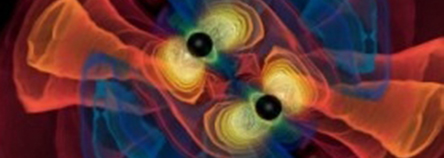
2 merging stars cause a ripple in the space/time continuum
The ‘head & nose’ are formed by the discs of gas, dust, and stars, pushed out by the gravitational shock waves of the 2 merging and stretching galaxies.