Vedic-Kin Lifestyle
Vedic-Kin Lifestyle
The name Russia comes from Ra-Seia (= planting seeds of Light). Edgar Cayce said in reading 3976-10: "Out of Russia’s spiritual development comes a greater hope for the world." The word VEDA means in Russian ‘Awareness".
The Russian language is as old as Sanskrit. The series ‘Ringing Cedars of Siberia‘ is translated into english based on what you feel when you read these books in the Russian language.

The very ancient ‘vedic’ history of Russia is preserved in the Russian language and now re-discovered via Anastasia. The word anastasia means resurrection, immortality. The word ‘ra-bota’ translates to ‘work’ but in Russian means ‘talk with the Ra (Sun)’, the primary purpose in life. The word ‘droog’ means not only friend but also someone else.
The word ‘mir’ means both world and peace. ‘King-dom’ means kin g of the dom, the oldest elder in the kin (family) in the home. The original meaning word for "God" means year. So ‘Kingdom of God’ meant originally ‘family as part of Nature’s cycle.’
Ra-dost means joy (to share your light). Dacha means garden, and also ‘to give’. the word ‘farm’ is based on the old word ‘to take’. The Russian word for family also means seed.
The word ‘Lady’ comes from indo-european Lada, meaning ‘love’. The thousands of years old Russian tradition was based on the sanctity of and direct lifeline to ROD, meaning: life-source, kin, birth, strength, life & joy, freedom. The human as a child of Rod.

The introduction of Orthodox Christianity led their inquisition to kill the ‘volkhvs’, the vedic wisemen, with extraordinary abilities, who taught the people about agricultural symbols and practices, nature, community, etc. They had to flee to Siberia in order to survive. Since total eradication of the pagan lifestyle did not happen, the Russian Church began to absorb many elements and symbols of this ancient vedic, pagan tradition.
The currently built log-cabins use the same sacred and ancient vedic symbology, like sunrise, noon, sunset, fertility. Now, Russians celebrate pagan holidays, such as death of winter, solstiches. The use of sacred geometry wood-carvings in and around the home will have specific influences on our daily lives.
Family food-gardens (7% of all agriculture-land), outproduce commercial agriculture (83%). The word ‘cult’ means taking care of mother earth.


Food produced in Russia’s 35 million family gardens
Some Russian adults spent 18 hrs/wk during 4 months only, to produce all the food they need for a whole year, while US adults watch TV 28+ hrs/wk over 12 months.
Half of Russia’s total agriculture-output comes from only 80.000 km² of marginal lands (the 7%), often abandoned by the commercial agro-bz. Lawns in the US cover over 200.000 km², resulting in a $25B lawncare industry.
Kin-domain
as a part of a self-sustainable eco-village

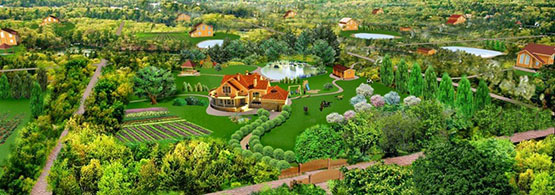
The difference between a self-sustainable kin-domain and a weekend/summer country-home is that the land the kin-domain is based upon would have to be sufficiently large (about 1 ha) to sustain most food, water and building materials for the family living upon it. Domain settlers own their plot, so they can safely invest in the restoration of the land and lifelong stewardship of it, after which it can be passed on to the next generation.
In the commune model, everyone is dependent on the collective always properly working together to meet the basic needs of all its members. On a Kin Domain the surrounding domain owners offer a strong supportive network for people/land development.
Each village of Kin’s Domains may have land that is shared by the collective community. This shared land could include such areas as a shared lake, school, meeting centre, visitor’s centre, riverside, roadway access, etc.
Although it would take several years to establish the plant and animal systems within the domain to reach equilibrium, the kin-domain is planted in a way that makes it highly productive for food, whilst requiring a minimum of effort.
Ideally, a kin-domain would be allodial land, free from taxes/fees and owned outright, with hereditary title in perpetuity, contrary to any form of a deed, which has only a ‘color of title’.

A kin-domain would have most of the following features:
• House/shed
• Living fences
• A wood forest
• Bee-house/hive
• Vegetable patches
• Fruit shrubs & trees
• Farm and companion animals
• An area for the cultivation of grains
• A dam or pond to provide a water supply
• Trees planted to provide wood for future generation’s buildings and for firewood where needed.
Many of these aspects can be easily integrated in the one area.
People plant their garden and build their home according to their heart’s desire.

Kin-domain as a sacred co-creation