8 MILE Movie
BIASES
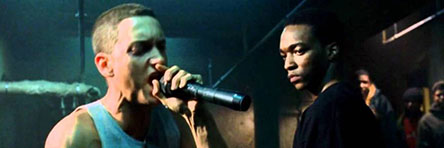
Our technology and ideas have evolved, but our brains can’t evolve fast enough to keep up with them. Consequently, biases are created and are used in almost every sales campaign, business, marketing campaign, movie, news, relationships, rap battle as shown in the 8 mile movie:
In-Group Bias: Notice Eminem’s first line: “Now everybody from the 313, put your mother f.cking hands up and follow me.” The 313 is the area code for Detroit. And not just Detroit. It’s for blue-collar Detroit, where the entire audience, and Eminem, is from. So he wipes away the out-group bias that might be associated with his race and he changes the conversation to “who is in 313 and who is not in 313.”
Herd Behavior: Put your hands up and follow me, he says. Everyone starts putting their hands up without thinking. So their brain tells them that they are doing this for rational reasons. For instance, they are now following Eminem.
Availability Cascade: The brain has a tendency to believe things if they are repeated, regardless of whether or not they are true. This is Availability Cascade. Notice Eminem repeats his first line. After he does that he no longer needs to say “follow me.” He says, “Look, look.” He is setting up the next cognitive bias.
Distinction Bias or “Out-groups” Bias: Brains have a tendency to view two things as very different if they are evaluated at the same time as opposed to if they are evaluated separately. Eminem wants the audience to see his opponent “Papa Doc” as someone different from the group, even though the reality is they are all in the same group of friends with similar interests, etc.
Eminem says: “Now while he stands tough, notice that this man did not have his hands up.” In other words, even though Papa Doc is black, like everyone in the audience, he is no longer “in the group” that Eminem has defined and commanded: the 313 group. He has completely changed the conversation from race to area code.
Ambiguity Bias: He doesn’t refer to Papa Doc by name. He says “this man.” In other words, there’s “the 313 group” that all of us in the audience are a part of, and now there is this ambiguous man who is attempting to invade us.
Watch campaign debates. A candidate will rarely refer to another one by name. Instead, she might say, “All of my opponents might think X, but we here know that Y is better.” When the brain starts viewing someone with ambiguity it gets confused and can’t make choices involving that ambiguity. So the one without ambiguity wins.
Credential Bias: Because the brain wants to take shortcuts, it will look for information more from people with credentials or lineage than from people who come out of nowhere. So, for instance, if one person was from Harvard and told you it was going to rain today and another random person told you it was going to be sunny today you might be more inclined to believe the person from Harvard.
Eminem uses this subtly two lines later. He says, “one, two, three, and to the four.” This is a direct line from Snoop Dogg’s first song with Dr. Dre, “Ain’t Nothin But a G Thing.” It is the first line in the song and perhaps one of the most well-known rap lines ever. Eminem directly associates himself with well-known successful rappers Dr. Dre and Snoop when he uses that line.
He then uses Availability Cascade again by saying, “one Pac, two Pac, three Pac, four.” First, he’s using that one, two, three, and to the four again but this time with Pac, which refers to the rapper Tupac. So now he’s associated himself, in this little battle in Detroit, with three of the greatest rappers ever.
In-group/Out-group: Eminem points to random people in the audience and says, “You’re Pac, he’s Pac,” including them with him in associating their lineages with these great rappers. But then he points to his opponent, Papa Doc, makes a gesture like his head is being sliced off and says, “You’re Pac? None.” Meaning that Papa Doc has no lineage, no credibility, unlike Eminem and the audience.
Objections Up Front: Any direct marketer or salesperson knows the next technique Eminem uses. When you are selling a product, or yourself, or even going on a debate or convincing your kids to clean up their room, the person or group you are selling to is going to have easy objections. They know those objections and you know those objections. If you don’t bring them up and they don’t bring them up, then they will not buy your product.
If they bring it up before you, then it looks like you were hiding something and you just wasted a little of their time by forcing them to bring it up. So a great sales technique is to address all of the objections in advance. Eminem’s next set of lines does this brilliantly. He says, “I know everything he’s got to say against me.” And then he just lists them one by one:
- “I am white.”
- “I am a fucking bum.”
- “I do live in a trailer with my mom.”
- “My boy, Future, is an Uncle Tom.”
- “I do have a dumb friend named Cheddar Bob who shot himself with his own gun.”
- “I did get jumped by all six of you chumps” And so on.
At the end of the list, there’s no more criticism you can make of him. He’s addressed everything and dismissed it. In a rap battle (or a sales pitch), if you address everything your opponent can say, he’s left with nothing to say. Then, the audience, or the sales prospect, your date, your kids, whoever, will buy from you or listen to what you have to say. Look at direct marketing letters you get in e-mail. They all spend pages and pages addressing your concerns. This is one of the most important techniques in direct marketing.
Humor Bias: Eminem saves his best for last. “But I know something about you,” he says while staring at Papa Doc. He sings it playfully, making it stand out and almost humorous. This is Humor Bias. People remember things that are stated humorously more than they remember serious things.
Extreme Out-group Bias: “You went to Cranbook.” And then Eminem turns to his “313 group” for emphasis as he explains what Cranbook is. “That’s a private school.” BAM! There’s no way now the audience can be on Papa Doc’s side but Eminem makes the outgroup even larger. “His real name’s Clarence. And his parents have a real good marriage.” BAM and BAM!
Two more things that separate Papa Doc out from the crowd. He’s a nerdy guy, who goes to a rich school, and his parents are together—unlike those of probably everyone in the audience including Eminem. No wonder Papa Doc doesn’t live in the 313, which was originally stated somewhat humorously but is now proven without a doubt.
Credential Bias (Again): Eminem says, “There ain’t no such thing as . . .”and the audience chants with him because they know he is quoting a line from “Halfway Crooks!” the song by Mobb Deep, another huge East Coast rap group (so now Eminem has established lineage between himself and both the West Coast and the East Coast).
And by using the audience to say “Halfway Crooks” we’re all in the same group again while “Clarence” goes back to his home with his parents at the end of the show.
Scarcity: The music stops, which means Eminem has to stop and let Papa Doc have his turn. But he doesn’t. He says, “F*ck everybody, F*ck y’all if you doubt me. I don’t wanna win. I’m outtie.” He makes himself scarce. After establishing total credibility with the audience he basically says he doesn’t want what they have to offer.
He reduces the supply of himself by saying he’s out of there. Maybe he will never come back. Reduce the supply of yourself while demand is going up. What happens? Basic economics. Value goes up. He so thoroughly dominated the battle that now, in reversal to the beginning of the movie, Papa Doc chokes. He doesn’t quite choke, though. There’s nothing left to say. Eminem has said it all for him.
There’s no way Papa Doc can raise any “objections” because Eminem has already addressed them all. All he can do is defend himself, which will give him the appearance of being weak. And he’s so thoroughly not in the 313 group that there is no way to get back in there. There’s simply nothing left to say.
So Eminem wins the battle. And what does Eminem do with his victory? He can do anything. But he walks away from the entire subculture. He walks off at the end of the movie with no connection to what he fought for. He’s going to choose himself to be successful and not rely on the small-time thinking in battles in Detroit.