Rites of Sericulture
Rites of Sericulture

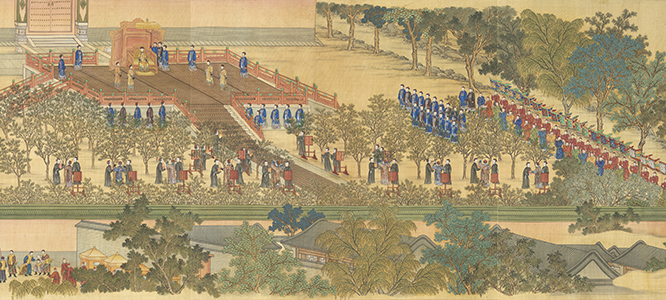
Empress Xiaoxianchun became the first empress in the Qing Dynasty to perform the rite of Sericulture, the making of silk, with the emperor’s consorts. The entire ceremony was painted on scrolls of about 0.5 x 6m each, in 1751, in memory of the empress, by Giuseppe Castiglione, (19/7/1688 – 17/7/1766).
He was an Italian Jesuit and missionary in China, where he served as an artist at the imperial court of three emperors – the Kangxi, Yongzheng and Qianlong emperors. He painted in a style that is a fusion of European and Chinese traditions.
Every third lunar month of the year, the empress would perform the ceremony. When there was an abundance of silk, she would dye and weave them into clothing for the emperor. Emperor Qianlong really appreciated silk clothing, and he wore it during worship and attending court business.

The empress had 4 children. Unfortunately, 3 of them died at a young age. Her grievance eroded her health over time. During a tour on a boat with the emperor to Shandong in the east, while watching the fish swimming in the river, the empress sighed with sadness: “I am not a fish; I would not know how happy the fish is?” On the way back to the capital, the empress died in Dezhou at the age of 36.

Located at Zhangzizhong Road, Dongcheng District, Beijing, is the Hejing Hotel, the former Mansion of Princess Hejing, the empress’s 3rd daughter, the only one that reached adulthood.
Emperor Qianlong mourned the loss of the empress with great sadness. He ordered to maintain her possessions in their original position for over 50 years:
The empress was born on the 22nd day of the 2ndlunar month in the 51st year of the reign of the Kangxi Emperor, which translates to 28 March 1712 in the Gregorian calendar. In 1748, the bereaved Emperor wrote the poem Expressing My Grief after her death:
"When entering her bedroom,
I inhale sadness.
I climb behind her phoenix bed-curtains,
Yet they hang to no avail.
The romance of the spring breeze and autumn moon all ends here.
Summer days and winter nights spent with her will never come again".

Emperor Qianlong visited her grave every year and wrote many poems in memory of her. His love for her was so deep that it took him a long time to install a new empress. She was his favorite out of many.
At age 80, coming to her grave to pay homage. He wrote:
“Every autumn, I can’t help but cry when I pay homage to you.
I am aging and I don’t wish to live till a hundred-year-old.
It’s comforting to know that we will be reunited in less than 20 years.”

His last poem to her, written in 1798:

After visiting major events, he would visit her grave and tell her all about them. They were married for only 20+ years and after her death, he could not but continue to love her for the rest of his existence, because this tained heart love was a clear case of mistaken Twin-Star Identity.

.jpg)
Scroll 3: Mulberry leaves picking
.jpg)
.jpg)
.jpg)