Hall of Supreme Harmony
Hall of Supreme Harmony

Hall of Supreme Harmony or "Hall of Gold Throne" is the heart of the immense Forbidden City palace complex. It is the grandest and the most important building in the nation.

There is also a large square for the officials to offer respects to the emperor in front of the hall, which has a capacity of ten thousand people.
In front of the main door of the hall, was one sundial (ancient timer), one Jialiang (ancient measurement instrument), representing imperial power; pair of bronze cranes, pair of bronze turtles and 18 bronze tripods, symbolizing longevity.


Bronze Lions guarding the Entrances

FOL in 3D
The 35.5 meters high hall has a double-layered roof which is the highest construction rank in the empire and thus is exclusively for the emperor. Its earthquake proof bracket joinery supports the roof and rafters which are decorated with carved dragons and phoenixes.
Covering a floor area of 2,377 sqm, the grand hall is the largest wooden structure in the world. No building in Beijing was allowed to be higher than it during the Ming and Qing Dynasties, because of its symbol of imperial power. The floor was paved with 4,718 golden-like bricks especially made from the high-quality earth of Suzhou. The bricks appear light black, bright and lustrous, but they don’t feel slippery at all.
There are a total of 72 pillars holding the hall, of which the one holding the roof beam has a height of 47 feet. The hall was built on a three-layered white jade platform. This base is surrounded by rails, with marble-carved dragon heads for drainage. During the rainy season, it is a spectacle of thousands of dragons spouting water:
.jpg)
The Hall was used for grand ceremonies such as the Emperor’s enthronement ceremony, the Emperor’s wedding, and the ceremony for conferring the Empress.
The Emperor met high-ranking officials and dispatched generals to the battles from this place. The hall has a variety of furnishings for the exclusive use of the Emperor.

The Emperor’s throne
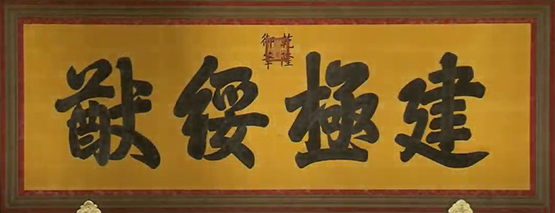
Qianlong’s self-painted sign with 4 Characters:
Respect Heaven- Love yr subjects – Rule w. Justice – Keep the Peace
In front of the dais, are bronze vessels, turtle cranes and cloisonné incense burners, which combined carry the message of eternity of the empire.
The Emperor’s throne of red sandalwood was placed on a two-meter high white jade dais in the center, which was adorned with gilt and engraved with patterns of clouds and 9 dragons.

Behind the throne was a carved gilt screen and on either side are incense burners in the shape of the mythical unicorn, signifying the obedience of all other kingdoms.

The gilded caisson ceiling high above the throne has a magnificent sculpture of a twisting dragon playing with a huge pearl called Xuanyuan Jing. The pearl "was able to identify whether the new emperor was the one chosen by the former emperor because he was competent for the throne. If not, the pearl would drop and kill him".

The grand throne was surrounded by the 6 huge golden pillars, engraved with dragons representing the supreme power of the Emperor.
Buildings were ranked by the number of Mythological creatures and the type of dragons placed on their roof-line:


The center path to the Hall, covered with detailed pearl and dragon carvings in large stone slabs, is only for the emperor. The pearl is a symbol of good luck, while the dragons represent the Heavenly God and the Emperor himself. This means that the Emperor receives his divine power from God:

The quarry where the stone slabs came from was 50 km away. It took hundreds of horses and men 30 days to pull the largest block of stone, weighing over 300 tons, over artificially iced roads to the Forbidden city.

Many movies made about the Qing and other dynasties, are produced in the Hengdian World studios, the world’s largest film & TV shooting base.