Temple of Heaven
Temple of Heaven
天坛

Fu Lion holding a harmonious world (Flower of Life pattern)
Feng shui Fu Dogs or Imperial Guardian Lions are a strong feng shui protection symbol. Fu Lions were traditionally placed in front of Imperial palaces, temples, and government offices. They were a traditional feng shui symbol of family wealth, dharma, and social status and were placed in front of homes.

Lion cub with GMS haircut
When displayed as a couple, the Yang force, left-brain, male, Fu Lion is holding a globe under his right paw, which signifies control and protection over his domain/home. The Yin force, right-brain, female, Fu Lion is holding a playful cub under her left paw, signifying strong maternal protective instincts.

The lion is not an animal indigenous to China. Today, there are Fu Lion feng shui cures to suit any taste and any home. The color, size, and material can influence where and how to use a Fu Dog/Lion from guarding a front door to adding a sense of calm and good luck to your home’s interior.

Tiān Tán
Temple of Heaven Park
A place of “Harmony between Heaven & Nature-loving Man”
A masterpiece of ancient philosophy, architecture, mathematics, mechanics, aesthetics and ecology

Its structures are exquisite, its internal spaces rise to the center, and the outer foundation eaves lift layer by layer, causing a strong sense of upward movement, which makes people feel dignified and stable.
The color contrast is strong without losing the coordination and propriety. It makes people step into the altar space like auspicious clouds into the heavenly world.
The Taoist Temple of Heaven is an excellent work of materialized ancient history, a masterpiece of craftsmanship of great artistic and scientific value, and a relic and carrier of ideology and culture of over 4000 years.
Its circular shape naturally includes the multi-dimensional transcendental Pi (π) factor, thereby creating a coherent resonance with their heavenly counterparts.
>
The complex was first built in 1420 as a Temple of Heaven & Earth. Sized 1.7 km x 1.6 km, it is the world’s largest heaven worship architecture and thrice the size of the Forbidden City complex, that was being built at the same time. The park has 92 buildings, over 600 rooms, lots of woods, and over 2500 juniper/cypress trees that are over 200 years old.
Here, the Emperor came to worship the God of Heaven and pray for a good harvest on the 15th day of the first lunar month and on Winter Solstice. If there was a lengthy drought, he would also go to pray for rain on the Summer Solstice.

After another Temple of Earth was built in 1530, Heaven and Earth were worshiped separately. The worshiping ceremony was mainly for the God of Heaven, secondarily for ancestors of the emperor, as well as for the Gods of the Sun, the Moon, the stars, wind, thunder and lightning.
The emperor was regarded as the “Son of Heaven”. Any natural disasters, bad harvests or instability in society were signs that the emperor had lost favor with the God of Heaven or being punished by him.
Hence, showing respect to the source of his authority, in the form of sacrifices to heaven, was extremely important. This practice goes back 4000 years, during the Xia Dynasty.
Architecturally speaking, the complex has two themes: heaven and earth. The surrounding walls are 6 m-high with a semicircular wall in the north and square shaped wall in the south. This layout represents an ancient belief that the Heaven is round while the Earth is square. The north wall is higher than the south wall, indicating that Heaven is higher than Earth. The main buildings are circular shaped but each has a round and a square wall around it.

Buildings in the complex include:
- Hall of Prayer for Good Harvests.
- Seven Star Stones.
- Divine Music Administration.
- Abstinence Palace complex.
- Echo Wall.
- Imperial Vault of Heaven.
- Divine storehouse.
- Circular (celestial) Mound Altar, situated inside a large square (earth) wall.

Long Corridor
The Long Corridor connects the Hall of Prayer for Good Harvests and the Divine Kitchen with 72 sections of rooms. According to the ancient stipulation of rites, the place for slaughtering the sacrificial animals should be more than 200 steps away from the sacrificial altar, so a winding long corridor was built with the Divine Kitchen in the middle and the Butcher House at the end.

Seven Star Stones
The 7 Star Stones are said to be the projection of the 7 Big Dipper Stars onto Earth to tell the emperor where the place for the heaven worshipping altar should be constructed.
After the Manchu established the Qing Dynasty, a smaller stone was added in the NE corner of these Stones by Emperor Qianlong to commemorate his ancestors who came from the NE part of China, totaling 8 stones.

Hall of Prayer for Good Harvests
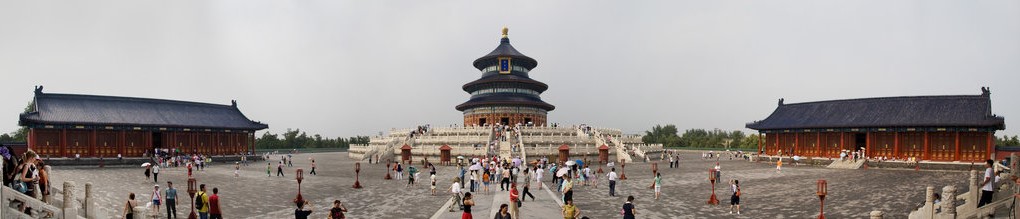
The three-story Altar is round in shape, with a bottom diameter of 91 m, a middle diameter of 80 m, and a top diameter of 68 m. The Hall is 38 m-high and has a diameter of 33 m. It has round eaves and a gilded pointed roof.
The gilded ball on the top symbolizes the supreme power of the emperor. It stands on a 6 m-high triple-tired circular stone terrace with carved marble balusters on each tier.
In 1751, Emperor Qianlong rebuilt the Hall and the 3 roof layers were changed to dark blue glazed tiles, to reflect the color of the sky. The hall was then given its present name, the Hall of Prayer for Good Harvests. It is made of wood without any use of steel, cement or a single nail.
The entire building is supported by 28 massive pillars made of fir tree from OR, USA. They are arranged in 3 rings, 4 pillars in the center are the thickest and the space between each of them symbolizes the 4 seasons of a year.

There are 12 pillars in the inner ring; each space between them represents the 12 months of a year. The outer ring has also 12 pillars, and each space between them symbolizes the twelve 2-hour (called Geng) time-divisions of a day. Together, the 28 pillars represent the 28 constellations in the sky.
The floor is paved with 9 rounds of green marble flagstones. In the center is a big round marble “Dragon and Phoenix Stone”, with ink patterns looking like the dragon and phoenix. During the worship ceremony, the emperor would stand on this stone and kneel down to pray for a good harvest.
In the center of the Hall, the tablet of the God of Heaven was placed on a white marble pedestal. The tablets of the emperor’s ancestors were placed on either side. In front of each table, there was a sacrificial table on which sacrificial vessels are displayed for holding offerings.

The two pavilions on the two sides of the Hall of Prayer were once used as the storeroom of the divine tablets. One is now arranged as a Worship Heaven Ceremony Exhibition Hall, featuring objects used for sacrifices and illustrating the entire procedure followed by the emperor for worship Heaven, with a model of Emperor Qianlong engaged in the most important ritual of the Qing dynasty.

The other pavilion has been turned into a hall for music and dance, exhibiting ancient instruments such as bells and carillons for making Shao music. Words, pictures, light boxes, models and sounds come together to reconstruct the music and the choreography of the various ceremonies that were once held in the temple.

Hall of Imperial Zenith

The building behind the Hall of Prayer for Good Harvests is the Hall of Imperial Zenith, the place where the tablets of the God of Heaven and the deceased emperors were kept.

According to custom, the emperor would come here to burn incense and prostrate himself in front of the tablets one day before the sacrificial ceremony. Then the tablets would be placed in the Dragon Pavilion. The emperor’s retinue took all the memorial tablets to the Hall of Prayer for Good Harvests.

The tablet of the God of Heaven would be kept in a shrine, while other tablets would be placed on the stone platforms on either side. After that, the emperor would go to the Divine Kitchen and the Storehouse to see whether the sacrificial offerings were perfectly prepared or not. Then he would return to the Palace of Abstinence.

The Sacred Way
The “Sacred Way” is the road that bridges the Hall of Prayer for Good Harvest with the Imperial Vault of Heaven. It’s 360 m-long, 30 m-wide and ascends from 1m-high in the south to 3m-high in the north. The increasing height represents the course of the emperor “going upward towards heaven”. The long road signifies that the path from earth to heaven is long.
The bridge has 3 passage ways:
- The central one, called “Divine Road”, is exclusively for the God of Heaven.
- The emperor used to take the eastern way, the “Imperial Road”.
- The western way was used by the ministers and royal family members.

Palace of Abstinence Complex
The Palace of Abstinence complex, was the place where the emperor fasted and bathed before performing ceremonies. Known as a “mini imperial palace”, the complex’s rectangular shape covers 4 ha. It is surrounded by two walls and a moat. It consists of the main halls, bedrooms, bell tower and more than 60 well arranged and uniquely shaped rooms.
The Bell Tower is near the Palace of Abstinence. On the day of the grand worship ceremony, the emperor would leave the Hall of Abstinence at 4:15 AM and the chiming bell would continue until he reached the Altar. After the ceremony was finished, the Bell would chime again.

The main hall of the Palace is called “Beamless Hall”, because the roof is vault-shaped without any beams. The roofs have green tiles and face east. As the Temple of Heaven was considered the residence for the “God of Heaven”, the emperor had to use a color which was of lower rank.
Three days before the worship of Heaven, the emperor went to the Palace of Abstinence for 3 days of fasting. He had to abstain from wine, meat, entertainment as well as his concubines, to show his respect to the God of Heaven.
In front of the main hall are 2 stone pavilions. On the right is the Time Table Pavilion, where the official of the Department of Astronomy would place a timetable.

Divine Music Administration
The Divine Music Administration, was the most prestigious ritual music academy in China during the 600 years of the Ming and Qing dynasties. They were responsible for the ritual music performances in the heaven worship ceremonies. All the officials, musicians and dancers were Taoists and experts on Chinese classical and folk music.
The Taoists developed two additional interests: gardening and pharmacy. Gradually, the place became one of the busiest temple fairs in Beijing until the Qing Dynasty stopped it.
Their most famous medicine was the herb motherwort (Yi Mu Cao), as the surrounding soil was very suitable for growing it. Many very profitable medicine shops were built. Motherwort became one of China’s earliest export commodities.

Imperial Vault of Heaven
The Imperial Vault of Heaven is a single-gabled round building built on one level of marble stone base. It was the place where the tablets of the emperor’s ancestors and the God of Heaven were kept. The latter tablet is placed in a shrine, with inscriptions engraved in Manchurian and Mandarin.
The Imperial Heavenly Vault is supported by 8 peripheral pillars in the outer circle and 8 golden pillars in the inner circle. A gilded bracket system connects all pillars so as to support the ceiling and the caisson.

Inside the Vault are images of dragons and phoenixes. The gilded image on the ceiling has 2 dragons playing with a pearl and the image on the domed ceiling caisson has a golden dragon. The type of construction has no parallel among ancient Chinese buildings:

There are also 8 stone platforms, on which the tablets of deceased emperors were placed. One day before the ceremony, the emperor would come here to read prayers of blessing and burn incense in front of these tablets.


The East & West halls kept the tablets of secondary deities, such as the Gods of the Sun, the Moon, the stars as well as the Gods of cloud, rain, wind, thunder and lighting.
Echo Wall
There are 3 places with marvelous echo effects in the Temple of Heaven:
- the Echo Wall, see above,
- the Triple-Sound Stone,
- the Heavenly Heart Stone.

1. The Echo Wall is a circular wall surrounding the Imperial Vault of Heaven. It is 3.7 m-high, 90 cm-thick and 193 m-long. When speaking, or even whispering at any point close to the wall, the sound will travel along the wall and could be heard clearly by someone at the other end.
2. In front of the Vault of Heaven are 3 stones known as the Triple Sound Stone. Standing on the 1st stone and clap, one echo would be heard, while on the 2nd stone 2 echoes are produced. A clap on the 3rd stone, creates 3 echoes. This is because the 3 flagstones are at different distances from the Echo Wall, and the sound waves are reflected by the wall and bounced back to the center at different times.
3. The Heavenly Heart Stone lies in the center of the Circular Mound Altar, where the emperor prayed for favorable weather, etc. It was considered the center of the entire universe. When emperors delivered ceremonial speeches here, something magical would happen. Even if the emperor spoke quietly, his voice sounded so powerful that it could be heard clearly by the whole audience:

It was believed that “a whisper on Earth sounds like a thunder in Heaven”. This means that every word & behavior in the human world will be clearly received by the God of Heaven. Therefore, the emperor proclaimed that this mysterious phenomenon meant that everyone must obey him or run the risk of being the enemy of the God of Heaven.
As the distance between the Heavenly Heart Stone and the walls is short, the original sound can hardly be distinguished from the echo, so people would hear a louder voice.

Circular Mound Altar
The Circular Mound Altar is also called the “altar to worship Heaven” and the “sacrificial altar”. The top plane has no house on it, so that anyone can talk directly to Heaven. It was rebuilt in 1740. The emperor came here on every Winter Solstice to report to Heaven the year’s good harvest and the country’s prosperity and also pray for the coming year’s prosperity and peacefulness.
It is an empty 55m diameter circular platform on 3 levels of marble stones, each decorated with lavishly carved dragons. All elements of the Altar, including its balusters, steps, and flagstones, are of the sacred number 9 or its multiples. There are stairs with 9 steps on each of its 4 sides. A ring of 9 stones surrounds the above round marble stone, then a ring of 2 x 9 stones, for a total of 9 surrounding rings, the outermost 9th-tier having 9 × 9 = 81 stones:

9 x 9 = 81 brass emperor-palace door studs:

In the past, people believed that the Heavenly Emperor lived in the 9th-tier sky, which symbolizes the supremacy of Heaven. As the largest single odd number, in traditional Chinese culture, the number 9 means noble and powerful and could only be used by emperors.

Lantern Pole (Wangdenggan)
The lanterns were used only by the emperor and were made according to specific measurements. The length of the Wangdenggan is 9 zhang 9 chi 9 cun (one zhang is 3.3 m, one chi is 3.3 dm and one cun is 3.3 cm).
The lanterns hanging on the Wangdenggan are about 2 m-wide and 2.5 m-high. The lanterns’ frames are made of wire with yellow cotton fabric pasted over.
The candles used were made of yellow wax and 1.3 m-high and up to 33 cm-wide, with a long imperial dragon, representing luck and fortune, carved into them. These extremely expensive candles could burn for 12 hours without needing to be trimmed.

Firewood Stove
It is a round shaped stove built with green glazed bricks. There are 9 steps leading to the top of the stove on the east, west and south. The Firewood Stove was the place for burning the sacrificial offerings to the God of Heaven. When the sacrificial rites began, a calf would be burnt in the stove to welcome the God of Heaven.

Temple in Heaven 2024