Chinese Characters
Chinese Characters


曆 (Li = calendar)
虬 (Qiu = dragon)
龙 (Long = dragon)
钱 (Qian = money)
钱币 (Qianbi = coin)
乾 (Gan = male, strong)
(弘 (Hong = great, liberal)
天子(Tiānzǐ= Son of Heaven)
白龙 (Bai long = white dragon)
金龙 (Jinlong = golden dragon)
魔鬼 (Mogui = demonic dragon)
钱龙 (Qianlong = money dragon)
皇 (Huang = Emperor, Sovereign)
帝 (Di = Emperor, god, imperialism)
皇帝 (Huangdi = Emperor, Sovereign)
天命 (Tianming = Mandate of Heaven)
純皇帝 (Emperor Chun = Emperor pure)
純 (Chun = pure, genuine, skillful, practice)
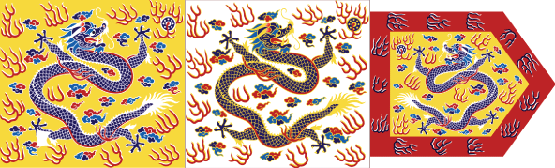
五爪龙 (Wu Zhao long = 5 clawed dragon)
帝王龙 (Diwanglong = Imperial King dragon)
魔王 (Mowang = Demonic King = Beelzebub)
皇帝退休 (Huangdi tuixiu = Emperor Emeritus)
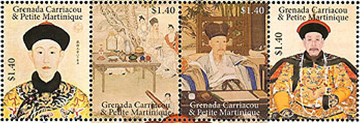
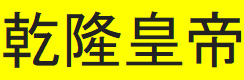
乾隆帝 (Qianlong Emperor), given name at birth Hongli (弘曆)
隆 (Long = grand, prosperous, thrive, swell, eminent, intense)

Living as emperor in the cosmic order
Chinese characters, also known as Hanzi (漢字) are one of the earliest forms of written language in the world, dating back 5.000 years. Nearly 1/4 of the world’s population still use Chinese characters today. As an art form, Chinese calligraphy remains an integral aspect of Chinese culture.
Chinese characters are logograms/logographies. The term ‘logogram’ was derived from Greek logos “word, discourse, reason”. The term ‘logo’ was derived from the term ‘logogram’, not the other way round. Logograms represent words or compounds of words. All the world’s oldest writing systems, such as those used in Ancient Egypt, Mesopotamia and China, use a logographic system.
The earliest Chinese characters were created using pictures or pictographs, which were originally inscribed on clay pottery and bone and then later on bronze and other metals. These characters eventually developed into the calligraphic style that we see in the modern day ‘rhombus-shape’ characters.
Some characters are pictograms where the character is a picture depicting the item. Others are ideograms representing an abstract concept (such as ‘up’ and ‘down’). Then there are characters that combine two or more pictograms and ideograms to create a new meaning, and characters that combine elements to give both the meaning and sound.
Pictographic characters comprise only about 4% of the characters. The vast majority are pictophonetic characters consisting of a “radical,” indicating the meaning and a phonetic component for the original sound, which may be different from modern pronunciation.
Alphabets and syllabaries are distinct from logographies in that they use individual written characters to represent sounds directly. Such characters are called phonograms in linguistics. Unlike logograms, phonograms do not have any inherent meaning. Writing language in this way is called phonemic writing or orthographic writing.
There are 47,035 Chinese characters in the Kangxi Dictionary (康熙字典), the standard national dictionary developed during the 18th and 19th centuries, but the precise quantity of Chinese characters is a mystery; numerous, rare variants have accumulated throughout history. Studies from China have shown that 90% of Chinese newspapers and magazines tend to use 3,500 basic characters.
Evolution of Chinese Characters:
Chinese characters have evolved over several thousands of years to include many different styles, or scripts. The main forms are: Oracle Bone Inscriptions (Jia Gu Wen 甲骨文), Bronze Inscriptions, (Jin Wen 金文), Small Seal Characters (Xiao Zhuan å°ç¯†), Official Script (Xiao Zhuan 小篆), Regular Script (Kai Shu 楷書), Cursive Writing or Grass Stroke Characters (Cao Shu 草書), and Freehand Cursive (Xing Shu 行書).
The Chinese script has been traditionally written from top to bottom and from right to left. However, left-to-right horizontal writing has been used more frequently in recent years in digital media and on the internet. This change is likely due to the influence of Western languages and technology.
The evolution of the Chinese character for dragon (long 龍) is illustrated here.

The Mongolian script is also written vertically, but columns move from left to right:

The Manchu characters are also written from top to bottom, and columns proceed from left to right:

In Tibetan script, syllables are written from left to right:

“Om-mani-padme-hum” mantra text
The Runic scripts are a series of “left-to-right” alphabets, like the Elder Futhark, used by the Germanic peoples to write their languages before adopting the Latin alphabet.


Cosmic characters are expressed vertically: