Quelling of Rebellions
Quelling of Rebellions

Qinglong era Manchu bows differ from earlier ones in a number of important ways:
- The most obvious way is that the Manchu bow is the largest bow in the family of Asian recurves.
- Manchu bows have longer “ears” and string bridges.
- This allowed for the Manchu archers to:
- use a heavier, longer arrow,
- while also acting as levers that enabled them to pull a heavier draw bow.

Qianlong’s brilliantly designed and exquisitely crafted musket epitomizes the pinnacle of imperial craftsmanship in the Qing era.
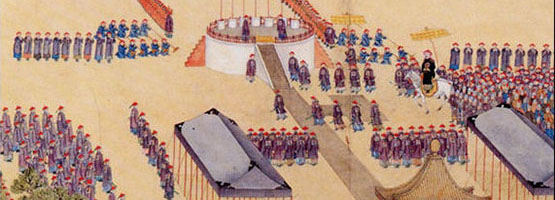
Etchings of Battle Scenes of Qianlong’s Quelling of Rebellions from 1760-1774, in the Western & Northern Regions:

Rewards for quelling the Uygurs
A set of etchings was commissioned by Emperor Qianlong to record in pictorial terms the courage of his generals and soldiers in quelling the rebellions in the Western Regions.

Battle at Aerchuer
Qianlong added his own poem to each etching, thus showing his appreciation for this demonstration of military might.

Battle at Elei Zhalatu

Surrender of the Eleis

Breaking the siege at Hesui

Victory at Heluo Heshi

Battle of Kulongkui

Battle at Yixi’er Ku’ernao’er

The Manchu archers defeated the Dzungar musketeers at Khorgos

Battle of Qos-Qulaq

Storming the camp at Gadan-Ola
_Surrenders_with_His_City.jpg)
The Turfan surrender with their city

The great victory at Qurman

Victory banquet from QL for the officers and soldiers
The Jesuits Giuseppe Castiglione, Jean-Denis Attiret, Ignatius Sichelbart and Jean-Damascène Sallusti and the Dutchman Allart van Everdingen created many of the above etchings.


Military costume QL in French Military Museum
