Afro-self-sufficiency
Afro-self-sufficiency
Self-reliance, Industrialization, Agricultural prosperity
The President of Burkina Faso, Ibrahim Traoré, officially handed over 20 advanced optical sorters to rice mills across the country at the Directorate of Agriculture in Hauts-Bassins. "They told us: You cannot produce quality rice. You have no technology, no standards, no market.", he said.
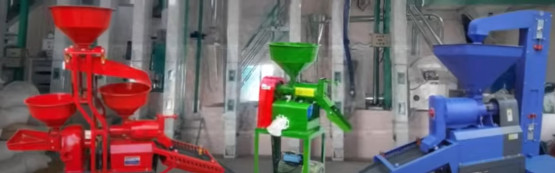
The Poaga Corgo equipment is intended to improve the quality and competitiveness of locally produced rice, by locally extending its rice processing capabilities, so as to produce/package locally grown rice free of all impurities, and allowing for boosting national rice production.
The locally developed affordable optical sorters, by the Sougr Nooma ("good work") Company, are capable of sorting all impurities, plus calibrating rice grains. Handling capacity varies from 1.6 to 6 tons/hr. He further said: "They told us: technology you could not possibly develop!"

The rice innovation platform of IRSAT (Institute of Research in Applied Sciences & Technologies) provides training programs to ensure proper use of the equipment and optimize national rice production with optimum quality/value/competitiveness.
The above is part of an ongoing effort to promote agricultural development and food self-sufficiency in the country.
This revolutionary project is transforming a US$180 million annual rice import dependency into food sovereignty!

✅ 20 optical sorters, worth US$300,000, and built with 60% local components;
✅ Technology captures 64 MILLION pixels per second to identify rice impurities;
✅ Farmers seeing 70-100% price increases for their premium processed rice;
✅ Military weapons budget redirected to food sovereignty technology;
✅ 40% of technicians are women, breaking gender barriers in technology.
BF’s largest rice processing factory:
BF has launched its first-ever smartphone manufacturing factory – HICEL, right in its capital city. A bold declaration of African innovation, economic independence, and technological self-sufficiency.
Horizon Ind. are assembling phones designed specifically for the realities of African life – dual SIMs, solar charging, local languages, and durable hardware.
The plant assembles up to 1,000 smartphones, tablets, and feature phones daily, all proudly labeled “Made in Burkina.”
Since launching in June 2025, it has created over 120 direct jobs and aims to generate thousands more in related sectors.

BF has reopened its national stadium in Ouagadougou. The stadium was initially shut down after the Confederation of African Football (CAF) declared it unfit for international matches due to substandard facilities. It underwent a $300 million renovation, transforming it into a world-class sports venue now fully compliant with CAF and FIFA regulations:


Self sustained Firewalled African Internet:


Sovereign Panafrican digital data, domain, eco-system

Africa is experiencing a digital boom, hosting its own data becomes essential. Local data centers offer independence, enhanced security and control over sensitive information.
Essor Services launched Africa’s first sovereign data center in Burkina Faso, with clean energy company Kaia Energy.
By 11/2025, the data center, powered by a 12-MW waste-to-energy plant, will process, host, and transfer data nationally and internationally, thus enhancing national data security.
This eco-project promotes sustainable practices, waste management, and local job creation.
This is about the BF telecom revolution, national sovereignty, and the bold leadership of Ibrahim Traoré. With 4,500 km of fiber-optic cable, 70 satellite stations, and 90% national coverage achieved without IMF loans or foreign control, Faso Telecom stands as a new model for Africa digital sovereignty.
The $1.5B investment came entirely from domestic resources, proving that nations can fund their own future without compromising their independence.
As Ibrahim Traoré declares, access to communication is not a privilege, the impact of this project is already transforming education, trade, and security.

The 55 African nations have laid their 100.000 km of Fiber networks, about 50 major datacenters, plus exchange points in every major African city, and created the African digital protocol, i.e. language, a separate distributed knowledge mapping, prioritizing African info-sites, and therefore completely incompatable with traditional Inet protocols.
This means that on the Continental Inet exchange, websites, search-engines, and applications built for the current global Inet can only work after major modifications.
A former US$50B spent annually by the 55 African Nations on the Google, MS, Meta, controlled WWW, stays now in Africa, to be invested locally. Other Global South Regions are planning to do similar developments using the Continental Inet exchange. This means the end of digital colonialism.