Faso Industrial Complexes
Faso Industrial Complexes
Refine the Raw…
Home made Detergents
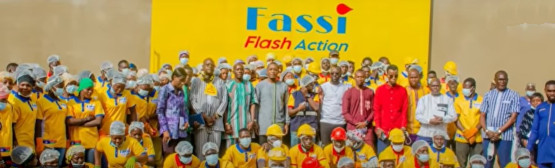
On March 6, 2025, the President of Burkina Faso, officially inaugurated the FASSI Detergent Industrial Complex (CIDF). This event marks a significant step in the BF’s industrial development, particularly in the field of detergent production.

At $9Mio, this industrial complex is supported by a private Burkinabe promoter, Madi Sawadogo. The production unit, specialized in the manufacture of liquid soap, has an impressive production capacity of 300 tons per day. This industry, which aims to meet the growing needs of the local market, will contribute to reducing the country’s imports:

Local Flour Mills and Pasta Production
On February 22, 2025, Burkina Faso started a new flour mill with a daily production capacity of 220 ton of flour and 80 ton of bran in Gampéla, as part of national efforts to strengthen local food processing and thus reduce wheat & flour imports:

The Moulin Double Star Mill (M2S), constructed by the Zidnaba Group at a cost of US$24 Mio, aligns with the government’s vision to enhance food security and promote industrial self-sufficiency.
Souleymane Zidnaba, of the Zidnaba Group, emphasized the project’s alignment with the government’s vision for greater local processing of raw materials.
Burkina Faso, with a population of 23 million, imported 270,300 ton of wheat and 16,700 ton of wheat flour in 2023.
The country does not currently produce wheat, but the government allocated 5,000 ha for wheat cultivation. This initiative aims to lay the foundation for local production and reduce dependency on imported grain.
Moulin Double Star offers 4 ranges of bakery and pastry flours: Yenenga, intended for bread making, Naaba, suitable for pastry making, Baraka, used for bread production, and Lanaya, used in biscuit making. They also plan to expand the flour mill with a corn flour production line.

Recently, the country launched the construction of an US$14Mio pasta manufacturing unit in Koulpélé in an effort to boost local pasta production and cut imports.
This ambitious venture, named Anadolu Industries, is a result of a partnership between Burkina Faso’s government, Anadolu Group in Turkey, and Qatar. It will produce 100 tons of pasta daily, in 5 different varieties.
The facility will also include a flour mill, supplied by local wheat producers cultivating 2,000 ha of land.
The dual-purpose project reflects BF’s larger strategy to boost local agricultural production and enhance food security, reducing its dependence on imported wheat products.
Since 2023, Burkina Faso has been working to revitalize its wheat sector. Last April, authorities announced a forecast of 250 tons of wheat from 125 hectares for the 2023-2024 campaign, yielding approximately 2 tons per hectare.
Although this yield is modest compared to Egypt’s 6 tons per hectare, it surpasses the figures for regional peers like Nigeria, Morocco, and Algeria, where yields range from 1 to 1.6 tons per hectare.
By 2026, the government plans to cultivate 1,500 ha of wheat, resulting in 6,500 tons annually. To support this, the government has temporarily suspended wheat flour imports, encouraging local mills to source from domestic growers.
The development comes after the country recently launched an infant flour manufacturing unit, Moulin de Transformation Agroalimentaire (MTA), in the capital city, on 24/9/2024.
The MTA facility boasts a production capacity of 12 tons/day. The factory will source raw materials such as cereals, soybeans, millet, legumes, and oilseeds from local farmers and peasant organizations, providing a stable market for agricultural producers across the country.
Tomato Processing
Société Faso Tomates (SOFATO) has launched a new tomato processing factory in Yako, Burkina Faso. The factory cost $8.9Mio, covers 1 ha, and has a processing capacity of 100 ton of tomatoes per day.
In 11/2024, a new $11.9Mio tomato processing plant was opened in Bobo-Dioulasso, a landmark step aimed at tackling post-harvest losses and improving agricultural productivity.
Société Burkinabè de Tomates (SOBTO) has been financed by an 80% equity investment through popular shareholding and 20% state participation. The factory is part of the community entrepreneurship program managed by the government’s Agency for the Promotion of Community Entrepreneurship.
This factory has a processing capacity of 6 ton/hr to enable the production of 800kg of concentrate per hour, which will be marketed under the brand name “A’diaa”, (Meaning: Arabic for Radiance and brilliance, often linked with spiritual or divine light. Symbolizes enlightenment and clarity).
Both factories are designed to reduce dependence on imports. Although BF is the 4th largest producer of tomatoes in West Africa and had a harvest of 313,500 ton of tomatoes in 2022, while still importing 23,600 ton of tomato puree.
The 2 factories, at full capacity, could produce over 29,000 ton of tomato puree per year, enough to cover all imports. It is projected to gross $16Mio over the next 5 years.
Burkina Faso is also exploring innovative farming techniques like hydroponics and vertical farming to enhance tomato production, especially in challenging climates.
Processing the entire cashew plant:
A fruit once discarded has become the weapon of a new economic revolution under President Ibrahim Traoré. In a small town called Peni, he launched a US$12Mio cashew apple factory, transforming annually 5,000 tons of a vitamin-rich but forgotten fruit into a national symbol of self-worth.


Why is Burkina Faso, once known for exporting only raw cashew nuts, now taking the harder path—processing, bottling, and branding its own products, like juices, wines, vinegars, and ethyl alcohol? Could this be the next chapter in a quiet sovereignty movement Traoré is leading? This isn’t just a factory with over 1,000 workers. It’s a declaration.
Soy beans processing and exporting:
BF secured a massive 2 Mio ton soybean and soybean-oil export deal to Saudi Arabia! This agreement marks a significant milestone in the country’s GMO-free agricultural sector and should have a profound impact on its economy.
From a Dead Sahel into a JACKFRUIT Forest:
Traoré transforms Burkina Faso’s most barren land into a thriving jackfruit forest—without foreign aid, without multinational firms, and without permission.

Papaya Production Profits Pay for all child-births:
3.000 ha of dead thornbush and dust land was transformed into papaya tree land, using innovative irrigation, and partially exported to strategic markets across Africa and Asia. Traoré’s plan is already redefining what it means to grow from the ground up, offering here over 30.000 direct/indirect jobs.

The Mango Revolution
The Mango Revolution unfolding in the Sahel region is not just cultivating orchards but crafting a bold new model for economic sovereignty across Africa.
What began as bruised fruit in forgotten villages is now challenging global trade rules and redefining what it means to rebuild Africa’s future—not through aid or loans, but with dignity and design.
In BF, over 60,000 households are now connected to a growing mango value chain. Thanks to policies like “Transform before Transport,” and a nationwide cold-chain infrastructure, the Mango Revolution has become more than a farming initiative—it’s a blueprint for self-reliance.
This isn’t just about mangoes. It’s about local processing, women-led cooperatives, satellite-powered irrigation, and a revolution that’s post-permission, post-aid, and post-colonial.
BF as Africa’s Shea Butter King & Queen:
In the heart of the Sahel, a tree older than empires is quietly powering a new economic revolution. The Shea tree—known locally as “Women’s Gold”—has survived drought, wind, and centuries of change.
Women cooperatives collect the shea kernels, process them into butter and soap and commercialize them. In this setup, they are able to take advantage of certain opportunities that they could not have done on their own. They have received loans to buy machines to facilitate processing.
Now, under a bold national plan, BF is moving to protect its groves, modernize production, and take full control of the global Shea butter market. From women-led cooperatives in Kaya to high-tech processing plants in Bobo-Dioulasso, this is the untold story of how a humble nut could generate hundreds of millions in revenue, create over 200,000 jobs, and transform rural life. But can this ancient tree carry the weight of national sovereignty in the modern economy?
Odiss Cosmétiques is transforming damaged skin and outdated beauty standards using one powerful tool: locally sourced, natural ingredients like shea butter, neem, and baobab oil. Odiss has grown into a certified organic brand that supports over 300 women across shea cooperatives.
Burkina Faso’s US$2B sheabutter deal with China made it surpass Nigeria and Ghana, and so Africa’s largest producer of high-quality organic shea butter.
Shea caterpillars are not just a seasonal delicacy but a growing street food business. Women entrepreneurs are turning these protein-rich insects into grilled snacks & stews.
First a survival food and a vital source of income, now an emerging industry with cultural and economic significance.
Pineapple Production Model
From a small BF rural plot to 200 acres producing over 10,000 tons annually, proves that food sovereignty and economic independence are within reach. This pineapple production boom is creating jobs, boosting exports, and inspiring farmers across the nation.
From transforming BF into a key agricultural player to resisting dependency traps, is a rare glimpse into an African-led success story that the world cannot ignore. BF’s agro policies could become a blueprint for the entire continent.

BF’s Ginger boom as a template for others
BF is making headlines with a Ginger Farming BOOM that generates $150Mio annually. This agro-transformation has turned ginger into a symbol of sovereignty, empowering farmers, and strengthening the national economy.
This homegrown revolution — from rural fields to international markets had a substantial impact on rural communities, the rise of women entrepreneurs, and the bold vision for an independent agricultural future.
Innovative farming methods, local processing, and strategic export policies are positioning BF as a rising force in the global ginger market.
Grapevines, conquering desertification!
Captain Traoré ordered Burkinabè citizens to plant 5 million grapevines along the desert frontier, to slow down desertification. It yielded grapes and raisins, and birthed the nation’s first wines. Markets, culture, and pride transformed as BF turned from drought victim to daring pioneers.
By rejecting foreign control and branding the harvest “wine of sovereignty,” he inspired African solidarity, proving that even in sand, imagination can plant dignity and harvest destiny.
Golden Sunflower oils & Seedcakes feed a Nation
In a nation starved of sovereignty, Ibrahim Traoré dared to rain 150 tons of sunflower seeds from helicopters across Burkina Faso’s barren plains. The gamble became a miracle: golden fields rose, oil imports collapsed, livestock thrived, soil healed, and tourism bloomed. What began as spectacle turned into strategy, transforming dependency into dignity.
China’s Largest HD Bucket Wheel Mining Machines!

Excavating 24/7 Gold, Coal, Uranium, a.o.

US$75B Crude Oil Deal Between Burkina Faso and India
In a groundbreaking move, Ibrahim Traoré brokered a historic US$75B crude oil deal between BF and India, marking a significant milestone in the country’s economic development.
India will finance the crude oil extraction, local refining, storage, and shipping infrastructure to be paid for in crude oil.