Milky Way Center
Milky Way Galaxy Center

Flares in the vortex center of the MW
So, astronomers WW called for the James Webb Space Telescope (JWST) to conduct a multi-epoch, large-area, multi-wavelength survey of the Milky Way’s innermost regions. Decoding the dynamics of the Milky Way’s heart, or Galactic Center (GC), should shed light on what happens in many other galaxies in our universe, as well.
Scientists wonder, what role does the supermassive black hole sitting in our galaxy’s center, Sagittarius A*, play in its evolution? Why is our galaxy’s star formation slower than it should be in cold, dark molecular clouds in the area? How do our galaxy’s central star clusters emerge in the first place?

Our galaxy contains 200-400 billion stars that contain over 200 billion planets. It is a spiral galaxy with a bulge, a disk, and a halo. The halo and central bright bulge contain old stars and the disk is filled with gas, dust, and young stars. The spiraling arms begin in the center and form a flat disc.

How does the MW’s black hole black hole affect our galaxy’s evolution? It has a mass 4 Million times that of our sun, yet it is completely invisible. We can only see the chaos surrounding it. Sgr. A is the engine of our galaxy. Silent but powerful. Its core is the place where space and time collapse:

Astronomers already know that massive, galactic black holes like this one grow mostly by feeding on gas that surrounds the holes themselves in plate-like shapes known as accretion disks. Thus, because the presence of such gas is also a necessary ingredient for star formation, its reasonable to infer a relationship between the growth history of Sgr A*, and the rate of star formation in the Galactic Center.
Active black holes emit large amounts of electromagnetic radiation, but Sgr A* appears to be relatively quiet on this front, suggesting it isn’t consuming large volumes of material. Astronomers refer to Sgr A* as a ‘quiescent’ black hole, which means it is basically dormant

Milky Way in the center of its double bowl N-S Magnetic Fields
Galaxies are impelled apart by N-N or S-S Magnetic Force Fields

Balls form rings around center balls between N & S pole bowls
This galactic disc, about 100,000 light-years across, seems to rotate like a ‘flat plate to which all stars are glued’ around its hollow center, by the "gravity of the dark matter mass (containing more than 99% of all the galactic mass)".

MW core sucking in dying stars + orbiting dwarf galaxies
Our Galactic Center is full of stars. It’s so dense, in fact, that smaller telescopes struggle to tell one star from another. Plus, our view of the Galactic Center from Earth is obstructed by large clouds of dust.
The JWST’s Near-infrared Camera (NIRCam) and its system of filters, which allow astronomers to separate spectra of infrared light into wavelengths emitted by specific materials, makes the observatory uniquely capable of peering through these dense regions of dust.
To the unaided eye, those regions just look like dark voids because we can only see visible light wavelengths, blocked by those dust veils. Infrared wavelengths, however, can cross over to the other side, ultimately hitting the JWST’s detectors.
The JWST is also capable of making observations in longer wavelengths of infrared light, which it uses to observe galaxies in the early universe. The light from these galaxies has stretched, or "redshifted" due to the continued expansion of the universe, where their light waves are moving towards the red end of the electromagnetic spectrum (where longer wavelengths are categorized). Infrared is longer in wavelength and lower in energy than visible light, making it invisible to humans.

The Galactic Center contains many stars of all masses. It is the only galactic core we can observe where each star can be investigated individually. And the more we learn about our galaxy, the more we will learn about how other galaxies evolve throughout the cosmos.

Neutron star twins orbiting around the MW core
Our galactic center seems to be operated by twin-forces, one pulling in stars that died, and the other pushing out ‘newborn’ stars, often as Twins. The Twin-center wormhole of one galactic plane might be interdimensionally connected to the Twin-center wormhole of another galactic plane.
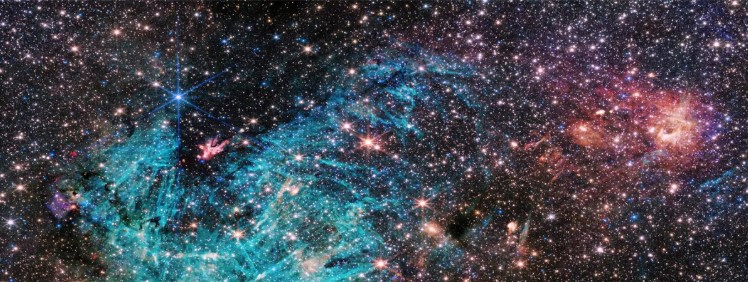
A region of intense star formation, partially hidden by thick dust, just 300 LY from the supermassive black hole at the center of our galaxy. This star-forming region, known as "Sagittarius C," exhibits 500,000 stars strewn like glitter across a blueish glowing backdrop.

The James Webb Space Telescope’s (JWST) Near Infrared Camera (NIRCam) shows members of a dense cluster of baby stars, or protostars, visible just left of center. Within this cluster also lies a burgeoning star that has already assembled a mass 30 times greater than our sun’s, yet is still growing.
Stars form inside clumps of cold, dense molecular hydrogen that collapse in on themselves due to gravity. These clumps are laced with interstellar dust that helps keep temperatures within 10 degrees Kelvin, absolute zero, being the coldest temperature theoretically possible in our universe. In some places, the large, clumpy swathes of dust are so thick that not even the JWST’s infrared vision can penetrate them.
However, we know that deep inside these clouds are nascent stars just beginning to form. Some of those stars, such as the protocluster shown here, have grown to a stage in which their winds can blow away those dusty wombs, rendering the stars themselves visible.

The full view of the JJWST’s NIRCam instrument reveals a 50 light-years-wide portion of the Milky Way’s dense center, located about 26,000 light years from us. An estimated 500,000 stars shine in this image of the Sagittarius C (Sgr C) region, along with some as-yet unidentified features.
Among those features are outflows from the protostars that glow like fire when set against the darker, more opaque molecular hydrogen cloud. In front of that dark cloud, to the top of the image, are foreground stars; around the lower edge are sections of bright, ionized hydrogen energized by the ultraviolet light of other young, massive stars.
The Galactic Center is the most extreme environment in our Milky Way galaxy, where current theories of star formation can be put to their most rigorous test.

In particular, astronomers are probing to see whether massive stars are more likely to form in regions of star-birth at the center of our galaxy than in the suburbs of the MW’s spiral arms. Typically, star-forming nebulas give birth to the least massive stars, M-dwarfs — and with increasing stellar mass comes a drop in the birth rate. This is illustrated by the fact that there are only a handful of the most massive stars, hundreds of times the mass of our sun, existing in the MW.
This tendency to form more of the least massive stars and fewer of the most massive stars is called the stellar initial mass function (IMF), and astronomers still do not fully understand what governs it.
The intensity of star formation in the Galactic Center may subvert the IMF, leading to the preferential formation of a greater abundance of massive stars. If this proves to be the case, then it may also apply to the earliest galaxies. If they had a higher IMF than we realized, it could explain why they are so luminous.
There are turbulent, magnetized gas clouds that are forming stars, which then impact the surrounding gas with their outflowing winds, jets and radiation. Webb has provided us with a ton of data on this extreme environment, and we are just starting to dig into it.