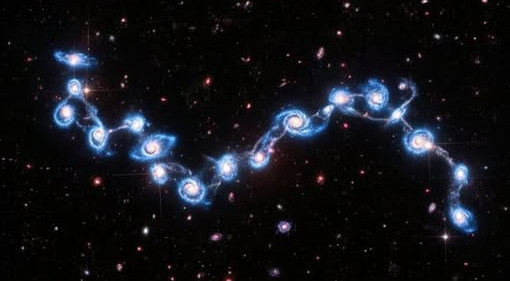
Cosmic Vine
The Cosmic Vine

18 Fruits of Life
around center circle
The James Webb Space Telescope is designed for infrared astronomy, enabling the observation of objects too old (the cosmic vine), distant, or faint for the Hubble Space Telescope.

The telescope’s primary mirror boosts 18 hexagonal mirror segments made of gold-plated beryllium, creating a 6.5 meter-diameter mirror, with a sizeable light-collecting area six times larger than the Hubble Space Telescope.
The cosmic vine is more than just a celestial wonder. It holds the key to unlocking the secrets of the galaxy. Recent studies on the cosmic web have emphasized the crucial role filament structures play in providing the infrastructure materials necessary for galaxies to grow.
Researchers believe that studying the cosmic vine will offer valuable insights into the fundamental processes of galaxy formation and evolution. The cosmic vine also raises questions that challenge our current understanding of celestial phenomena.

A chain of 17 Galaxies
Cosmic Vine
- Structure: The "Cosmic Vine" is a string of 17 galaxies gravitationally embedded by a complex cosmic web of filaments of gas, dark, and ordinary matter, with an estimated mass of 260 billion solar masses.
- Size: It stretches across approximately 13 million light-years, which is about 130 times the diameter of our own Milky Way galaxy.
- Age: Astronomers observed this structure from a time when the universe was only about 3 billion years old, offering a rare glimpse into the distant past of about 10 billion earthly years ago.
- The number 17 appears when knowledge and technology is developed mostly though activities inside the left-cerebral cortex, plus the R-brain.

A filament is a thread in the cosmic web, which is made of mostly dark matter and laced with ordinary matter, that spans the entire universe.
Galaxies residing in a huge filament of dark matter have been found to be mostly rotating in the same direction that the filament is spinning.
This discovery challenges what astronomers know about how this infrastructure influences galactic evolution.