QC Theme Park
People Amusement Overview
People amusement venues evolved from Greek amphitheaters and Roman circus maximus & colosseum, to the participation in church services. From the Greek Parthenon and the Roman Pantheon to the modern stadiums and music halls & parks:
Theme Parks and Amusement Parks
An amusement park is an elaborate park, usually catering to adults, teenagers, and small children. A theme park is a type of amusement park built around one or more themes, such as American West or Atlantis in the Bahamas. Today the terms amusement parks and theme parks are used interchangeably.
Amusement parks evolved in Europe from fairs and pleasure gardens which were created for people’s recreation. In the USA, world’s fairs and expositions were a major influence on the development of amusement parks.
Most amusement parks have a fixed location, instead of a few days/weeks per year for fun-fairs and carnivals.
The Modern Amusement Park
The Blackgang Chine amusement park, established in 1843 on the Isle of Wight, UK can be considered the oldest existing theme park in the world. Lake Compounce in Bristol, CT may be the true oldest continuously operating amusement park in the USA (1846). Another old and traditional amusement park is the family owned Knott’s Berry Farm.
The Modern Theme park
Santa Claus Town opened in Santa Claus, Indiana in 1935. It included Santa’s Candy Castle and other Santa Claus-themed attractions. It is the first themed attraction in the USA: a pre-cursor to the modern day theme park. The first park on Coney Island was built around a nautical theme.
In the 1950’s the Herschend family took over operation of the Marvel Cave tourist attraction near Branson, Missouri. Then they modernized the cave, which led to large numbers of people waiting for the tour. Then the entire village became the theme park, Silver Dollar City.
Starting with Disneyland in the 1950s, the theme park experience became part of a larger package, reflected in a television show, movies, lunch boxes, action figures and finally park rides and costumed characters that make up one or more of the various “themes.” These parks offer a world with no violence or social problems.
The adrenaline generating thrills of the theme parks are often obscured from the outside by high fences re-enforcing the feeling of escape. They are kept clean. New thrill rides are regularly added for customer retention purposes. The theme park is either based on a central theme or, divided into several distinctly themed areas, lands or “spaces.”
Another variation of the ”theme park” are the animal parks. Marineland of the Pacific opened in 1954. It paved the way for SeaWorld parks which added thrill rides later. Today, central Florida boasts more theme parks than any other worldwide destination.
Disneyland and the Corporate-Owned Amusement Park
Walt Disney was influenced by earlier theme parks such as Tivoli Gardens in Copenhagen and De Efteling in Holland.
Disney took these influences and melded them with the popular Disney animated characters and his unique vision. “Disneyland” opened in Anaheim, CA in 1955. It changed this industry forever. Key to the design process was replacing architects with art directors from the film industry.
The Disney World resort complex in Florida opened in 1971; still the largest theme park and resort complex in the world. The Disney Company, accounts for around half of the total industry’s revenue in the USA, with over 50 million adventure seekers each year.
Kennywood, a park open since 1898, features Television personalities. The first regional theme park, the Six Flags theme park, was the vision of Angus Wynne, Jr. He helped create the modern, competitive theme park industry.
Perhaps the most indirect evolution of an attraction into a full-fledged theme park is Universal Studios in Hollywood. The backlot tram tour from 1964 slowly evolved into a large attraction with: a western stunt show in 1967, “the Parting of the Red Sea” in 1973, props from the movie Jaws in 1975, and the “Conan the Barbarian” show in 1984.
An aging population and a slowing economy are forcing The Disney Company and others to seek their fortunes in emerging tourist markets such as in the M-East and China.
Present and Future of Amusement Parks
Since the 1980’s, the amusement park industry is bigger than ever before. From large, worldwide type, theme parks to smaller and medium-sized regional venues. Simple theme parks directly aimed at smaller children have emerged, like Legoland in the USA and Europe. The only limit to future theme park ventures is imagination.

RR-jet engine: 153.000 lego bricks, 2×1.5 m, 300 kg
In 2001, Disney built the Paradise Pier, a re-creation of the traditional yesteryear seaside amusement park. Kennywood created “Lost Kennywood” with classic rides that recall the possibly more tranquil times of the early 20th century.
Amusement parks in shopping malls began in the 1990’s, blending traditional amusement park entertainments – roller coasters, water parks, carousels, and live entertainment– with hotels and movie theaters. Aging baby boomers also demand more restaurants, gardens and live entertainment.
Family fun parks starting as miniature golf courses have begun to grow to include rock-climbing, batting cages, go-karts, bumper cars, bumper boats and water slides.
The latest development is vertical entertainment towers with residential and commercial floors. The "invisible tower" in S-Korea will reportedly be used primarily for leisure activities. It will include observation decks, a movie theater, a roller coaster, a water park and various food and beverage outlets.
The popularity of theme parks has led to more "theming" – the use of an over-arching theme so as to create a holistic and integrated spatial organization of a consumer venue –
in non-theme park edu-tainment venues, such as the FEC‘s, that now have to integrate their material play world with the virtual game world played out on smartphones, etc.:

Amusement Park Rides and Attractions
The earliest rides included the carousel. The Ferris wheel is the most recognized product of a fair. Then came the roller coaster. These gravity driven mechanized thrill-machines on rails were the beginning of even more thrilling amusement park rides. Most rides are set around a theme. Often the mixture of attractions can be divided into several categories.
Thrill rides
There is a core set of thrill rides most amusement parks have, such as the tilt-a-whirl, twister, gravitron, chairswing, swinging inverter ship, and the top spin. There is constant innovation in ways to spin and throw passengers around in an effort to have people return.
Roller coasters
Although the 2-7 different roller coaster rides may be the most attractive aspect of a park, many people come for other reasons. Try the Robocoaster 4D simulator, where kids can design their own riding experience, indoors or outdoors:
Train/Water rides
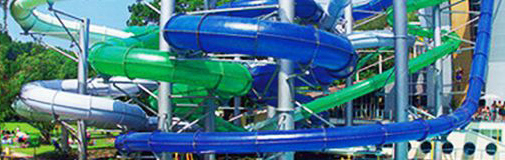
The earliest park trains were mostly custom built. Amusement parks with water resources generally feature a few water rides, like the log flume, bumper boats, and rowing boats.
Such rides are usually gentler and shorter and often more suitable for all ages and on hot days.
Transport rides
Transport rides are used to take large numbers of guests from one area to another. They usually cost extra, even in parks where rides are free. They are generally popular as they offer an alternative to walking. Transport rides include chairlifts, monorails, and trains.
Cuisine
Food is routinely sold through food booths and indoor restaurants and the offerings range from common fast food items, to restaurant selections, to indigenous street food, and may include specialty items or delicacies depending on the nature of the park and availability of ingredients. However, amusement park menus generally include:
- Pizza
- Popcorn
- Hot dogs
- Ice cream
- Soft drinks
- Sandwiches
- Hamburgers
- Fried chicken
- Cotton candy
Admission prices and admission policies
Amusement parks collect most of their revenue from park admission fees. Other revenue sources are parking fees, food and beverage sales, and souvenirs.
Amusement parks operate on 1 of 2 admission principles:
Pay-As-You-Go
In this format, a guest enters the park at little or no charge. The guest must then purchase rides individually, either at the attraction’s entrance or by purchasing ride tickets (or a similar exchange method, like a token). The cost of the attraction is often based on its complexity or popularity. For example, a guest might pay 1 ticket to ride a carousel, but would pay 4 tickets to ride a roller coaster, or allow guests to purchase unlimited admissions to all attractions. A wristband or pass is then shown at the entrance to gain admission.
Disneyland opened in 1955 using the pay-as-you-go format. Initially, guests paid the admission fees at the attractions. This evolved into a ticket system that is still part of the amusement-park lexicon. In this new format, guests can purchase ticket books that containe a number of tickets, labeled “A,” “B” and “C.” Rides and attractions using an “A-ticket” are generally simple, with “B-tickets” and “C-tickets” used for the larger, more popular rides. Smaller tickets could be traded up for use on larger rides (i.e., 2 or 3 A-tickets would equal a single B-ticket).
The advantages of pay-as-you-go include:
* guests pay for only what they choose to experience
* attraction costs can be changed easily to encourage use or capitalize on popularity
The disadvantages of pay-as-you-go include:
* guests may get tired of spending money continuously
* guests may not spend as much on food or souvenirs
Pay-One-Price
An amusement park using the pay-one-price format will charge guests a single, large admission fee. The guest is then entitled to use almost all of the attractions as often as they wish that day. So-called “up-charge attractions” may not be included in the admission charge, like bungee jumping, or go-kart tracks, or games of skill.
The advantages of pay-one-price include:
* guests can more easily budget their visit
* guests may be more likely to experience an attraction they’ve already paid for
* guests may be willing to spend more on food and souvenirs
Click here for theme park rides manufacturers.