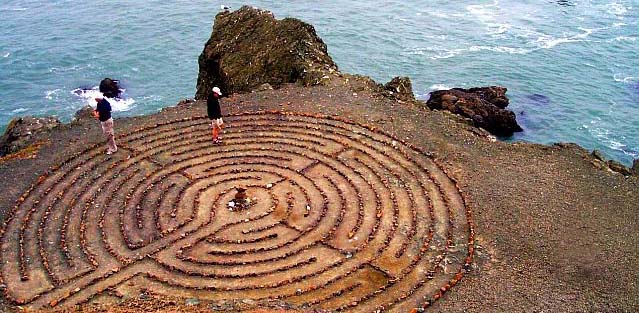
The Labyrinth
The Labyrinth
A labyrinth is an ancient pattern found in many cultures around the world. Labyrinth designs were found on pottery, tablets and tiles date as far back as 4000 years ago. Many patterns are based on spirals from nature. The Native Americans call it the Medicine Wheel. It is the Kabalah, in mystical Judaism. One feature they all share is that they have one path which winds in a circuitous way to the center.
The medieval version, first developed during the 9th and 10th centuries CE, combined the 11 circuits of the Otfrid labyrinth with the 4-fold symmetry of the Roman labyrinths to produce a design better suited for use in a Christian context. By the 11th and 12th centuries this form became common in various manuscripts and in the decoration of church floors in Italy. In the early 13th century it spread to France, and became the principle form throughout southern and western Europe.
A labyrinth is not a maze: a maze developed initially from medieval labyrinths. The earliest mazes in the gardens and palaces of Europe were created by rearranging the walls of a labyrinth to achieve a pathway with choices; often including a number of dead-ends.

A Labyrinth is a sacred design painted on the floor, to be walked quietly as a spiritual meditation. This unicursal design requires the walker or pilgrim to begin at the outside of the circle and wind slowly toward the center and then slowly out again, using the same ceremonial path.
There are 3 stages to the walk or “quest”:
- releasing on the way in,
- receiving in the center, a place to be, sit or stand still,
- returning to the world with whatever you received in the center.
Suggestions for walking the Labyrinth:
(1) Focus inward as you walk in and release and let go of the details and tensions of your life.
(2) The center is a place of prayer, meditation, listening, insight, and feeling in the Present.
(3) As you walk out you can integrate the insights you gained earlier and may feel more balanced, or more grounded, authentic, centered, alive and/or closer to your Creator, your neighbor, self, or nature.
There is no right or wrong way to walk a labyrinth. Each time you walk it, you feel more balanced and become more empowered to find and do the work your soul is calling you to. The Labyrinth becomes a mirror for your life; it touches your sorrows, releases your joys, and quiets the mind.
It is meant to be a transformative spiritual journey, open to anyone. Walk it with an open heart and mind and use it as a tool to unite your Mind, Heart, Soul and Spirit.
Disengage from the rest of your day and relax. Sit down or walk around the outside of the labyrinth. Think about issues, concerns, questions, or wishes you want to reflect upon during this walk. Or simply decide to clear and quiet your mind and be in a receptive state.
When you walk the labyrinth for the first time, the impact may seem remote. It is a laboratory for practicing self-observation and finding your natural rhythm. Listen to your breathing.
Allow yourself to find the pace your body wants to go. It may change throughout the walk. You may "pass" people or let others step around you. Reflect on your behaviors and feelings while walking with others on the labyrinth! Please remove your shoes if their sounds could disturb others.

The 4 quadrants of the Labyrinth are seen by some as the 4 stages of the Holy Roman Mass:
1. Lower LH: the evangelium or awakening: When did I first become aware of this issue?
2. Upper LH: the offertory or sacrifice: What do I have to give up in order to resolve this issue?
3. Upper RH: consecration or transubstantiation: What needs to change? Christ enters the equation.
4. Lower RH: communion or culmination: What will the issue look like when the changes are made?
Each quadrant has 7 turns, following the 7 main chakras who successively switch in polarity. The path follows first the inner half of the circuits, then you gradually work your way to the exterior rings.

Labyrinth in Amiens Cathedral
Some see the walk as a rescue of the Goddess (the feminine, intuitive) within them. To some she also represents the earth or the dark shadowy places within us. Some see it as the ‘Virgin in the center’ who is kept imprisoned and needs to be rescued by her ‘hero’; a more masculine, rational, assertive, analytical, power-motivated mode of operation.
In the pilgrimage tradition the center of the Labyrinth is called "Jerusalem" and the path, "The road to Jerusalem." It is easier and saver to connect here with the divine deep in you, than actually traveling all the way to Jerusalem, Israel.

The Kincardine Labyrinth in Canada
Walk the divine spark in you.
Every walk is different, even for the same people, and the effects of walking are cumulative. The more often you walk over time, the deeper the experiences can become. The labyrinth provides countless opportunities for new levels of understanding and healing. Research has shown that the labyrinth’s energy can align and balance the chakras and the fluidic systems in the body, creating feelings of renewal, increased energy, clarity, balance and peace for the walker.
As you leave the labyrinth, you may wish to turn and pause to silently express your gratitude for its gifts. You may write down some of your thoughts and feelings.

Tree of Life Labyrinth
Place a human body in a place of transcendental proportions, such as the Golden Mean Ratio: 1.61833…, then the mind can resonate easier with the transcendental, intuitive, more creative dimensions. The bible provides instructions on how to build structures with this sacred proportion such as Noah’s Ark, the Ark of the Covenant, Solomon’s Temple, and the New Jerusalem in the last pages of the book.
In ancient times, labyrinths were built with awareness of earth energies, sacred geometry, and astronomy. They were often built at a natural power center where an underground water-dome (Yin) is crossed by a Ley line (Yang = straight line of energy). The Nascan Indians used this understanding to draw water to their habitats.

The 36 ft diameter Solar feminine Labyrinth
at MPBC, Charlotte-NC, USA,
protected by many huge oak trees
and sentinels on the 4 corners,
this natural place was consecrated by us.

A unique 7 lobes design in the center + 11 circuits

The center rock-cube was obtained
from the quarry at Berchère les Pierres, France;
the source of all stones that form the Cathedral in Chartres,
soon after the controlled demolition of the Twin-Towers,
so as to redirect the flow of cosmic energy
from all stars of the Virgo constellation to Charlotte-NC.

Four planes of this rock face the cardinal directions N, S, W, E,
plus two face the heavens above and the earth below.


Ring of Solomon with heptagram

Aztecs 7 Worlds-Peyote-ritual

7p. star as part of the Great Hermetic Arcanum:


The water found under the black Madonna in the Cathedral of Chartres comes from the deep down bowels of the earth. It is the result and by-product of various chemical processes [like a base + an acid yields a salt + (new) water] along with great pressure and heat. Because of that it tries to escape, rise and form domes with veins. These Yin energy centers were felt by the ancients and became sacred sites.
Studies show that often the domes were first, but sometimes the pattern of the structure shaped the pattern of water. Most underground water doesn’t come straight from the sky.
Some sites are “very radiant” only part of the year. For the rest they are as warm as the people warm it up through the focusing of their attention energies and activities at it. Also the geometry influences the level of natural radiance.
The Chartres & Charlotte curvy walk with its many smooth 180° turns effects the flow of energy/neutrinos through each turn of the small & large intestines of the gut-brain, and the solar-plexus of the labyrinth pilgrim. It is the harmonious and healing interaction between the consciousnesss of the galaxy, stars, our planet and the consciousness of each of them.


11 circuit masculine Hendecagram Labyrinth in Nerja, Spain


11 pnt stars cover the Momine Khatun Mausoleum,
built 34 mtrs heigh in 1186 in Nakchivan, Azerbaijan.

Chartres Cathedral 11 circuit faminine Labyrinth with 112 cogs


He is the Father of Al-chemy, chemistry, etc. etc.
‘Magical’ Gothic stained glass formulator.
There exist many different shapes of labyrinths:
