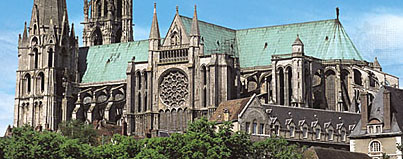
Chartres Cathedral
Notre Dame Cathedral at Chartres,
a physical and a meta-physical theme park ?
This Cathedral is a milestone in the development of Western architecture because it employs all the structural elements of the new Gothic architecture: the pointed arch; the very particular rib-&-panel vault; and, most significantly, the flying buttress.

It is also celebrated for its many stained-glass windows and sculptures. Because most of its 12th-and 13th-century stained glass and sculpture survives, Chartres Cathedral is one of the most completely surviving medieval churches.

Its spiritual intensity is heightened by the fact that no direct light enters the building. It is filtered through stained glass, so that the whole experience of visiting this Cathedral feels
"out of this world".

The interior of the cathedral is remarkable. The nave, wider than that of any other cathedral in France (16 meters), is in the purest 13th-century ogival style.

In the 2nd center is a labyrinth, the only in France still intact, with a diameter of 13 meters and 290 meters of winding passages, which pilgrims followed on their knees.

The warm glow of the light inside the cathedral results from the ≈ 180 irreplaceable & beautiful stained-glass windows.

The Cathedral was built following a fire that largely destroyed the previous church in 1194. The new walls, roof and choir were finished by 1221. In 1260 the building was completed and consecrated as one of the most compelling expressions of the strength and poetry of medieval Catholicism.
The city of Chartres owed its prosperity as a marketplace to its bishop, who combined the secular with the sacred by organizing four annual trade fairs on the four feasts of the Virgin Mary, to whom the cathedral was dedicated: Nativity, Annunciation, Purification and the Assumption.
The choice was colored by the claim of the cathedral to possess the robe that Mary wore when giving birth to Jesus. Emperor Charles the Bald gave this piece of oriental silk to Chartres around 876. Its preservation in the fire of 1194 was regarded as miraculous. Today it remains in the Treasury.

What was thrilling architecturally about this Cathedral was the clerestory, the upper area of the wall supported on the arcades, which took the form of a huge glass casket in which the architecture merely serves as a frame for the stained glass filling the two rows of enormous windows.
To provide stability for the daring construction, immense flying buttresses were used in an unprecedented way.

The glass follows a uniform style, with figures in the upper panels related to the legends of saints, and in the lower panels representing the trade guilds and corporations who paid for them. Further donations for the glass and sculptures came from the nobility and gentry.

Chartres Cathedral ranks as a triple masterpiece. Equally superb are its architecture and sculpture, survivors of two major fires and numerous wars and revolutions.
Its last narrow escape from total destruction occurred in 1836, when a fire destroyed the roof timbers and melted the lead. The timbers over the nave were replaced by an iron structure and then roofed over with copper. Fortunately, the unique stained glass ‘chartres blue’ can still be admired, especially in the robe of ‘Notre Dame’ Mary as shown below:

The Chartres cathedral school had been a famous centre of learning during the 11th century, where -for many centuries- pilgrims did homage to Our Lady of the Underworld, the Black Virgin, whose statue stood in a crypt or grotto beneath the church, next to an ancient well, whose water was affected by the currents welling up from deep inside the earth. The pilgrims then drank that uniquely crystallized water.
This more than 2000 years old Druidic statue represents a Virgin with a child on her knees, the so called black Madonna.

This didactic tone was later expressed in the program for the creation of the glass and the sculptures. It unfolded a vision of the role of the church in the world that was manifested by Pope Innocent III (1198-1216) who re-established the temporal power of the papacy to an all time height.

The program was given expression in the sculptures on the West side’s Royal Portal of 1150-1175, and on the 2 immense transepts that were added on the north and south facades.
Each side is a miniature pilgrimage church, with a west front with 3 portals and porches where figure sculpture stresses the mission of the church to teach and preach. The north portal, contains over 700 figures and shows the antecedents of Christ, the south side shows the era of the church. 4500 sculptures adorn the portals in all outside walls and show the history of mankind. The west facade shows all 10 chakras via the number of pedals equal to the Hindu chakra system.
A thing that adds even more to this mystery is the fact that the ground plan of Chartres Cathedral is proven to be based on the Golden Number, the Devine Law governing Number, Weight and Measure. The length of the Nave, the Choir and the Transepts and also the distance between pillars prove to be multiples of the Golden Number Ñ„, to be derived from the pentagon and its diagonals, forming the five pointed star.

5-pointed Twin Stars "holding" the vesica pisces,
the geometrical birthplace of all matter
As a result of this, the ground plan of this building radiates a sense of perfect balance and proportion. The ancient well is the cathedral’s Sacred Center, 37 meters below the place where the altar and sculpture now stand again.

Ascension in the Sacred-Center
The vault is about 37 meters above it. Many windows were replaced by a bishop who wished to be seen in full daylight, following the destruction of the screen in 1763.

Chartres has become the focus of new kinds of pilgrimages, like dedication to the preservation of the Latin Mass, but also modern ways of connecting to one’s inner & outer world.

listening to the organ’s music
