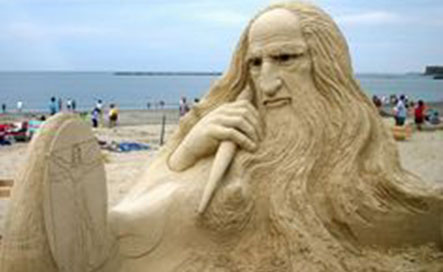
Vitruvian-daVinci-Agrippa
Vitruvian-daVinci-Agrippa

Vitruvius, De Architectura:
THE PLANNING OF TEMPLES
Book III, Chapter I
- The design of a temple depends on symmetry, the priciples of which must be most carefully observed by the architect. It arises from proportion (which in Greek is called analogia). Proportion is a correspondence among the measures of the members of an entire work, and of the whole to a certain part selected as the standard. From this result the principles of symmetry. Without this and proportion there can be no principles in the design of any temple; that is, if there is no precise proportion between the members of a finely-shaped human body.
- For Nature has so designed the human body that the face from the chin to the top of the forehead and the roots of the hair is a tenth part; also the palm of the hand from the wrist to the top of the middle finger is as much; the head from the chin to the crown, an eighth part; from the top of the breast with the bottom of the neck to the roots of the hair, a sixth part; from the middle of the breast to the crown, a fourth part; a third part of the height of the face is from the bottom of the chin to the bottom of the nostrils; the nose from the bottom of the nostrils to the line between the brows, as much; from that line to the roots of the hair, the forehead is given as the third part. The foot is a sixth of the height of the body; the forearm a quarter, the breast width also a quarter. The other limbs also have their own symmetrical proportions. And by using these, ancient painters and famous sculptors have attained great and unbounded distinction.

- Similarly, in the members of a temple there ought to be the optimal harmony in the symmetrical relations of the different parts to the general magnitude of the whole. Then again, in the human body, the navel is naturally the centerpoint. For if a man lies on his back with hands and feet outspread, and the centre of a circle is placed on his navel, his figure and toes will be touched by the circumference. As such, a square will be described within the figure, in the same way. For if we measure from the sole of the foot to the top of the head, and apply that measure to the outstretched hands, the breadth will be found equal to the height, like the sides of a square.
- Therefore, as Nature has designed the human body so that the members correspond in their proportions to its complete frame, the ancients seem to have had good reason for the rule that in the execution of their works they should observe the same relations of the several members to the general pattern of the plan. Since in all the works they passed down, they did so specifically in the building of temples, whose the merits and faults usually endure for ages.
- It was from the members of the body, that they derived the fundamental ideas of the measures which are obviously necessary in all works, as the finger, palm, foot, and forearm. These they apportioned so as to form the "perfect number", and as the perfect number the ancients fixed upon 10. For it is from the number of the fingers of the hand that the palm is found, and the foot from the palm. Thus, the number 10 is perfect as it is made up by the fingers of the two palms.

The above passage, from the Roman architect M. Vitruvius ‘De Architectura’, was a source of inspiration for Andreas Palladio‘s villas, Fibonacci’s number sequence, as well as Leonardo da Vinci’s diagram sketch of the the Vitruvian Man.
This passage is also providing the Key of the composition of the ancient architecture, firmly revived in the Renaissance.
The emphasis is on rationalization of geometry, by means of small whole numbers to build the composition. In this manner Vitruvius delineates the proportion of a male human body that Leonardo so faithfully reproduced around 1490.
Rationalization as the basic rule of composition and the simplicity of an ingenious design are often ignored.

approaching the perfect proportion, using
the irrational, transcendental number π
(click image for larger view)
Both Leonardo and Vitruvius make no mention of the Phallus as the center of the square, but it plays an important role. The side of the square is 4 cubits (under arm +hand) or 24 palms as can also be measured on the ruler beneath the square, and deduced from the Vitruvius’ text.
The diagonal of such a square comes close to 34 palms (33.94… exactly). If we rotate the square around Phallus for 45 degrees we get the upper point of the circle, and from this we can calculate the diameter of the circle as 29 palms (the difference between the square and the circle is 5 palms).

Vitruvius is reporting that the navel is the exact center of the human body. The circle on Leonardo’s drawing has it’s center in the navel, but if the figure is ‘squared’ the center becomes the phallus which is, concerning this drawing from the compositional point of view, more important, since it is the center of the underlying geometry that outlines the basic features of the figure.
The most fundamental composition consists of a circle, a square, and a triangle, a sigillum known to magicians and alchemist, sometimes called the Universal Seal of Light or the Seal of Hermes. The compositional triangle on this drawing is concealed, even though that it outlines important segments. It is drawn in the circle within the square and it coincides with the progression of squares as depicted on the illustration.

Progression of squares
The main proportional lines come from the progression of squares. Each next square is half the previous size, and the measures obtained are the same as described by Vitruvius.
Distinguished is also the triangle with the size of a square and apex in the navel.

Vitruvian equil-triangle between legs
It seems that the drawing, or better the original design as explained by Vitruvius, contains many layers of geometry and symbolism that concord in one single image delineating the proportions of the human body.
This idea of ‘reason’ governing ‘form’ was the fundamental theme of the Renaissance and is traceable in best architecture and art in general. It would not be odd if Leonardo had a close contact with scholars that spread the source of the Renaissance thought, which didn’t distinguish between art, science, and magick in terms of conflicting or opposing discourses as is the case today.
The origins of all sacred geometry

H. C. Agrippa’s Star-woman diagram, described in his ‘3 books of Occult Philosophy‘ (published in 1533) shows the crescent sun near the circle’s center, surrounded by the 5 signs for the planets Mercury, Venus, Mars, Jupiter, Saturn:

Master of the influences of the 5 planets
Each human body approaches the proportion of the golden mean, thus Leonardo wanted his Vitruvian man to represent that. All of creation does this closely approximating.
The golden mean proportion is the only mathematically ideal, perfect standard from which all is created.
The 5 pointed star is the most perfect example of a design fully based on the golden mean ratio.
All segments relate to one another according to the irrational, transcendental, golden mean number φ.
Michelangelo, Pacioli, Raphael, and daVinci were the leading artists that used this ratio quite often from 1475 – 1525.
The golden mean spiral is derived from it.
We applied both the π and φ ratios to villas we built and to the diagram below, that unites Agrippa’s esoteric diagram and da Vinci’s exoteric diagram:

GM Proportioned Star & Spiral,
the ideal and perfect standard

Covered by French Gothic Cathedrals

.gif)