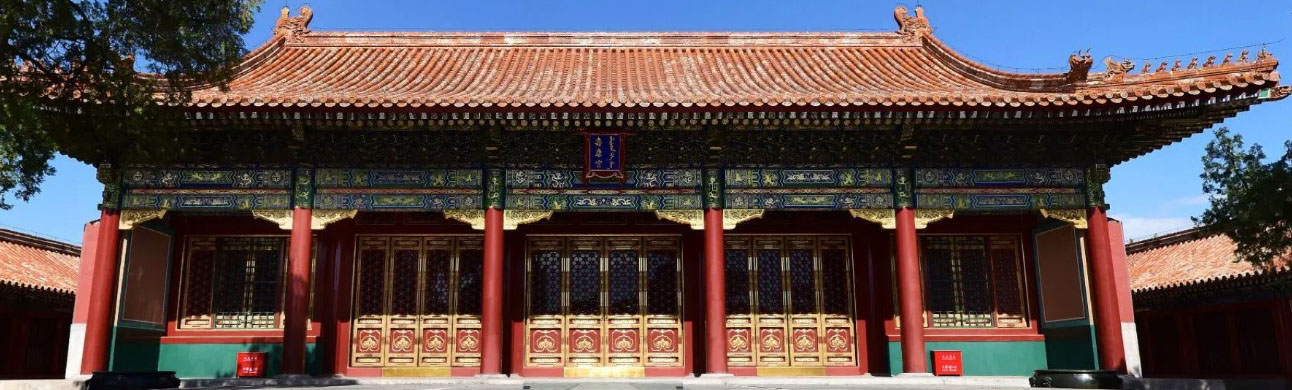
Buddhist Forbidden City
Tibetan Buddhist Heritage in the Forbidden City

Forbidden City layout
The forbidden city was built in perfect symmetry/harmony in a N-S direction with the Polaris North star in the center. The emperor was thus seen as the North Star of his empire.
Symbolism set in stone and wood
In 1925 the palatial complex in the heart of Beijing, known as the Forbidden City, opened to the public as the Palace Museum. Enclosed by high walls and a moat, the compound had been the home of the emperor and his consorts (wives) for more than five hundred years. Few would have ever come near, let alone venture into, the vast complex of 9.999 rooms.
The outer court, entered from the south, was reserved for official events. The inner court to the north housed the imperial family and members of its household. The museum now houses 42,000 religious artifacts, 80% of which are related to Tibetan Buddhism. This rich collection witnessed the height of Tibetan Buddhism in China.

Pavilion of a thousand Autumns
The Forbidden City is one of the world’s largest and best-preserved complex of wooden buildings. Its NW corner contains a cluster of 10 Tibetan Buddhist halls. These include Baohua Hall, Yuhua Pavilion, and Fanzong Tower. None of them is open to the public, and thus retain a mystery.
Yuhua Pavilion (Pavilion of Raining Flowers)

It was built during the Ming Dynasty. In 1749, Emperor Qianlong decided to renovate the Yuhua Pavilion, and modeled it after the Mandala Tower at Tholing Monastery in Ngari, Tibet. It served as a place for the recitation of Buddhist sutras and workshop for religious imagery. In it was the Qianlong Emperor’s private chapel.
It is the only structure in the Imperial Palace complex to combine Han and Tibetan design elements. The Buddha statues on the top 4th floor represent 4 different levels of religious practice.
Winter sunshine filters through the huge red doors onto the rosewood Buddhist pagoda on the ground floor of Yuhua Pavilion. Above the door hangs a tablet with an inscription by Emperor Qianlong. Inside are Buddha statues that were presented as tributes to the emperors by generations of Dalai Lamas and Panchen Lamas.
The pavilion houses enamel mandalas of the 3 most important images of Buddha in Tantric Buddhism, as well as many gold and copper Buddha statues, instruments used in rituals, miniature porcelain pagodas and Thangka paintings donated by Tibetan nobles, but some were made by craftsmen from the imperial household.
Most of the Thangka paintings were created around 1750. Heavy curtains prevent the sun from fading their colors. Therefore, under torchlight, the bright mineral pigments in the paint are still vibrant, and remain forever fresh. Of the 2000 paintings in the Palace Museum, most were created by Tibetan painters during the reign of Emperor Qianlong.
Although the large wooden structures and porcelain pagodas have been equipped with an earthquake-proofing base, most relics remain untouched. There are so many artifacts that there is no room for visitors. Thus, the pavilion is not open to the public. However, they are vividly displayed in the virtual “Digital Palace Museum” tour.

Palace of Compassion & Tranquility (Cining gong)
In front of the main hall of the Palace of Compassion & Tranquility is a terrace from where most ceremonies took place. The back room was the place where the Empresses worshiped Buddha via statues and ritual instruments.

Status of Tibetan Buddhism
In 1653 Emperor Shunzhi welcomed the 5th Dalai, then leader of the Gelug sect of Tibetan Buddhism, and dubbed him the title “Dalai Lama.” In 1713 Emperor Kangxi gave the 5th Panchen the title “Panchen Erdeni,” thereby formally acknowledging the political and religious status of the Dalai and Panchen Lamas of Tibet. Their influence spread, and the number of Tibetan Buddhist halls there expanded.
In 1780 the 6th Panchen Erdeni arrived at the Forbidden City to congratulate Emperor Qianlong on his 70th birthday, when Tibetan Buddhist activity in the royal court peaked. It waned when the Qing Dynasty began to decline.
Close to the Yuhua Pavilion is a square where large-scale Buddhist ceremonies were held. The prayer flags used during these ceremonies still remain. At the end of each year, the emperor would take part in an exorcism ceremony, the most important Buddhist event in the imperial court. On that day, the emperor would sit beside the Dalai Lama and Panchen Lama, as well as other senior monks, demonstrating the prominent status of Tibetan Buddhism in the Qing Dynasty.

Handscroll Floor plan of the Palace complex of Longevity and Health

80th Birthday celebration of the E.D. Chongqing
In the Qing dynasty (1644–1912), the empresses dowager (the most senior position), empresses (the top consort and head of the imperial harem), and other consorts were assigned living quarters in the inner court. These palaces were differentiated by location, size, and furnishings to accord with a woman’s status within the imperial court.
Within days of ascending the throne, the Qianlong emperor (r. 1736–95) approved architectural plans to build an elaborate complex for his mother, Empress Dowager Chongqing (1693–1777), the Palace of Longevity and Health (Shoukang gong). See images in banner and above.
This complex had 75 structures. Each section had a specific function, such as spaces for rituals, religious devotion, living and sleeping, and entertainment. The Main Hall was where Empress Dowager Chongqing received the emperor, empress, and high-ranking consorts for the lunar New Year when they came to pay their respects to her:

She received lower-rank consorts, grandsons, and great-grandsons on special occasions in the Rear Hall. One chamber was reserved for her Buddhist devotions with Buddha statues and ritual instruments. Other rooms for vernation of her late husband’s “spirit tablet”, and for her living quarters. An avid lover of opera, Chongqing was entitled to a small indoor theater, complete with a stage and a “scenic illusion” wall painting (tongjing hua).
She lived in the Forbidden City only 2 months each year to celebrate important annual events, such as the winter solstice, the lunar New Year, and her birthday. The rest of the time she traveled or stayed in another palace complex.
Among the notable features of Chongqing’s life are the many splendid gifts she received from her son, the Qianlong emperor, government officials, and many others. Her palace was filled with treasures, such as hundreds of jade objects, wish-granting ruyi scepters, elaborate robes, paintings and calligraphies, ceramics, and lacquerware.
Objects of top quality were used as decorations, rotated according to season, or brought out for special viewings.
The Qianlong emperor presented his mother with a renowned scroll of ancient calligraphy called “Letter on recovery from illness”. This thoughtful gift shows how much he appreciated and recognized his mother as a connoisseur and admirer of Chinese culture. He also painted and wrote calligraphy for her, signing it in a special way to signal his high respect for her.
After her death, he placed some of her hair in an especially made golden stupa of 250 pnds, as a ”relic in a shrine”. This stupa with Tibetan sun & moon on top was made up of gold and silver alloy with coral, turquoise, lapis lazuli, semiprecious stones, and glass. The Pedestal was made of zitan wood.


Preservation of Artifacts and Cultural Exchange
To better protect Buddhist artifacts in Tibet, the Palace Museum and the government of Tibet Autonomous Region decided to cooperate and build museums, restore artifacts, and hold exhibitions. Archaeological research has also started. Preservation of artifacts have began at Jokhang Monastery.
India has a wealth of artifacts and cultural sites. China and India did conduct frequent exchanges, but nowadays, their people know little about each other. Western countries are very interested in Tibetan Buddhist artifacts, and they have made significant progress in Tibetan Buddhist studies.
In 1923, the Buddhist complex burned down. In 2012, the restoration work was finished. The Palace Museum mgmt hoped to take advantage of its rich resources & artifacts and become the Research Center for the Tibetan Buddhist Heritage, because its history remains still quite hidden.
But so far nothing happened …..

"Ten Thousand People Copy Confucian Classics" activity in the Shaolin Temple in Zhengzhou is based on the Qing Dynasty emperor Qianlong’s Tripitaka which includes Han classics, Tibetan classics as well as Southern Buddhism’s classics.
The Copying Confucian Classics activity combined Chinese traditional calligraphic art with age-old Buddhism. Several hundred masters, calligraphers, prestigious public figures, and others attend the copying activity on Dragon Heads-raising Day in the spring of each year.