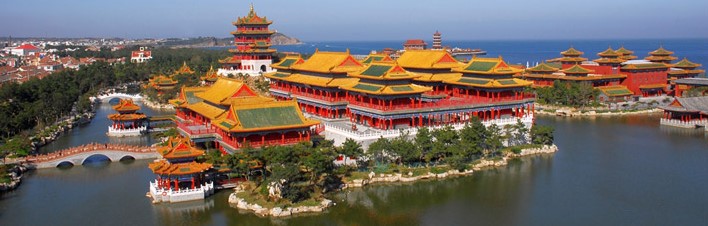
Summer Palaces
Summer Palaces

Qingyiyuan, Gardens of Clear Ripples,
the Summer Palace with Kunming lake

Around 1749, the Qianlong Emperor decided to build a summer palace in the vicinity of Jar Hill to celebrate the 60th birthday of his mother, Empress Dowager Chongqing.
Longevity Hill is about 60 m-high and has many buildings positioned in sequence. The front hill is rich with splendid halls and pavilions, while the back hill, in sharp contrast, is quiet with natural beauty. The central Kunming Lake, covering 2.2 sqkm, was entirely man-made and the excavated soil was used to build Longevity Hill.
In the name of improving the capital’s waterworks system, he ordered the Western Lake to be expanded further west to create two more lakes, Gaoshui Lake and Yangshui Lake.

Throne room in Summer Palace
The three lakes served not only as a reservoir for the imperial gardens, but also a source of water for the surrounding agricultural areas.

36 mtr long Marble Boat

At the foot of the hill is the Long Corridor that stretches 700 meters. The beams of the corridor are decorated with over 8,000 colored paintings, which contributes to its fame as the most charming corridor in the world. The corridor is located amidst the Kunming Lake, the western bank of which is said to mimic the Su Causeway of the West Lake in Hangzhou.


Its construction lasted from 1153 to 1764. Many architectural features in the palace were built to resemble various attractions around China. Partially restored in 20th century.
Yuanmingyuan, the Old Summer Palace Complex

The Garden of perfect brightness
The Imperial Paradise
It was the main imperial residence of the Qianlong Emperor and his successors, where they handled state affairs; the Forbidden City was only used for formal ceremonies.
Widely perceived as the pinnacle work of Chinese imperial garden and palace design, the "Old Summer Palace" was known for its extensive collection of gardens, its building architecture and numerous art and historical treasures. It was reputed as the "Garden of Gardens" in its heyday.
It was one of three large imperial gardens. Yuan is Chinese for "garden".
- The Garden of Perfect Brightness (Yuanming Yuan),
- the Garden of Eternal Spring (Changchun Yuan), and
- the Garden of Elegant Spring (Qichun Yuan).
These gardens are collectively referred to as the Yuanming Yuan, although they were distinctly separate projects.
Initial construction began in 1707 during the reign of the Kangxi Emperor. It was a gift for the emperor’s fourth son, Prince Yong (the future Yongzheng Emperor), who would greatly expand the Imperial Gardens in 1725.
The Yongzheng Emperor also introduced the waterworks of the gardens, creating lakes, streams and ponds to complement the rolling hills and grounds, and named 28 scenic spots within the garden.
He also constructed a number of "living tableaux" he and his family could observe and interact with. One such scene was called "Crops as Plentiful as Fields" which involved court eunuchs pretending to be rural farmers on an island.
The "Courtyard of Universal Happiness" was a mock village where the imperial family could interact with shopkeepers, again eunuchs in disguise.
Lateron, Emperor Yongzheng tired easily, and this drove him to look for elixirs of health and life. Taoist priests came up with remedies. These elixirs contained heavy metals which probably contributed to Yongzheng’s sudden death. Upon succession, his son Qianlong drove the Taoist priests out.

Fanghu Shengjin
During the Qianlong Emperor’s reign, the second expansion was well underway and the number of scenic spots increased to 50. The Garden of Eternal Spring was begun in 1749, till 1783, on 26 ha, and consisted of hundreds of acres of pavilions, palaces, lakes, pagodas, streams, bridges, pathways, artificial hills, etc.
One of his Jesuit artists showed the Emperor engravings of the fountains at Versailles, France. Fascinated, the Emperor commissioned his friend Giuseppe Castiglione to oversee the construction of a similar fountain.
This project quickly expanded from a single fountain to an entire complex of palaces, scenic views, and waterworks, involving tens of thousands of people.
Privileged guests would encounter, upon entering, a sequence of stone buildings done in a hybrid Chinese-European style, known as the Xiyang Lou, or “European Palaces.”


According to traditional Chinese garden design, a garden should include discrete scenes that are sequentially revealed to the visitor as they traverse the landscape. Each view should contain an unexpected element that would astonish the viewer in its creativity and cleverness. Their "European Palaces", despite their foreign appearance, were fully in line with this tradition.
With palaces in Europe, the building was the central focus. In this Chinese paradise, the mostly single-storied buildings were linked together, and formed just one part of the view. Altogether there were up to 3000 “individually named structures”, of a total floor space of 160.000 km² + 130 “formal views”, spread out over 800 acres.

Digital remake of one of the European style Palaces
A wall enclosed the section of the garden of the European palaces. Only their tall roofs, covered in traditional Chinese ceramic tiles, were visible from the rest of the complex. The viewer would have no reason to suspect that the buildings were unusual until they passed through the gate and suddenly encountered this fantastical vision of Europe on.

The Qianlong emperor, or his consorts, never lived in any of the European palaces. Their function was to hold his enormous collections of European and European-style objects. Some of these treasures were given to him by European monarchs, while others were imported from the West, or even created in China as imitations of European luxury goods.
The emperor constructed the "Distant Waters Observatory", specifically to display a set of Beauvais tapestries gifted to him by King Louis XV of France. These tapestries, designed by François Boucher, depicted imaginary scenes of China. This was a unique situation in which a European artist’s vision of Asia was hung in a fantasy European architectural setting commissioned by a Chinese emperor:

The Aviary, which held the emperor’s menagerie of peacocks and exotic birds, appeared to be entirely Chinese in design from the western façade. However, after the visitor exited the Aviary on the eastern side, they would look back over their shoulder to see a curved façade done in an exuberant European Rococo style. It would have appeared to them as if they had entered the building in China and exited it in Europe.
Another visual trick was placed at the far eastern end of the European Palaces section. After descending from the Hill of Linear Perspective, the visitor would get on a boat to cross the Square Lake. On the eastern shore of the lake, Castiglione had painted twelve illusionary scenes using European linear perspective. These paintings were meant to fool the viewer into thinking that an entire European city street had been constructed in the garden.


The Qianlong emperor also had a particular interest in European technology like clocks and automata. In the garden maze (in Chinese, “The Garden of Ten Thousand Flowers”), the first to be built in China, there was a marble building that housed a collection of bird automata that could sing, as well as a large music box that had been brought from Europe.
The fountains constructed in these gardens form another collection of European-style machines and are particularly impressive from both an aesthetic and engineering point of view. The fountain in front of the Hall of Calm Seas included an ingenious water clock comprised of sculptures depicting the twelve animals of the Chinese zodiac, including rat and rabbit sculptures. Each animal was associated with a specific two-hour period of the day and water would shoot from the animal’s mouth during the appropriate time:

Each day at noon, water would spout from all of the animals at once. Although these fountains were constructed using European hydraulics, their imagery was adapted to suit Chinese taste. European nude figures were not used. Instead, the fountains’ iconography referenced Chinese traditions, such as the animals of the zodiac, as well as other mythological stories and Daoist parables.

The splendors of the palace and the grounds were depicted in the 40 Scenes of the Yuanmingyuan, an album produced in 1744 by Qianlong’s court painters. Qianlong personally directed the design and construction process, including a library with over 120.000 books, including the Siku Quanshu.
The last European appearance in the Old Summer Palace was a diplomatic mission in 1795 representing the interests of the Dutch and nearly bankrupt Dutch East India Company. The Titsingh delegation included Isaac Titsingh, the Dutch-American Andreas Everardus van Braam Houckgeest, and the Frenchman Chrétien-Louis-Joseph de Guignes:

The Emperor’s response to British King George III
Since all the Chinese buildings were made of wood, nearly nothing remained of this vast imperial paradise after 3500 British and French troops stole about 1.5 million objects totaling $144 Billion worth of Chinese art, shipped it to Europe, and then torched all structures in 1860. The 3-day looting and burning of Yuanmingyuan was ordered very deliberately by the British Government. It was the largest cultural destruction ever done by humans in recorded history:

It was a shocking act of cultural vandalism, and vengeance for the killing of British envoys, who wanted to enforce their right to sell opium to the people of China in exchange for their much desired tea, silk, and porcelain. With already a huge number of addicts from opium forcefully exported from British India, the Emperor had to decline the "offer".
The best visual record of this imperial paradise is found in a set of paintings: the “40 Scenes” in Yuanmingyuan.

A US$5 billion replica of the entire Old Summer Palace complex was built as a full size copy in the vast gardens of Hengdian World Studios, the world’s largest filming site, dwarfing Universal + Paramount studios combined, providing sets for Chinese Dynastic films and over 300 episodes/wk of TV dramas, located in the eastern Zhejiang Province, about 1000 km South from Beijing.
It has also copies of most sections of Beijing’s Forbidden City.
It covers 8000 acres, and contains over 100 gardens. It is a village of over 200.000 people, including 50.000 actors, and one of China’s most popular tourist destinations, with over 50.000 visitors/day.

Where Immortals Once Resided in Myth:
Penglai Sanxian Mountain Scenic Area:
The destroyers of Imperial China