Qianlong as Manjushri
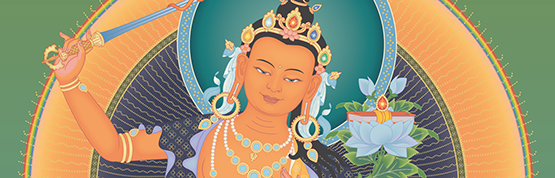
Qianlong as Mañjuśrī
Nurhaci, a military leader of the Jurchens of Northeast China and founder of what became the Qing dynasty, named his tribe after Mañjuśrī as the Manchus.

This painting is arranged with Qianlong at the center of a cosmogram, a symbolic universe. The background shows clouds and the 5-peaked sacred Wutaishan mountain. He is seated on a lion-guarded dais, placed on a lotus blossom. The throne is risen by a giant waterspout out of an azurite pond.

Victoria Regia Lotus max diameter 2.2m, holds up to 70 kg
In front of the throne are Tibetan ritual instruments, placed on a table that contains 4 swastikas, an ancient solar symbol, meaning "to be well". The emperor is clothed in a Banzhida (monk’s cap), and robes, which are delicately patterned with pomegranate and floral scrolls painted with refined detail.
The emperor as Mañjuśrī holds the wheel of law in his left hand and makes the gesture of argumentation with his right. In each hand, he also delicately fingers the tensile stems of lotus flowers that appear behind his right and left shoulders.
On the viewer’s left, the lotus bears an upright sword and on the right, the lotus is a platform for a sutra. These are the attributes of Mañjuśrī and visually manifest the persona that the emperor has assumed.
In the nimbus surrounding Qianlong, 19 important historical figures appear. On the central axis above Qianlong’s head, we encounter an image of Tsongkapa, the founder of the Yellow Hat (Geluk) sect of Buddhism. He was also an incarnation of Mañjuśrī, which can be seen by examining Tsongkapa’s attributes of a sword and sutra.
Other figures in the nimbus can be identified as Dalai lamas, panchen lamas, tutors to the lamas, and other deities. Qianlong is positioned at the center in a manner to reinforce his centrality to the history of Buddhism, past and present.
In a separate roundel above the nimbus containing the portrait of Qianlong, we encounter a second portrait. The likeness depicts Qianlong’s Tibetan spiritual leader and teacher of Sanskrit, Rolpai Dorje (1717-86). The Tibetan inscription on the Qianlong emperor’s throne contains word play that alludes to the name Rolpai Dorje:

Qianlong was close to Rolpai Dorje, who supervised the translation from Chinese into Manchurian, Mongolian and Tibetan of the entire Śūraṅgama Sūtra completed in 1763. Qianlong was a sincere believer in Tibetan Buddhism.
Other evidence of this includes the gesture of giving his mother for her 70th birthday more than 9000 statues of Buddhist deities. Also, in his tomb Qianlong arranged to have Sanskrit inscriptions, which suggests he found this language of Buddhism more personally compelling than the secular languages of Chinese and Manchu, in which he was fluent.
The Tibetan inscription in a gold script on the dais confirms that Qianlong is depicted as an incarnation of Mañjuśrī.

The text reads:
Most Sagacious Mañjuśrī
You who have taken up the role of a mighty Dharma king,
Supreme among men,
Abide forever upon your immutable diamond throne.
May there be auspicious fortune that all your wishes are instantly fulfilled.
This unusual portrait reflects upon the political strategy of the Qianlong emperor as well as his personal religious beliefs. It is testimony to the multicultural nature of his court/empire.
The emperor was portrayed in the center of a thangka, a traditional Tibetan-style religious painting, but called upon the Italian artist Giuseppe Castiglione, to paint his face.
By having himself depicted as the enlightened being Mañjuśrī, the Bodhisattva of Wisdom, the Qianlong emperor positioned himself squarely in the Tibetan Buddhist hierarchy.
The inscription proclaims Mañjuśrī to be the ruler of the Buddhist faith. By assuming Mañjuśrī’s identity, the Qianlong emperor indirectly laid claim to that role for himself.
This was significant because relations between the Qianlong court and their Mongol & Tibetan residents were couched in Buddhist, rather than Confucian, cultural rhetoric.

Qianlong, in monk dress, leaving the White Pagoda,
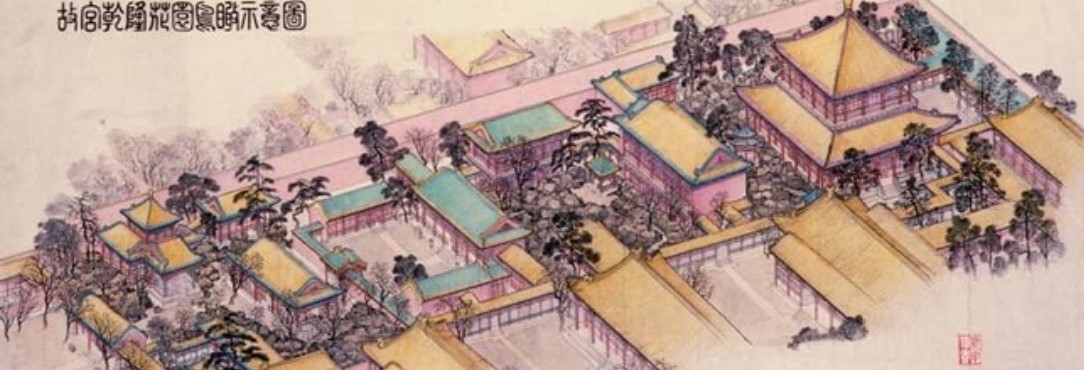
part of the 900 yr old Winter-Beihai-Park complex,
extensively enlarged by him over a period of 30 years:

5 Dragon Pavilions in world’s oldest Imperial Gardens Park
The Qianlong emperor ordered thangkas, with himself as the central deity, displayed in the Tibetan Buddhist chapels he erected in Beijing. The one sent to the 7th Dalai Lama is displayed in the Potala Palace, in the “Hall of Three Splendid Worlds”, in Lhasa, Tibet.
This hall encompasses the holy world in heaven, the human world on earth, and the Dragon nether world. Keeping both Qianlong’s portrait and his grandfather Kangxi’s tablet in this sacred hall of the Potala temple granted to these items a religious as well as a geopolitical significance.

Qianlong in wall tapestry
The association of the name Manchuria with the Sanskrit name of the bodhisattva Manjushri has been created early in Manchu rule in documents exchanged between the emperor and the Tibetan clergy. Qianlong’s wish to be seen as the reincarnation of Manjushri may not have been an exclusively political tactic, because the emperor had converted to Tibetan Buddhism in 1745 and is said to have studied the Sutras daily.

My Jolly Qiulong Dragon as a cloud at sunset on 8-8-2019
The official dress code of the Qing Court came to include a string of court beads, like Buddhist ‘rosaries’, worn as a necklace, probably used to popularize Tibetan Buddhism.
Buddhist emblems, like bells and thunderbolts (vajra), are symbols of compassion and wisdom. They were ritual objects that were produced for the imperial art collection and can be seen today in the Palace Museum.

Ink on silk, wheel of law in left hand

Tibetan writing by Qianlong Emperor