Winter Palaces
Zhongnanhai

The name of the Zhongnanhai complex, adjacent and west of the Forbidden City, means "Central and Southern Seas", referring to two lakes, the "Central Sea and Southern Sea", within the compound, also called "Sea Palaces".
The two lakes were part of a series of projects carried out during construction of the Imperial City. The corresponding "Northern Sea", or "Beihai" to the north is now a public park.
The Taiye Lake originally formed the core of an imperial garden called Western Park or Western Court, with parklands on the shores, enclosed by a red wall in the western part of the Imperial City.
The Qianlong Emperor’s daily routine at Zhongnanhai: Each morning, after a first breakfast of cold swallows nest soup, he would travel by heated palanquin to the gardens’ Studio of Convivial Delight, a pavilion he built to capitalize on the view of the South Lake, where he would have a bigger breakfast.
.jpg)
Painting showing the reception for the victorious Qianlong Army from the Jinchuan campaign (1771–1776) at the Hall of Purple Light in Zhongnanhai.
Mao Zedong moved into Zhongnanhai in late 1949. He set up in the Garden of Abundant Beneficence, a large courtyard compound favored by both the Qianlong and Kangxi emperors, where he would hold court with dignitaries and live until 1966.
Having re-established Zhongnanhai as a center of political power in the new China, Mao set about rebuilding the compound according to his tastes. Most of the pavilions, shrines, and temples survive from this period. Whereas the Northern Sea had a religious focus, the shores of Central and Southern Seas were dotted with a number of worldly palaces.
The interconnected Northern, Central and Southern Seas are jointly called the Taiye Lake; adjacent Shichahai (‘Sea with Ten Temples’) is connected to Beihai through Qianhai.
Beihai, Winter Palace Park

Winter Palace, now called BeiHai Park, covers 68 ha, half of which is a lake. It is an excellent living example of the ancient Chinese art of landscaped gardens, with artificial hills, pavilions, halls, temples and covered corridors blended with trees, hills and a lake in a harmony of man and nature.


Early in the 10th century, the Liao dynasty created a secondary imperial palace, called Winter Palace. The lake was added during the Jin Dynasty. The earth removed to construct the lake was used to create three islands.
Yuan Dynasty
The Mongols conquered the Jin and established the Yuan Dynasty (1279-1368). Their first Emperor, Kublai Khan, expanded the site and made it their capital city. Now Beijing.

Ming Dynasty
When the city was laid out around 1410-1420, during the reign of Ming Emperor YongLe, the winter palace gardens were restructured. The lake was expanded and turned into a magnificent imperial chinese garden. However, the primary imperial palace became the newly created Forbidden City.

Throne room

Study room
Ingeniously secure door locking mechanisms
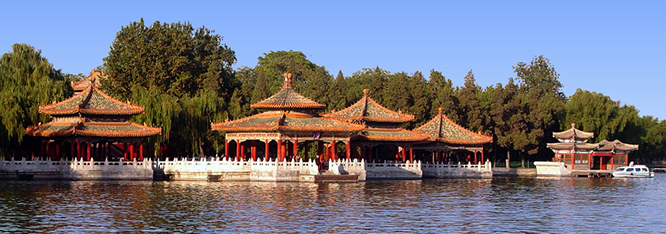
Most of the buildings now standing were constructed during Emperor QianLong’s reign. He added the Five Dragon Pavilions and the Nine Dragon Screen:

9 Dragon Screen (67’x12′), actually showing 635 dragons,
on both sides, at Qianlong’s Winter-Beihai-Park, Beijing (1756)

5 Dragon Pavilions, one with round roof:


In 1651, the White Dagoba, a Buddhist tower in Tibetan style, was erected. Qing Emperor Shun Zhi agreed to this project as a gesture of devotion to the Buddhist faith, and from a desire for unity among China’s various nationalities. It stands on top of the hill on Jade Island (JiongHua):

