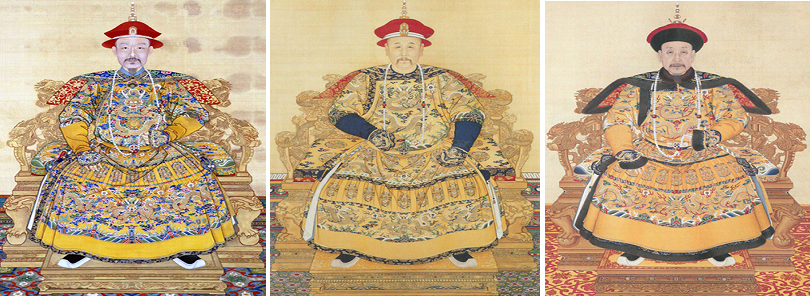
Great Qing Emperors
THE 3 GREAT QING EMPERORS

The Qing emperors (1644 to 1911) formed the last of the successive dynasties of China. As “alien” rulers, the Manchus inherited and adopted the cultural norms and political institutions of the previous Han Chinese Ming dynasty (1368 to 1644), at the same time maintaining their own Northeast Asian military organization, customs, and language. After consolidating their power within the former Ming boundaries, the Manchu emperors extended the territory of the empire to include Mongolia, Xinjiang, Tibet, and Taiwan.

During the 18th century, China experienced almost unprecedented peace and prosperity. The population expanded, and the agricultural and commercial economies developed. In the 19th century, however, internal unrest was compounded by foreign aggression.

1806 map Chinese + Independent Tartary
The strong emperors of the 17th and 18th centuries were succeeded by less able descendants who were unable to cope with the cataclysmic events that followed in quick succession.

Three great emperors presided over the high period of Qing rule: the Kangxi emperor (r. 1662 to 1722), the Yongzheng emperor (r. 1723 to 1735), and the Qianlong emperor (r. 1736 to 1795). Together their reigns spanned 136 years.

Kangxi Navy reclaiming the island of Taiwan in 1683
The Kangxi emperor was the second emperor of the dynasty, but was in fact its consolidating founder. He was a man of energy and vision, possessed a great intellectual curiosity, such as astronomy, and embodied both the literary and the martial qualities that were valued in a Chinese emperor.

Kangxi Emperor with Jesuit astronomers
As a martial emperor, he put down remaining internal rebellions in the southwest in order to secure Qing rule. He was untiring in the effort to overcome the menace of Mongol tribes in the area to the northwest of the Great Wall, personally leading troops into battle as late as the 1690s.

Mongol Empire
In order to familiarize himself with the central and southern parts of China, Kangxi made six royal tours to the Jiangnan area, the center of literati culture, beautiful scenery, and abundant agriculture. These tours also served the purpose of winning the allegiance of the Han Chinese elites of the south.
Kangxi also took care to present himself as a literary emperor, well-educated in Chinese culture. He was diligent in his study of Chinese literature and classics, sponsored the collection of a great library, and liked to have himself painted as a scholar.
The Yongzheng Emperor (r. 1723 to 1735) proved to be an extremely diligent and able ruler. Unlike his father, who liked to ride and hunt, Yongzheng devoted himself to minimizing corruption, and administratively & financially strengthening all governmental institutions and practices.


The Qianlong Emperor ruled from 1736 till his abdication in 1796, a few days less than his grandfather, the Kangxi Emperor. He acted as Emperor Emeritus till his death in 1799. In total, he was the longest-reigning de facto ruler in the history of China, and at age 89 he was the longest-living.

Emperor Qianlong’s Conquest of Xinjiang
During the reign of the Qianlong (qian=money; long=dragon) Emperor, the Chinese empire grew to a size unprecedented in Chinese history. It included Tibet, Xinjiang, Mongolia, parts of central Asia, Siberian Russia, and Taiwan. Myanmar & Annam in the south were forced to recognize Chinese suzerainty.
At the height of Qianlong Emperor’s rule, China dominated East Asia militarily, politically, and culturally, and was in fact the greatest economic and cultural empire in the world, and he was seen by the West as the most powerful man on earth.
Creation of a Multi-ethnic State
One of the most important reasons the Qing Emperors were successful was their ability to infuse Chinese culture and Manchu culture. The Canton System of trade between China and the West worked well for the Qing dynasty.
Under the reign of Qianlong a multi-ethnic Chinese empire began to emerge. Comprising of Han Chinese (the most dominant ethnic and Chinese-language-speaking group), and of Mongols, Tibetans, and Manchus, etc. Each indigenous religious tradition, such as Tibetan & Mongol Buddhism and Manchu shamanism, was well supported.

The Chinese heartland enjoyed an extended era of peace and prosperity as the population doubled to 320 million, farmlands expanded, commerce and export continued to thrive, handicraft industries prospered, and painting, printmaking, and porcelain manufacture flourished.

The ancient trade road

The $9T 2021 B&R Project
People in Europe and Persia wanted Chinese tea, silk, and porcelain (China), exclusively exported via the Pearl riverport Canton, the most cosmopolitan and industrious town in the world with thousands of workshops, that also produced western style silverware at a fraction of the cost of the ones made in Europe.
The Europeans had to pay for all those products in silver, as the Chinese saw silver as the only safe currency. Silver came mainly from Bolivia, where the Spanish colonialists forced indigenous cheap labor to work as miners.


Piet Hein (Piet Pirate) often captured the Spanish & Portugese Gold & Silver fleet on their way home. Also Peter Stuyvesant (Pegleg Pete) was involved in the Caribbean.

The 13 factories or "Golden Ghetto" in Canton harbor
The foreign traders of the East-India company had to deal through a select group of Chinese merchants, called the Hong merchants, of which Howqua was the wealthiest of all men at that time, because he invested his money in the rise of the U.S.A via his Boston friends, and lent the silver money he earned instead of storing it in a vault, and started to trade with the new American traders like the Grant family from Boston, one of F.D.Roosevelt’s ancestors, the longest serving American (32nd) President. Opium was first imported in 1767 in small amounts, but banned in 1813.
Qianlong cut rents & taxes, encouraged new agriculture methods, implemented flood-control measures on rivers, secured China’s borders, maintained peace and traveled widely. His approach to foreign policy was to lavishly welcome foreign diplomats and then turn down all their requests, like rebuffing the British Ambassador, George Macartney, in 1793:
At his summer residence in N-China, in a mongol tent surrounded by a garden of 10.000 trees, he gave the British envoy a note for his King that read:
“We have never valued indigenous articles, nor do we have the slightest need of your country’s manufactures. Our Celestial Empire possesses all things in prolific abundance and lacks no product within its own borders. There is therefore no need to import the manufactures of outside barbarians (the 1789 French revolution, French/Dutch/British control of indigenous SE-Asia, etc.) in exchange for our own produce.“

The people of the world paying hommage to the Emperor
The century of humiliation and threat of extinction begins.