Emperors as Developers
The Qing Emperors as Developers and Builders

Emperor Qianlong touring Chengde
The private courtyards, pavilions, gardens, and residences were constantly expanded, renovated, or redesigned under the successive emperors. The Qianlong emperor was an avid builder within the Forbidden City and elsewhere in Beijing and the capital area. The Empress Dowager Cixi, who held a great deal of power in the late-19th century, resided there when she served as regent for her nephew and grandnephew, and oversaw new construction and decoration.
Although they tirelessly built new temples, private residences, and other structures within Beijing, the emperors also sought to leave the confinement of the Forbidden City and its unpleasant summer climate. Each summer, Kangxi escaped north of the Great Wall to the Mulan hunting grounds in Manchuria—the Manchu homeland—where he hunted, engaged in archery and other competitive activities, and generally enjoyed the fresh air of the mountains.

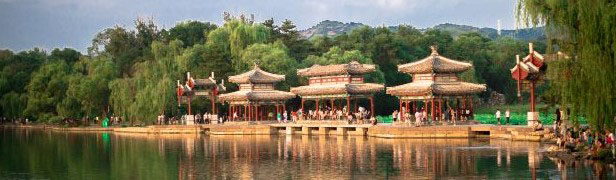
Rehe mountain resort built from 1703-1792
In 1703, Kangxi began construction of another palace and garden complex at Chengde (also known as Rehe or Jehol), “The Mountain Resort for Escaping the Summer Heat”—Bishu shanzhuang. At Chengde, as at the Yuanmingyuan, many of the 72 landscape scenes were designed to resemble famous Jiangnan temples or vistas.

Jumping shaolin monk
Outside the palace walls of the Mountain Resort, there are 8 Outer Temples, built between 1713-1780. Many in Tibetan style. The ‘8 Outer Temples’ is a collective name given to 12 temples. They were administered by Lifan Yuan, an administrative department for the affairs of ethnic minorities, such as the Mongolians and Tibetans.

Doors with Dragons to keep bad spirits out
These Temples symbolize the various ethnic groups from all parts of China, directing their loyalty towards the center of authority. Emperor Qianlong (1711-1799) expressed this concept in his poem "One Hundred Rhymes from the Mountain Manor for Escaping the Summer Heat."
He wrote: "These buildings embody the successful unity of the hearts of the people of the inner and outer lands." Following this belief, the palaces, halls and gardens erected under Qianlong’ s direction stress the use of architecture to embody the theme of national unity.

The Xumi temple was designed to celebrate the 70th birthday of the Qianlong Emperor. It was built for the 6th Panchen Lama who came from Tibet to convey his congratulations. It is a fusion of Chinese and Tibetan architectural style. The Miaogaozhuangyan Hall is where the Panchen Lamas preached and the Jixiangfaxi Hall with a roof made of gold plated copper tiles was their home.


Putuo Zongcheng Temple, copy of Potala Palace, Tibet
The Putuo Zongcheng temple complex of 222.000 sqm, of equal size and splendor as the Potala Palace in Lhasa, was built to commemorate the 80th birthday of his birth-mother the Empress Dowager Chongqing.
It served the Buddhist ceremonies and festivals, but it was also the location where the Qianlong emperor would meet the different ethnic envoys from within the empire.
The location served as a peaceful getaway from the bustling life of Beijing, as well as complimented the nearby hunting grounds that the emperor enjoyed with his guests.

Puning Temple, 37m high, the Temple of Universal Peace, and modeled after the most sacred Lamaism Samye Monastery, in Tibet. It features temple halls, pavilions, drum towers and bell towers. It was built after Emperor Qianlong captured the ruling Dzungar khan, who was a follower of Lamaism.
The world’s largest wood-carved Buddha statue is inside. It shows a ‘1000’ different eyes and a ‘1000’ different arms and hands stretched out from its frame. The statue is made from 5 kinds of wood: pine, cypress, elm, fir, and linden. It actually has 42 hands, of which 40 hold different musical instruments.

This 22m, ‘1000’ hands, Guanyin, inside the Puning Temple. Guanyin is a Buddha of mercy and goodness, a transliteration of “Avalokitesvara” from ancient Indian language, meaning: "Whenever you are in danger, the Buddha is ready to help".

Pule Temple of Universal Happiness (1766) with Han & Tibetan features

Anyuan Temple (1758), dedicated to Dasi Deva, the leader of the Dzungars, after putting down their rebellion in Xinjiang. Also known as Ili Temple, it imitates the style of the Guerzha Temple near the Ili River in Xinjiang. Then Qianlong deported 12,000 Dzungars and settled them near Anyuan.

Puyou Temple was a built in 1760 to celebrate Qianlong’s 50th and his mother’s 70th birthday. It was the Tibetan Academy of Scriptures. About 1000 lamas studied there esoteric Buddhist doctrines, medical science and the calculation of the Buddhist calendar. It has a collection of 90 arhat statues, the remainder of the 500 statues that once existed in Chengde.
The Qianlong emperor spared no expense in expanding the gardens, pavilions, libraries, and residences there. He built the famous 9 story Pagoda with an octagonal base:

The mountain resort also served a diplomatic function, receiving Central Asian and other foreign emissaries.