The Universal Ruler
The Qianlong Emperor as a "Universal Ruler"

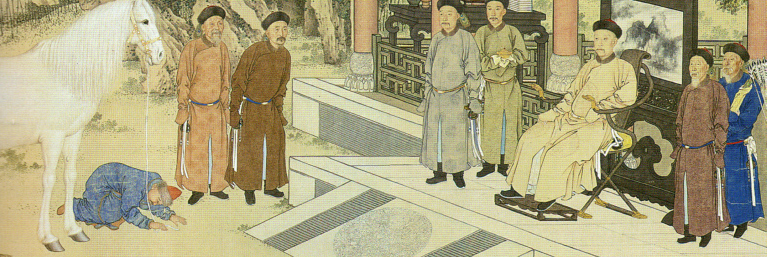
Qianlong with Mongol leaders at banquet at Chengde Mntn
Qianlong was the first Manchu ruler to feel completely at ease with both his Manchu and his Chinese identities, and also conceive of himself as a "universal ruler." He deliberately represented himself differently to each of the various constituents that formed his extensive, multi-ethnic empire:
- To the Tibetans, he portrayed himself as a reincarnation of one of the most important bodhisattvas of Tibetan Buddhism, Manjusri.
- For the Mongols he took on the role of a steppe prince who understood their steppe traditions.
- To the Han Chinese he portrayed himself as a scholar and great patron of Chinese learning and art.

As emperor, Qianlong was both patron and participant in these religions, which included the Manchu Shamanism of Qianlong’s ancestors, Tibetan Buddhism (a religion he personally practiced), Buddhism practiced by the Han Chinese majority, and Daoism, China’s indigenous religion.


Coins, peaches of immortality coins
Thus, the contingent of Jesuit missionaries who had come to China during the Kangxi Emperor’s reign and still resided in Beijing were often incorporated into the activities of his court and deemed to be proper subjects of the "Universal Monarch."

One of the most fascinating aspects of Qianlong was the amazing breadth of his interests and abilities: he was a classic scholar, a martial arts expert, a skilled huntsman, the only Chinese Emperor to speak 4 languages, a deeply spiritual person and the patron of China’s diverse religions.
Qianlong was such an effective ruler because he was skilled in a wide variety of disciplines, and was notably successful in almost all aspects of rulership. He was a keen policy maker who charged through mountains of paperwork, a skilled military tactician, strategist, and commander-in-chief of China’s army, and a hands-on administrator, who signed off on every edict issued by his government.
He said: "The army may be unemployed for a hundred years, but it cannot be left unprepared for a single day."

After many victories, the Emperor ordered the European Jesuit and court painter Giuseppe Castiglione to produce a series of paintings commemorating the successful campaigns against the Muslims and Zunghars. This series of 16 works, known alternately as the Achieving Victory or Pacification of Xinjiang group, depicted the important battles, surrenders, and victory processions of the campaigns.

After Castiglione and other court painters completed the drafts, the works were sent to France to be engraved on lithograph plates, after which both the plates and lithograph prints were sent back to Peking. After this it became customary for the court, upon the successful conclusion of a military campaign, to order court artisans to engrave commemorative lithographs themselves.

He also found time to make 150 lengthy inspection and public relations tours in China, so as to get a first-hand picture of everything from irrigation projects to troop installations.
In 1776, close to his mother’s death in 1777, he visited the Yellow Emperor’s mausoleum, and placed a stone tablet with the characters "Ancient Yellow Emperor’s Tomb on Qiaoshan."

The management of the empire’s vast network of rivers, canals, and irrigation systems has been a fundamental task of China’s rulers, while the threat of floods has been the greatest threat to economic and political stability.

In the Yangtze river outside Xiao Dong Men of Ezhou City, sits a huge rock. It is meandering and looks like a golden dragon, named "Longpan Rock". It echoes with the "Feng Huang Tai" along the east bank of the river, collectively known as "Dragon and Phoenix Set", embodying prosperity of a country.
There is a legend that Guanyin, the Goddess of Mercy, was fascinated by the Longpan Rock and came here specially for a rest. In the summer flood season, the river water rises to the Goddess of Mercy Pavilion as if the pavilion in the water was floating in a large lotus blossom with ethereal waves. It was built 700 years ago, during the Song Dynasty.

Emperor Qianlong called it “Dragon Temple Xiaodu”. It is 24m-long, 10m-wide, and 14m-high. In the dry season, the Longpan Rock appears like a giant turtle, emerging from the water, carrying the majestic Goddess of Mercy Pavilion with broad back, towering steadily in the river.
