Doukki Gel
Doukki Gel


A mirror of what Africa was thousands of years ago
Doukki Gel is an ancient Nubian city in Sudan, located near the capital of the Kingdom of Kerma. It served as a key Kushite religious center, particularly for the god Amun during the Meroitic period.
Amun was often depicted as a ram, or ram-headed, in ancient Nubia and Egypt as a symbol of virility and fertility, a characteristic absorbed from the Kushite deity Amani which merged with Amun. A ram’s horn refers to the golden spiral bony projection grown on the head of a male sheep (ram):


Ram of Amun with King Taharqa Amun with Φ-spiral horn of Ram

"The God Jupiter depicted as Ammon", after Rome conquered Egypt
This representation of Amun as a spiral-horned ram also symbolized the god’s connection to the sun and the cosmos via the spiral MW Galaxy, thus the ram becoming a sacred animal. The ram could also be shown with a sun disk "Amun-Ra", the powerful fusion of Amun and the sun god Ra.
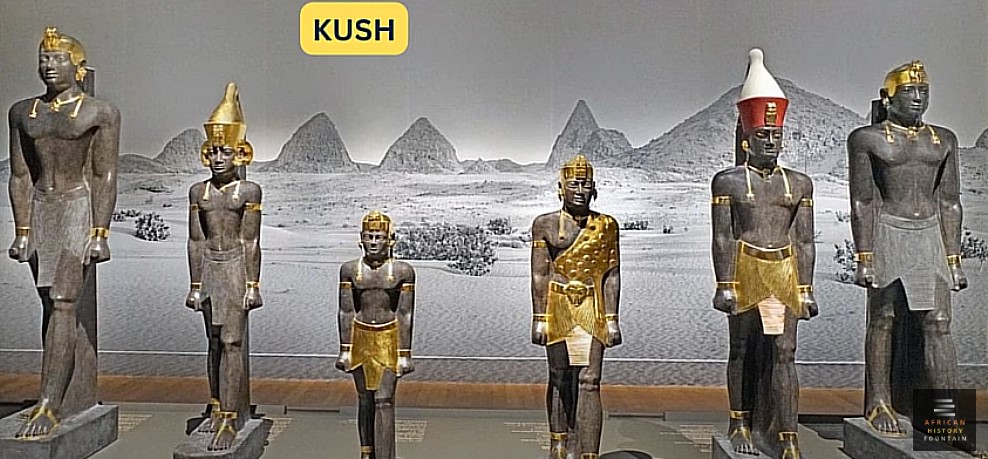
Round temples, towering monuments, fortress-like palaces, and colossal statues prove this was no imitation of Egypt, but a bold and original African capital of glory:

It was occupied from the 1800 BC to 400 AD. A temple complex was developed with an unusual circular plan and unique construction, different from the earlier Kushite capitals and Napatan/Meroitic centers.

Doukki Gel, the sacred city of "Black Pharaohs"


The 25th Dynasty‘s reunification of Lower Egypt, Upper Egypt, and Kush created the largest Egyptian empire since the New Kingdom (16thC BC and 11thC BC). They assimilated into society by reaffirming Ancient Egyptian religious traditions, temples, and artistic forms, while introducing some unique aspects of Kushite culture.
It was during the 25th dynasty that the Nile valley saw the first widespread construction of pyramids since the Middle Kingdom (2030 BC–1650 BC). Many in now N-Sudan.


Unique Architecture:
The site features unique buildings with oval and circular plans, constructed with mud brick and featuring large chambers and tower-like entrances, which differ from typical Egyptian and Nubian architecture.

A Religious Center:
It developed into a significant religious center for the Kushite Kingdom, with a temple complex that includes the large circular (Π) Amun temple.
After the Fall of Kerma:
Doukki Gel was founded by Egyptians after they destroyed the Kerma capital around 1450 BC, during the 18th dynasty. The site shows evidence of later development under the Kushites, including a large Amun temple.

Ongoing Research:
The site is currently undergoing active excavation and study by various international teams, providing ongoing insights into its architecture and history, not seen elsewhere in the world.
Kingdom of Kerma:
Before Doukki Gel’s prominence, the city of Kerma was the capital of the Kingdom of Kush, a flourishing center of trade and power.
The Napatan and Meroitic Periods:
Doukki Gel saw significant development during the later Napatan and Meroitic periods (8thC BC — 4thC AD).
Kushite Rule:
The Kushite rulers continued to maintain independent from Egypt for centuries, establishing their own distinct culture and capitals, including Kerma, Napata, and later Meroe, with Doukki Gel serving as an important religious hub.

Temples breathing in Π & Φ harmony with the Stars,
their priests speaking the language of the Stars.
The remaining foundations of Kerma-Doukki Gel point to circular temples and palaces of an extraordinary ceremonial city of the Kerma Classique period (1750-1500 BC), and the significance of the Nubian architecture, the meeting point between the African world and Pharaonic Egypt.
The historically linked sites of Kerma and Doukki Gel form a vast archaeological complex that extends over more than 22 hectares, 12 km upstream from the 3rd Cataract of the Nile, in the current N-Province of the Republic of Sudan.
They occupy a strategic position, at the crossroads of important trade routes that link the regions of sub-Saharan Africa to the Red Sea and the Mediterranean. The remains uncovered so far bear witness to a continuing occupation over about 3 millennia, from the early Kerma period (2500-2050 BC) to the Meroitic period (290 BC-350 AD).
The monuments of Kerma, notably the Deffufas, are built by traditional, authentic methods of using mud and burned bricks in its construction. This is the 1st time in the Nile valley.

The Western Deffufa, located in ancient Kerma in N-Sudan, is one of the oldest known monumental structures in the Nile Valley, dating back to at least 2500 BCE. Rising about 65 feet high, it was built entirely from sun-dried mudbricks:

The Sphinx decoded?

Stellar Twins

Beneath the Sand, the Kings Still Speak:
Beneath the desert’s endless breath,
Where silence guards forgotten death,
A city sleeps, a crown of stone,
A throne of gods, a world unknown.
Doukki Gel — her name is hushed,
Her temples buried, her streets are crushed,
Yet in the dark her voices rise,
Like drums that echo through the skies.
The sand may cover, the world may lie,
But stars still map her majesty high.
Round towers dream of moons once seen,
Where Kushite queens walked proud and keen.
The rams of Amun guard the gate,
Their shadows etched in halls of fate.
Their horns still gleam in hidden night,
Their power waits for dawn’s first light.
Here kings once sat with eyes of fire,
Not slaves, not myths, but lords entire.
Their lips were carved, their faces strong,
Their names erased, yet they belong.
O desert, cruel, you hid their glow,
But time itself will overthrow.
The sand is not a tomb but veil,
A story buried to prevail.
For every stone still hums a song,
Of armies vast, of kingdoms long.
Of incense burning, of hymns profound,
Of dancers turning, of sacred sound.
They told us Africa did not reign,
That Black men built no ancient name.
But Doukki Gel beneath the dust,
Stands waiting still, betraying trust.
When spades shall pierce her hidden veins,
The world will quake, the lie will wane.
For gold will shine and walls will rise,
And truth will blaze in blinded eyes.
Remember this, O child of sun:
Your history is not undone.
Your cities live, though buried deep,
Your pharaohs wake when others sleep.
So walk with pride, for you are heir,
To Kushite crowns, to temples rare.
The sand is shifting, time is near —
Doukki Gel will reappear.