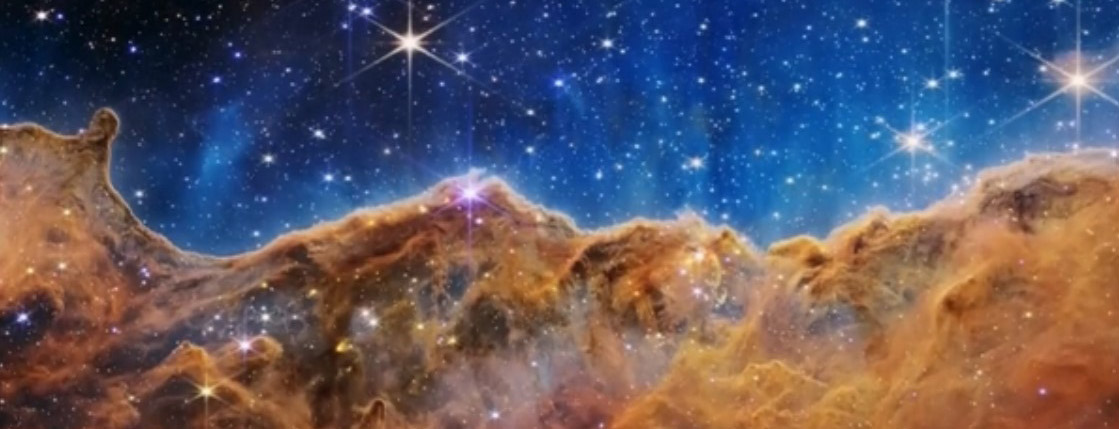
The Milky Way Galaxy
The Milky Way Galaxy
Our Cosmic Home

Our entire cosmos contains over 2000 billion galaxies.

Our Milky Way is a barred spiral galaxy. This is a spiral galaxy with a central bar-shaped structure, a stellar nursery, which is saturated with stars. Bars can affect the motions of its spiral arms, its stars and interstellar gas.

The thin disc is 1K LY thick. The thick disc varies from 4K to 16K LY.
Here the velocity of the stars is higher than in the thin disc.
The bulge diameter is 16K LY. It contains about 10 Billion old stars.
The Halo’s diameter is about 300.000 LY.

Our Milky Way Galaxy is part of the Virgo super cluster, that comprises of over 5,000 galaxies, which together are about 100 million light-years across.

Galaxies are not randomly distributed in space; they swarm together, by gravity, to form groups and clusters.
The Milky Way is a member of the Local Group, which is part of the Virgo Cluster, which in turn is part of the 100,000-galaxy-strong Laniakea Supercluster.
Our Galaxy and its neighbors are flying at ≈600 km/sec in the direction of the constellation Hydra, as well as racing within a larger cluster of galaxies towards the constellation Virgo at ≈300 km/s. In total, our galaxy is flying through the universe at about 1,000 km/sec. Speed of Light is 300.000 km/sec.

.jpg)
The Milky Way, ≈13 Billion years old, and the Andromeda Galaxy, together containing over one Trillion stars, will be merging in about 3 Billion years.
The Andromeda spiral galaxy is 150.000 LY across:

They belong to a group of 50 closely bound galaxies known as the Local Galactic Group.

Ever since astronomers first laid their eyes on the sparkling spiral arms of our home galaxy, the Milky Way, they have wondered what processes might drive the evolution of these massive, star-studded structures.
Presumably, those same processes are why we see such a stunning diversity of galactic neighborhoods in the observable universe, which contains an estimated 2T galaxies with unique sizes, shapes and compositions.

Flares in the vortex center of the MW
So, astronomers WW called for the James Webb Space Telescope (JWST) to conduct a multi-epoch, large-area, multi-wavelength survey of the Milky Way’s innermost regions. Decoding the dynamics of the Milky Way’s heart, or Galactic Center (GC), should shed light on what happens in many other galaxies in our universe, as well.
Scientists wonder, what role does the supermassive black hole sitting in our galaxy’s center, Sagittarius A*, play in its evolution? Why is our galaxy’s star formation slower than it should be in cold, dark molecular clouds in the area? How do our galaxy’s central star clusters emerge in the first place?

Our galaxy contains 200-400 billion stars that contain over 200 billion planets. However, our galaxy might contain more roque planets than stars. A roque planet has left a certain solar system and possibly trillions of them race through the MW like a comet, w/o a home-star.
Some of these cosmic nomads are bigger than Jupiter, and got ejected from their solar systems through gravitational encounters. It is like a cosmic pin-ball machine where planets get flung into the darkness of interstellar space.
It is a spiral galaxy with a bulge, a disk, and a halo. The halo and central bright bulge contain old stars and the disk is filled with gas, dust, and young stars. The spiraling arms begin in the center and form a flat disc.
One of the biggest unresolved questions about the Milky Way surrounds how its black hole, Sgr. A*, affected our home galaxy’s evolution.
Astronomers already know that massive, galactic black holes like this one grow mostly by feeding on gas that surrounds the holes themselves in plate-like shapes known as accretion disks. Thus, because the presence of such gas is also a necessary ingredient for star formation, its reasonable to infer a relationship between the growth history of Sgr A*, and the rate of star formation in the Galactic Center.
Active black holes emit large amounts of electromagnetic radiation, but Sgr A* appears to be relatively quiet on this front, suggesting it isn’t consuming large volumes of material. Astronomers refer to Sgr A* as a ‘quiescent’ black hole, which means it is basically dormant

Milky Way in the center of its double bowl N-S Magnetic Fields
Galaxies are impelled apart by N-N or S-S Magnetic Force Fields

Balls form rings around center balls between N & S pole bowls
This galactic disc, about 100,000 light-years across, seems to rotate like a ‘flat plate to which all stars are glued’ around its hollow center, by the "gravity of the dark matter mass (containing more than 99% of all the galactic mass)".

MW core sucking in dying stars + orbiting dwarf galaxies
Our Galactic Center is full of stars. It’s so dense, in fact, that smaller telescopes struggle to tell one star from another. Plus, our view of the Galactic Center from Earth is obstructed by large clouds of dust.
The JWST’s Near-infrared Camera (NIRCam) and its system of filters, which allow astronomers to separate spectra of infrared light into wavelengths emitted by specific materials, makes the observatory uniquely capable of peering through these dense regions of dust.

To the unaided eye, those regions just look like dark voids because we can only see visible light wavelengths, blocked by those dust veils. Infrared wavelengths, however, can cross over to the other side, ultimately hitting the JWST’s detectors.
The JWST is also capable of making observations in longer wavelengths of infrared light, which it uses to observe galaxies in the early universe. The light from these galaxies has stretched, or "redshifted" due to the continued expansion of the universe, where their light waves are moving towards the red end of the electromagnetic spectrum (where longer wavelengths are categorized). Infrared is longer in wavelength and lower in energy than visible light, making it invisible to humans.

The Galactic Center contains many stars of all masses. It is the only galactic core we can observe where each star can be investigated individually. And the more we learn about our galaxy, the more we will learn about how other galaxies evolve throughout the cosmos.

Neutron star twins orbiting around the MW core
Our galactic center seems to be operated by twin-forces, one pulling in stars that died, and the other pushing out ‘newborn’ stars, often as Twins. The Twin-center wormhole of one galactic plane might be interdimensionally connected to the Twin-center wormhole of another galactic plane.
The APEX Telescope Large Area Survey of the Galaxy (ATLASGAL) done in sub-mm wavelengths, which is between IR light and radio waves. This allows us to see all the near 0°K gas and dust in the galactic plane as bright red blotches. This area typically gives birth to new stars.
Our Sun is a young star of 5 billion years. Rollercoaster riding inside the Orion arm, at ≈ 200 km/sec, it takes our entire solar system ≈ 250 million years to go around the Galaxy’s Bulge, ≈ 26.000 light-years away. Viewed from earth, this center is located just beyond the border of Sagittarius and Scorpio, and this bulge is about 13.000 light-years thick.
The winds emanating from our Sun slam into a magnetized medium of charged particles, atoms, and galactic dust. Thus, they continuously inflate a giant bubble in interstellar space called Heliosphere in which the Sun and its planets reside:

Around 225 million years ago, the earth’s landmass started to split up in what we know now as the 5 continents. Thus, one "Galactic Year " has passed since then.

Every day our planet appears to make one full spin around its axle, with a surface speed at the equator of 1666 km/hr. The moon cycles around our planet such that we see a full moon every 28 days. From any position on earth it takes about 18 years and 7 months for the sun and the moon to appear in the same tri-angular location again. Major events in our lives are often marked by 1, 2, or 3 times this period.
Center point between Earth and Venus orbiting around the Sun
follows a 5 petal pentagonal harmonic shape
Our planet races around the fast moving sun at ≈ 30 km/sec, and thus moves in a complex coil-like motion in space, creating the illusion of a 365 day cycle around it, and is now entering into an entirely different magnetic energy.

Milky Way center from high-up in the mountains of China


