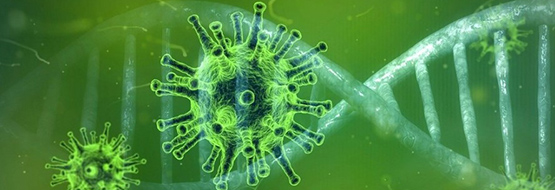
Viral Protein
Bacterial or viral or special protein

Bacterial and viral infections cause symptoms such as fever and chills. Viral infections cannot be cured by antibiotics.
Viral infections often involve many different parts of the body or more than one body system at the same time, such as sinus congestion, cough, etc. The pain of viral infections is often described as itchy or burning.
A bacterial infection is often a pain that is in a specific part of the body, such as a cut. If it is infected with bacteria, pain will occur at the site of the infection.
There are also synthetically fabricated proteins that evade the immune systems of infected hosts and cause dis-eases that cannot be cured with any known vaccine.
Recent research shows that Key is how to increase the activity of the protein AGO4 (Argonaute-4) to enhance protection against viral infections. Required for RNA-mediated gene silencing (RNAi). Binds to short RNAs such as microRNAs (miRNAs) and represses the translation of mRNAs which are complementary to them. Lacks endonuclease activity and does not appear to cleave target mRNAs. Also required for RNA-directed transcription and replication of the human hapatitis delta virus (HDV).
Infections involve many factors..

Recently, researchers have discovered a variety of new viruses which challenge traditional thinking, including so-called “giant viruses”, named for their large protein shells, not their deadliness to humans.
These giant viruses possess a far more complex genome than we know of normal viruses, and are capable of repairing and replicating their own DNA.
An almost entirely new virus, the DNA Yaravirus (Yaravirus brasiliensis), was discovered in Lake Pampulha, Brazil. The name comes from a water deity in Brazilian mythology and folklore. 90% of its genes have never before been described in public scientific databases and literature.
The Yaravirus is not represented by a large/giant particle and a complex genome. Therefore, the researchers concluded that this icosahedral-shaped virus throws open the door to a whole other world of viruses we know nothing about.

Cytomegalovirus (CMV)
Cytomegalovirus (CMV) is an illness caused by a type of herpes virus (an organism that uses your cells to make more copies of itself). Most people will get infected in their lifetime, but many will have mild or no symptoms.
Mechanism for Inactivating Airborne Viruses:
The positive (H+) and negative (O2-) ions surround the hemagglutinin (proteins that form on the surface of organisms and trigger infections) and change into highly reactive OH groups called hydroxyl radicals (•OH).

These take a hydrogen molecule from the hemagglutinin and change into water (H2O). The ions destroy the virus surface structure, for example its envelopes and spikes, on a molecular level.

The virus cannot infect even if it enters the body.
The Nipah virus (NiV) is a nonsegmented, single-stranded, negative-sense RNA virus belonging to the genus Henipavirus, family Paramyxoviridae. Transmission of the disease to humans is associated with close contact with infected pigs.
There is no treatment or vaccine available for either people or animals. The primary treatment for humans is supportive care. Thus, the only option is a counterwave to the wave-signature of this virus.