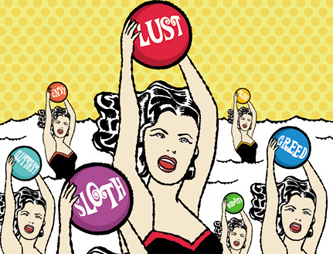
7 Deadly Sins / PCs
7 most Poisonous Pain-Catchers
might refer to:
The 7 Deadly Sins and the Four Last Things, a painting by Hieronymus Bosch, or a follower.
The "7 Deadly Sins"’, also known as the "Capital Vices" or "Cardinal Sins", are a classification of vices that were originally used in early Christian teachings to educate and instruct followers concerning fallen man’s tendency to sin.
The Roman Catholic Church divided sin into two principal categories: "venial", which are relatively minor, and could be forgiven through any sacrament of the Church, and the more severe "capital" or "mortal" sins, which, when committed, destroyed the life of grace, and created the threat of eternal damnation unless either absolved through the sacrament of confession, or otherwise forgiven through perfect contrition on the part of the penitent.
Beginning in the early 14th century, the popularity of the 7 deadly demons as a theme among European artists of the time eventually helped to ingrain them in many areas of Christian consciousness throughout the world.
Used by both Pope Gregory the Great and later by Dante Alighieri in his epic poem The Divine Comedy, the 7 deadly sins are as follows:
- Luxuria (extravagance, lust),
- Gula (gluttony),
- Avaritia (greed),
- Acedia (sloth),
- Ira (wrath),
- Invidia (envy), and
- Superbia (pride).
The TREE of KNOWLEDGE
of both Good & Evil ?

The identification and definition of these 7 Deadly Demons has evolved over time. Not mentioned in the Bible, Dante’s Divine Comedy Part II, Purgatorio, has been the best known source, meaning purification through penance in Purgatory.
We prefer to call the 7 Deadly Demons our 7 most Poisonous Pain-Catchers. They have an opposite side which we call the 7 most Glorious Virtues. They can change like a coin’ s surface, because they can flip from moment to moment.

Pain-Catchers are created during times of resistance to a certain experience. Unable to fully feel through the pain of that moment, we subconsciously created an entity that would catch and carry that pain-residue forward.
Rather then striving for the virtues or wrestling with their polar opposites, we can permanently take the Deadly out of Demons by taking the Poison out of the Pain-Catchers. This is done through the use of an exhortation.
Our DNA is already afflicted by birth through our ancestry of Pain-Catchers. The Goal of our Soul is to restore the DNA ‘Tree of Knowledge’ to its original format, the ‘Tree of Life‘.
From personal experience we have "coined" the following words that come closest to what we feel is actually meant:
- Greed versus Giving
- Anger versus Forgiveness
- Jealousy versus Mindfulness
- Overdoing versus Moderation
- Self-importance versus Humbleness
- Loveless Longing versus Purified Soul
- Joyless versus Joyful

Greed versus Giving
Greed is, like Lust and Gluttony, a vice of excess. However, Greed (as seen by the Church) applied to the acquisition of wealth, in particular. Thomas Aquinas wrote that Greed was "a sin against God, just as all mortal sins, in as much as man condemns things eternal for the sake of temporal things." In Dante’s Purgatory, the penitents were bound and laid face down on the ground for having concentrated too much on earthly thoughts. The Latin for Greed "Avaritia" is more of a blanket term that can describe many other examples of bad behavior. These include disloyalty, deliberate betrayal, or treason, especially for personal gain, such as bribing.
Scavenging and hoarding of materials or objects, theft and robbery, especially by means of violence, trickery, or manipulation of authority are all actions that may be inspired by greed. Such misdeeds can include Simony, the selling of the free grace of God for goods, a gift of silver would reduce one’s tenure in Purgatory. In America, churches preach a gospel of prosperity which makes promises Jesus never made.
The church has its own share of greed, muted its prophetic voice to protect its fortunes, as a Non-Prophet Organization.
Institutional Greed insinuates itself into national policy, not just from a voracious appetite for more financial means, but from a deep-seated fear about the future.
Thus, greed is the compulsive behavior of the Fear-carrying Pain-Catcher demanding attention. St. Paul wrote in his Roman prison: ROMA: Radix (the root) Omnium (of all) Malorum (evils) Auaritia (is avarice). As we might do today with U.S.A.: The United States of Avarice.
In America, you are what you own. Its hand is the grasping hand, always needing more to feel secure, fulfilled, and always fearful of losing what it has. The opposite is the way of asceticism: You are what you refuse. The hand is held up in righteous refusal. This path can be as compulsive as affluence. Many of us bounce between Mall and Monastery.
Jesus offers a 3rd way. These hands are open, open to receive the Creator’s blessings and open to generously pass them on to others. Open hands, grateful hands, generous hands. When we are in our spiritual space, we know what we need, what is enough. There’s peace and there’s joy about what we have and what we give. The NT reads: “Delight yourself in the Lord, and he will teach you what your heart can afford to want.” It’s that place where our Maker’s desires and our hearts’ desires are in sync.

Anger versus Forgiveness
It may be described as wrath, and uncontrolled feelings of hatred and anger. These feelings can manifest as vehement denial of the truth, both to others and in the form of self-denial, and the desire to seek revenge outside of the workings of the justice system, fanatical political beliefs, and generally wishing to do harm to others when an unbearable injustice has been done to you. The most unendurable is the willful death of one’s twin-star by others.
A modern definition would also include hatred and intolerance towards others for reasons of race or religion, leading to discrimination. The transgressions borne of Wrath are among the most serious, including murder, assault, discrimination, and in extreme cases, genocide. It is the only vice not necessarily associated with selfishness or self interest (although one can of course be wrathful for selfish reasons, such as jealousy). Dante described Wrath as "love of justice perverted to revenge and spite". The wrathful in his Purgatorio were enveloped in blinding smoke.
It’s very unhealthy to carry anger. It increases the stickiness of blood platelets. These platelets latch onto fatty deposits in the arteries and increase the risk of heart disease. When anger is surfacing ask: Is this worth sticky platelets?
There are different forms of anger:
- Outward Anger: the kind that instantly blows up.
- Inward Anger: the kind that turns cold in bitterness, sadness, depression, and stomach problems. It is said, “Hell is not fire, it is ice.” Anger can turn the heart to ice. We seem to swallow more anger than we can digest. When we become our anger, resentment, and bitterness, we are unrecognizable to others and ourselves. Our anger becomes a charged Identity of ours.
- Mind or Idea-Anger: it can turn political & social groups, churches, temples, and mosques into anger factories. Anger is the physical/mental/emotional arousal pattern that occurs in response to a perceived threat to the ego characterized by the desire to attack or defend. It is part of our biological self-defense package.

Current brain research tells us that anger comes from two pathways, the so called “feeling brain” (amygdala) and the “thinking brain” (neo cortex). Even when the threat is only perceived, the body goes into high alert. Its color is red. Anger settles in the mouth like pursed lips, clenched jaws, grinding teeth. Some may shout obscenities or refuse to eat.
Psalm 4: “Be angry but sin not”. Anger itself is not a sin. Anger helps restore ego boundaries which have been damaged by another’s trampling of our bodies or personhood. It can be part of the good energy of justice. We should befriend it and make it our spiritual ally. We can offer it to Christ, have it transfigured, then integrate it and become more whole and healthy. It can become a call to reflection & discernment, to self-knowledge and testing what is real.
The Key to healing and wholesomeness seems to be:
- Recognize the anger. It is sneaky. It likes to hide behind a mask.
- Don’t act on an anger while the body is in full throttle.
- Own your anger. It is yours. Take responsibility for it. Ask for its name.
- Settle anger issues a.s.a.p. and productively.
- Learn creative, non-passive, and nonviolent ways to confront hurt and injustice, and evil. Anger can be a godly energy for justice if the means and methods match the goals. No need to kill for Christ or justice, or torture for democracy, or lie for truth.
- At the heart of healing is appreciation and forgiveness, which we receive by grace and also give to others.
- Practice the c2C each time you feel the sensation of anger in your body. All Anger-Pain-Catchers are not gone instantly. Only One at the time.

Jealousy versus Mindfulness
This vice is characterized by an insatiable desire; someone desires something that someone else has, which they perceive themselves as lacking. Dante defined this as "love of one’s own good perverted to a desire to deprive other men of theirs." In Dante’s Purgatory, the punishment for the envious is to have their eyes sewn shut with wire, because they gained sinful pleasure from seeing others gone low.
Envy turns its sneering face against all virtues and goodness. From the beginning it is endless anguish and self-torment. Green with envy. The grass is always greener on the other side of the fence. Such is envy’s fix. The Greek term for envy means to have an evil eye. The Latin word is invidia, which has to do with the eyes, to look maliciously upon.
Jealousy comes from one or more of our Pain-Catchers, the pain of comparing or being compared unfavorably with others. It may lead to self-improvement but could also turn to self-despising. Envy is the consuming desire to have everyone as unsuccessful as you are. Envy turns sad at another’s success and feels joy over another’s misfortune, ‘Schadenfreude’ in German.
Envy is manifest by the almost secret smile when one hears of another’s fall. The root of envy seems to be: Some cannot stand their Maker’s generosity to others because they have lost sight of their Maker’s generosity to them. The glare of other’s blessings has blinded them to theirs. A possible antidote to envy is keeping a daily “gratitude journal”: list five or more things a day for which you are thankful. Then express them aloud before starting your evening meal.
The culture around us conspires to inflame our envy. The Divine Household is here to proclaim our inner, un-erasable worth. We could practice mindfulness, observing our own and other’s habits, patterns, and choices so that we can see our own belovedness , our own infinite worth, un-comparable goodness and uniqueness in our Maker’s eyes.
The biblical Jesus exhibits this self-aware consciousness: an exceptionally high level of personal refinement that is practical and attainable for all humans who sincerely discipline themselves to attain it. He didn’t want anyone to blindly follow him. He wanted us to become as he became, a self-aware, mindful, and enlightened being.

Overdoing versus Moderation
Modern views identify Gluttony with an overindulgence of food and drink, though in the past any form of thoughtless excess could fall within the definition of this vice. Marked by unreasonable or unnecessary excess of consumption, gluttony could also include certain forms of destructive behavior, especially in sport, or for its own sake.
Substance abuse or binge drinking can also be seen as examples of gluttony. The penitents in the Purgatorio were forced to stand between two trees, unable to reach or eat the fruit hanging from either, and were thus described as having a starved appearance.

Self-importance versus Humbleness
In almost every list Self-importance or Pride is considered the original and most serious of the 7 Poisonous Pain-Catchers, and the ultimate source from which the others arise. It is identified as a desire to be more important or attractive than others, by failing to give compliments to others though they may be deserving of them, and feeling excessive love of self.
Vanity and Narcissism are prime examples of this vice. Dante’s definition was "love of self perverted to contempt for one’s neighbor.". In the Divine Comedy, the penitent were forced to walk with stone slabs bearing down on their backs in order to induce feelings of humility.
Pride makes all other vices deadlier. It makes Envy greener, Anger meaner, Greed greedier and Gluttony “hungrier.” It deepens Sloth’s despair and gives Lust a strut. Pride infects all vices and all virtues. Its reach is long and its roots are deep, and “It comes early and stays late.” The problem with the self-made man is that he worships his creator.
The root of pride is anxiety. Being fearful about the perceived finitude of the body and life. Some try to enlarge themselves by building bigger towers and buying bigger equipment. The strategy of Pride is that it attacks us not on our weak, but strong points. Pride appears to have 3 main idols:
- The Pride of Power. It lives by the creed: Might makes Right. In Genesis the Creator calls us to have dominion over the earth. However, pride turns this sacred calling into a plundering of our planet.
- The Pride of Knowledge. We make an idol of learning. Some trade their souls for the ultimate knowledge. By our brains we shall be saved. The amount of available knowledge doubles daily. But where is wisdom?
- The Pride of Goodness. Saint Bernard wrote of a proud monk: “He is inclined to fast more, pray longer, sleep less, look sicker and suffer more than his fellows, proving that he is the holiest man."
There’s Vanity. A vain person enters a room or walks down the street assuming all eyes are on him or her. Then there’s showiness: I like to look good. Then we have the pride of rebelliousness against authority and rules; the pride of conceit and scorn; the pride exhibited by the rolling of eyes; the pride in winning all arguments; the pride of false humility: “O, it was nothing!” often drips with pride.
Pride is deadly because it blinds us to its presence. If you don’t think you have it, watch out ! Pride moves into “the shadow of solitude.” Do you sense pride in your uniqueness, exceptionalism? Do the normal rules apply to you?
Humility and forgiveness can overcome the invasive power of pride. For all his power, wisdom, and goodness, Christ bowed beneath the other. Can Christ’s mind be in us while we struggle with Pride? Perhaps, the c2C exhortation can help you eliminate this awesome power of pride. May be more humility will then slowly shine through.

Loveless Longing versus a Purified Soul
Loveless longing (Lust) is usually thought of as involving obsessive/excessive thoughts/desires of a sexual nature. Unfulfilled lusts leads to sexual or sociological compulsions / transgressions such as sexual addiction, adultery, rape, etc. Lust can be described as the desire for the release of sexual energy. The partner can thus be seen as a "means to an end" for the fulfillment of the subject’s desires, and becomes thus objectified in the process.
Dante’s criterion was "excessive love of others," which therefore rendered love and devotion to God as secondary. In Purgatorio, the penitent walks within flames to purge himself of lustful thoughts.
Lust is desire, driven and distorted by the other 6 vices. Thus, it is an expression of deeper needs, conflicts, wounds and compulsions. It might be a desperate attempt to feel something, to find worth. Learning about sexuality is part of the spiritual practice of “honoring the body.” Seeing it as the temple of the Spirit, therefore keeping it in top shape.
The erotic is deeper than the sexual. It feels like a life-force that brings joy, creativity and connection. The sexual Pain-Catchers often live in secrecy and shame. Some people believe that their human value equals their sexual value. The need to love and be loved, tends to make sexual sinning the mother of all sinning. Perhaps our Pain-Catchers crave the opposite of what we need as souls?
Selfless love should represent the highest degree of development and feeling of community with others in human relationships. Using the c2C exhortation allows the Catchers of our loveless longings to be transformed into the Catchers of our selfless love. We will then become Purified Souls bringing joy, peace, love, light, and life to the world.


Joyless versus Joyful or Jolly
No Flip-Flop
Early Christians defined Sloth as apathy, depression, and joylessness (a refusal to enjoy the good of God’s Creation). There were two more aspects, Akedia and Sadness.
The Greek word Akedia describes a spiritual apathy that affected the faithful by discouraging them from their religious work. The literal meaning is no–caring, thus a dissatisfaction with life. Sadness (tristitia in Latin) is a feeling of discontent or dissatisfaction, causing unhappiness with one’s current situation. Dante described Sloth as being the "failure to love God with all one’s heart, all one’s mind and all one’s soul." It is the only vice lacking love. In his Purgatorio, the sloth’s were made to run continuously at top speed.
The American work-mania and laziness-phobia have produced a nation of workaholics. The Italians say: “ Dolce fa niente”, the sweet of doing nothing. Sloth is a deadly spiritual malaise. The modern view of the vice is a failure to utilize one’s talents & gifts and an unwillingness to act.
I experienced it as an inability to hold on to the feeling of Joy, because the State of Suspension I was held in for more than two decades by the Christ within me. Although I received a lot of new insights and understanding about myself and my environment, I was unable to succeed longterm in anything professional or material on the earthly plane during those decades, no matter what I tried.
Pride and Sloth are paradoxes. The Pride Pain-Catchers think too highly of themselves, the Sloth Pain-Catchers too lowly. Pride seeks our Maker’s throne, Sloth flees responsibility. Pride turns us into control freaks. Sloth gives up all control and seeks sweet oblivion. It is the abdication of the lower self, not in something higher but in something lesser.
It appears necessary to experience this state of being so as to get Potentate Pain-Catchers to agree to leave for re-hab.
Pride is in the assertion of the self over and against other Pain-Catchers. They can be seen as the loss of self to some impulse or vitality, or even to nothingness itself. We seem to be either predisposed to one or the other. Sloth is the distortion of the dream of self-transcendence, however it is a necessary part of the path of surrendering the ego.
With Sloth too much is demanded. We are afraid to fail. When we refuse to use the right exercise of power, others may exercise their power in malevolent ways. How about America’s pride in anti-intellectualism. Many Americans take pride in their sloth. The compulsive consumption and busyness of a slothful person are covers for despair.
There is also spiritual sloth. Some of us think they can become instant saints by reading self-help books that promise personal transformation in a few weeks. The most emblematic one is the ‘Couch Potato’. Sloth may masquerade as a fashionable form of despair, a luxury of the elite. Sloth takes the form of a carefully cultivated cynicism. Such cynicism doesn’t demand much. It doesn’t demand anything.
Sloth is the loss of passion for life and goodness. It believes in nothing, cares for nothing, enjoys nothing, seeks to know nothing, interferes with nothing, loves nothing, hates nothing, finds purpose in nothing, lives for nothing, and only remains alive because there is nothing it would die for. It’s a form of grief, but not the loss of a loved one. In Sloth one grieves because one cannot really connect with the beloved.
Jolly is full of or showing high-spirited merriment. Synonyms are spanking, festal, comic, laughable, jovial, festive, brave, rattling, risible, braw, zippy, comical, sunny, funny, lively, gay, cheery, mirthful, merry, amusing, snappy, brisk, alert.
Ego desire fills you with things that only mask the emptiness. Soul desire goes to our Maker and asks for life. Christ can be invited to free us from Sloth’s deadening power. The Grace – via the c2C – which comes to deliver us from Sloth sets a table before us, the feast of Life, Light, and Love, a feast full of JOY that says, “O taste and feel that God means Good!”
The Roman Catholic Church also recognizes 7 Holy Virtues which correspond to each of the 7 Deadly Sins or Vices:
Vice:
- Lust (excessive sexual appetites)
- Gluttony (over-indulgence)
- Greed (avarice)
- Sloth (idleness)
- Wrath (anger)
- Envy (jealousy)
- Pride (vanity)
Virtue:
- Chastity (purity of soul)
- Temperance (self-restraint)
- Charity (giving)
- Diligence (zeal/initiative)
- Forgiveness (composure)
- Kindness (admiration)
- Humility (humbleness)

Like the 10 Commandments, the 7 Deadly Sins have long been a source of inspiration for writers and artists.
Further reading:
- Summa Theologiae, by St. Thomas Aquinas
- Inferno, by Dante Alighieri
- Purgatorio, by Dante Alighieri
- The Concept of Sin, by Josef Pieper
- The Traveller’s Guide to Hell, by Michael Pauls
- Sacred Origins of Profound Things, by Charles Panati
- Faerie Queene, by Sir Edmund Spenser
- Picture Book of Devils, Demons and Witchcraft , by Ernst Lehner, Johanna Lehner
- Defeat the 7 Deadly Sins, by Alan Fensin 2007
- Oxford Univ. Press series on 7 Deadly Sins, 2006.
