Huang-Di
HUANG-DI 黃å¸
Yellow Emperor 黃皇å¸

2700-2600 BC
è»’è½… Xuanyuan,
named after a dragon-shaped asterism:


Chinese star map from 2400 BC.
Before Huang-Di was born there occurred "a radiance from a star in the Big Dipper/Bear asterism" (Ursa Major).

Big Dipper between Draco and Xuanyuan (Lynx+Leo)
The constellation Lynx is shaped like a Yellow Dragon
The Chinese word for "star, heavenly body" is 星 xÄ«ng. The term for "asterism" is 星群 (xÄ«ng qún, lit. "group of stars"). The modern term for "constellation", as defined by the IAU system, is 星座 (xÄ«ng zuò).


Xuanyuan 17 star-asterism on two different Chinese star maps,
covering the IAU constellation Lynx and part of Leo.
It is through Xuanyuan è»’è½… (dragon-shape 17 star asterism, part of one of the 28 mansions or Chinese constellations) that Huang-Di arrived on Earth. One of these stars is Regulus (in the IAU constellation Leo). A rare similarity between our Sun or Star and the double-twin Regulus Stars is that our planet Earth can receive harmonic radio signals in metric wave bands from these 2 pair of Binary Stars:

Huang-Di temple in Xinzheng, Henan,
place where He became leader of the Youxiong clan,
Youxiong means "possessor of bears" (Bear/Dipper Stars)
Said to be born in Shou Qiu, Huang Di is seen as the founder of the Chinese civilization. His legendary reign came at the tail end of the transition from a matriarchal (men serving women) to a patriarchal society (women serving men).
He is credited with the introduction of various governmental institutions, wooden houses, carts, boats, the bow & arrow, characters, music and their instruments, daily utensils, and a writing system which is the script used on oracle bones.
When men first learned to write, "all spirits cried in agony, as the innermost secrets of nature were thus revealed."

The oldest books on love and sex, "The Su Nü Ching" and "The Secrets of the Jade Chamber" were written by him and his closest advisers, such as P’eng Tzu, Ts’ai Nü, and Su Nü, the Immaculate, his most beloved courtesan.
They explain the hidden, higher purpose of reproduction and love- & joy-making, namely that sex is vital to someone’s spiritual and physical health: "the Tao of Sex Wisdom".


He taught people how to grow crops and tame wild animals. He helped establish the Chinese calendar, early Chinese astronomy, traditional Chinese medicine, and coining money.
His ministers, Tai-Mao and Li-Shou devised a sexigesimal (60) based number system and corresponding arithmetic.
They were convinced that numbers had philosophical and metaphysical properties in order "to achieve spiritual harmony with the cosmos." They knew that man’s "…existence depended upon numerically specified actions and obligations:"


There was no use of algebraic notation. The digits in their base 10 systems were ciphered and they were written vertically on bark, bamboo, silk, and paper. Their numeral system was a multiplicative grouping system.


Huang-Di Pig-Dragon totems
Ancient Chinese writings confirm that the Yellow Emperor invented the Art of Warfare through the 4 useful branches of military knowledge concerned with (1) mountains, (2) rivers, (3) marshes, and (4) plains. Further expanded 3 millennia later by Flavius Belisarius in the Mediterranean under the name "The Byzantine Treatise on Strategy."
Huang-Di had to fight 70 battles in order to pacify the Empire. He led his men out of the fog of wars by the "compass chariot" he had invented and won complete victory:
.jpg)
He instituted the feudal system of vassal princes.

click map for more details
Emperor Yan-Di is reputed to have introduced farming techniques among the tribes along the Yellow River in Shanxi Province. His dynasty lasted for about 500 years.

Huang-Di is credited with defeating the Yan-Di Emperor and others. That won him the leadership of the tribes throughout the Huang He (Yellow River) plain.

Huang-Di was called the Yellow Emperor. Yellow represents earth, solar plexus chakra, dragons, and the center.

Dragon-Owl totum
Huang-Di’s first wife, Lei Zu, discovered silk, invented the silk loom, and taught women how to breed silkworms and weave fabrics of silk. Lei Zu was the first female inventor, scientist and politician in Chinese history. She helped the Yellow Emperor unify central China.
His 2nd wife was Feng Lei, 3rd wife Tong Yu, and 4th wife Mo Mu, married for her virtue, not beauty.


Huang-Di created an ideal kingdom whose tranquil inhabitants lived in harmonious accord with the stars and natural law and possessed virtues like those espoused by early Daoism.
The Tao could not be spoken of, for words cannot describe the infinite Universe. Huang-Di tried to inculcate its virtues in his own kingdom, to ensure order and prosperity for all.

HuangDi’s tomb: Mausoleum complex
Huang-Di did not enlighten people, did not demand worship. He and his helpers were amazingly rational beings, by teaching the natives all kinds of useful skills and sciences.
Most important were their own affairs. These were dominated by the creation of complex, and incomprehensible (to us) apparatuses and contrivances.

Huang-Di temple at Jinyun, Zhejiang province
Huang-Di manufactured "miraculous tripods" for very distant communications, because all were pointed at the star Regulus of the Xuanyuan asterism. These tripods were famous for their ability to receive and ‘store’ knowledge and data.
"When the Yellow Emperor met the West Empress at the Mountains of Wangwu, 12 large sphere-shaped mirrors were wrought for tracking our Moon’s movements", to beam back all Jupiter based energy+information coming in via our Moon:

The Yellow Emperor was said to have turned into the form of the Yellow Dragon at the end of his life. Since the Chinese consider him to be their ancestor, they sometimes refer to themselves as "children of the dragon":

56 meter long wingless yellow dragon


Since the yellow dragon is seen in China as the center of the cosmos, the Qing emperors chose the use of the Yellow dragon as the symbol of their imperial power:

Mural near Yellow Emperor Mausoleum
Memorial mausoleum, built next to the tomb of the legendary initiator of Chinese civilization, is the most important ancient grave site in China. The main sights include Mausoleum of Yellow Emperor and Xuanyuan Temple. There is also a stone tablet erected in 1776 by Qing Emperor QianLong 乾隆, with the characters "Ancient Yellow Emperor’s Tomb on Qiaoshan":

Xuanyuan Temple (軒轅庙 XuÄnyuánmiào), named after the Yellow Emperor’s personal name "Xuanyuan", as recorded in the Shiji, is a temple dedicated to the religion of Huangdi in Huangling. It is the largest of such temples in China:


Construction of the temple started in 1993. The shrine is about 8,000 sqm and is made entirely of granite. Its central building is called the Hall of Xuanyuan (軒轅殿 XuÄnyuándiàn). Annual celebrations are held in April.
Representatives from across China and overseas attend the ceremony, paying their respects to an emperor that inspires Chinese nationalism.
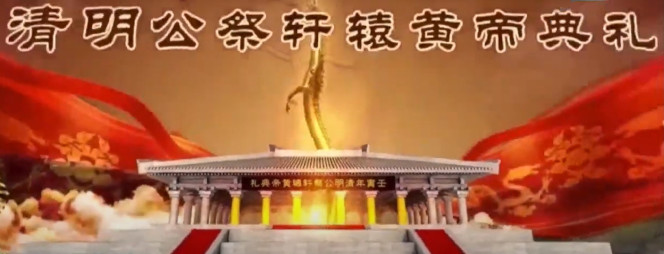
There are other smaller Xuanyuanmiao in Henan, Hebei and Gansu provinces, that hold annual celebrations since 2006, called Qingming festival, and laying of wreaths as well:
His tomb is surrounded by ancient cypresses; several planted by the emperor himself. Some are 19 meters high and a 10 meters girth at the base.

His trees
Today, Huang-Di is most known for authoring the Neijing, of which the essence can be summed up as:
"Health and well-being can be achieved only by remaining centered in Spirit, guarding against the squandering of energy, promoting a constant flow of Qi and blood, keeping a harmonious balance of yin & yang, adapting to the changing seasonal and annual macrocosmic influences, and nourishing one’s self properly. This is the way to a long and happy life."

Acupuncture points, created in 2500 BC:
the first Bio-Resonance Technology
The Neijing offers a framework by which modern medicine, technology, and science can integrate with the principles of natural Traditional Chinese Medicine (TCM). This is the true Integral Way … integrating our microcosm and macrocosm.
Many Taoists claim the Yellow Emperor formulated many of their precepts (commands), incl. the quest for "long life".

His tomb stone
The deliberate death by poison of his pregnant "most beloved" concubine made it impossible for him to continue offering his people a "Garden of Eden" social environment.
Huang-Di’s soul, "having possessed the essence of thunder" could move through space at enormous speeds. His "yellow dragon, " Changhuan, helped him race back to his star.
After Huang-Di’s soul ascended Earth, his palace and town of Huangling was destroyed by 7 streaming meteors (‘dragons’).
All sons of Huang-Di were bypassed and Zhuanxu, Lei Zu’s grandson, was selected as heir to Huang-Di.
The core of his heart & solar plexus went both into lockdown for ≈4500 years, until his soul descended and re-united with his "most beloved" on 9/11/2002, in order to release any pain-catchers, any karma-remnants, resolve any floating issues from ≈4500 years ago, and then call back his power.
Huang-Di Sijing philosophy as "a syncretism (combining different beliefs/thoughts/faiths), to find the underlying element of unity, that is grounded in a cosmology of the Way and an ethos of self-cultivation":


A bronze pot containing the “elixir of immortality” was found near Luoyang. The 2,000-year-old liquid is mainly comprised of potassium nitrate (KNO3) and alunite, the main ingredients of an immortality mix recorded in an ancient Taoist text:


"I dreamed I was a butterfly dreaming I was an emperor"

Circle in square in square in square
