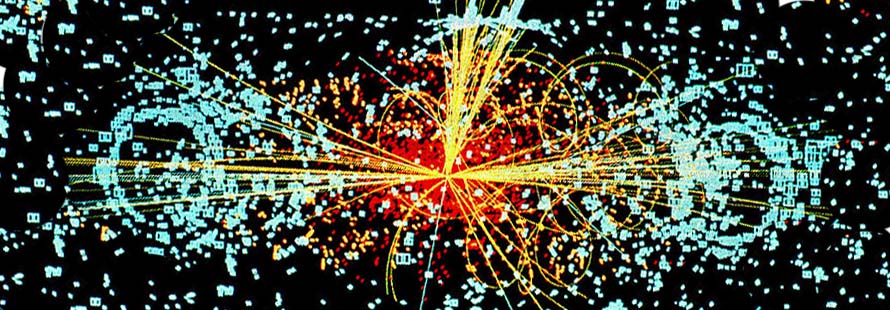
The Higgs boson?
The Higgs boson ?
The Standard Model of particle physics lays out the basics of how elementary particles and forces interact in the universe. This ‘unification’ implies that electricity, magnetism, light and some types of radioactivity are all manifestations of a single underlying force called, the electroweak force.
For this to work mathematically, it requires that the force-carrying particles have no mass. Experiments proved that to be not true, so a group of physicists headed by Peter Higgs came up with a solution to solve this conundrum: the Higgs boson, the 17th and last missing piece in this model.

The model proposes that a so-called Higgs energy field exists everywhere in the universe. As force-carrying particles zoom through this field, they attract Higgs bosons. The more Higgs bosons cluster around a particle, the greater its mass and its resistance to move through (inertia), will be.
Imagine the universe like a party. Unknown guests can pass through the room quickly and unnoticed; popular guests will attract groups of people (the Higgs bosons) who will slow down their movement through the room.

Inside the Large Hadron Collider (LHC) at Cern, located 328 feet underground in a 27 km tunnel, is the most powerful particle accelerator ever built, where high speed proton collisions generate a range of even smaller particles that scientists sift through in search of a signal in the data suggesting the existence of the Higgs boson.
The field cannot be observed, but the high-energy proton collisions can "shake" the field and produce Higgs bosons.
The Higgs boson is one of the few particles that seem to interact with both ordinary protons & neutrons This particle is to the pervasive mass-generating Higgs field what the photon is to the electromagnetic field.
Thanks to the wave-particle duality of quantum mechanics, Higgs bosons can also be thought of as waves (quantum physics) that appear in the Higgs field when it is shaken.

The twin detectors at LHC did not notice the Higgs boson directly, because once it’s created inside the detector it decays so quickly that the detectors can only see the other 5 type of particles the boson decays into. The standard model predicts the rates of decay for each of them.
The CMS detector presented the rates of decay for all five pairs of bottom quarks, tau quarks, photons, W bosons and Z bosons. The other detector is not yet finished. The chance of the signal observed is due to background processes rather than a Higgs boson has now sunk to 2 in a billion.
However, it could still be that it’s not the standard model Higgs boson, but a more exotic boson, if the other detector proves that the ratio of the rates of Higgs decay to W versus Higgs decay to Zs would not be as predicted.
By observing these collisions, scientists hope to address such questions as the origin of mass, prove the existence of dark matter, how fundamental forces unify, and whether there are more than 3 dimensions, because what they know now is next to nothing compared to what they still have to know….
The LHC smashes together protons, which generate Higgs boson particles together with many other particles. China’s Circular Electron Positron Collider (CEPC) is supposed to generate literally millions of Higgs bosons, by colliding electrons and positrons to create an extremely clean environment that only produces Higgs boson particles.

Those high energy physicists that jumped the great divide between the left and right hemisphere of the neo-cortex call it the ‘God particle‘, because these Higgs particles cause to create something (mass) out of nothing (photons).
Some scientists call the Higgs field the Etheric field, the birth place of matter. The forces belonging to the etheric realm come from the periphery, have negative values, and work only within a circular area. Other scientists call the entire Higgs field/boson theory utter nonsence.
However, experimental particle physics is very dangerous to Science as a Whole, because with its observational fig leaves, it continues to beguile us that they are doing science instead of just pushing technology to the limits.