Balancing Body + Yin/Yang
Balancing the Body
How does the ear affect body balance?

The inner ear is composed of two parts: the cochlea for hearing and the vestibular system for balance. The vestibular system is made up of a network of looped tubes, three in each ear, called the semicircular canals. They loop off a central area called the vestibule.
The vestibular system detects movement through special sensory cells which are activated as you move your head. This system sends signals to the vestibular nerve, which joins the cochlear nerve and carries electrical signals to the pons of the mid-brain, which is responsible for coordinating movement.
Balance disorders occur because of issues in the inner ear. Vestibular neuronitis results from an infection that inflames the inner ear or the nerves connecting the inner ear to the brain. This inflammation disrupts the transmission of sensory information from the ear to the brain, causing dizziness and difficulties with balance. Inner ear infections are usually viral. Middle ear infections are usually bacterial, affecting the area around the eardrum.

Organ of Corti
The Cochlear Spiral Ganglion (SG) Neurons are the auditory portion of the VIII Nerve, which is formed by sensory neurons that innervate the inner ear, which means the distribution and excitation of nerves to its vestibular and auditory receptors.

The neurons of the cochlear portion innervate the sensory hair cells of the organ of Corti, a structure in the cochlea, which produce nerve impulses from sound vibrations. Their somas are in the cochlear spiral ganglion where two types of neurons can be distinguished:
- 95% of them are AFferent Typeâ€I neurons, whose bipolar and myelinated fibers innervate only one cochlear inner hair cell (IHC).
- 5% of them are AFferent Typeâ€II neurons, which are pseudo-unipolar and unmyelinated fibers that innervate multiple cochlear outer hair cells (OHC), but each OHC only receives one contact from one Typeâ€II neuron:

The spiral ganglion VIII nerve fibers are involved in various hearing and/or vestibular problems, and in dysfunctions of the synapses between cochlear hair cells and the afferent fibers.
These could cause noise trauma, deafness related to dizziness, genetic hearing loss, restriction in blood supply to tissues, causing a shortage of oxygen that is needed for keeping the tissues alive, etc.
Balancing your Yin and Yang
The roots of Taoist Yoga originate in the ancient healing systems of acupuncture, Tai Chi and Qigong. It was termed ‘Yang Sheng’ the ‘Art of Guiding and Leading Energy’.
Fundamental is the recognition of Qi or Chi or Prana (India). Both agree that the purpose of yoga, through posture, breathing, and meditation, is to channel and store this life force energy Qi in the body, helping us achieve longevity, optimum health and to accelerate spiritual development.

fire & water
When active and energetic, Qi flows through our muscles, the Yang layer of the body. When we are still, Qi moves through the more resistant connective tissues and skeletal system, the Yin layer of the body.


The key to practicing Yoga is to bring the Yin (feminine) and Yang (masculine) into balance. Hatha Yoga (Ha=Sun and Tha=Moon) emphasizes yang, meaning movement, muscular contraction and heat.
Ballet is Bal-ance (let is a normal suffix)
Conclusion
Use Yang energy to build heat in the muscles and become pliable and elastic via a series of standing postures, through Indian Yoga, or Chinese Tai Chi. Then sit down. Let the Chi saturate more deeply into the body, by using long passive stretches to open the denser and more resistant Yin tissues, like tendons, joints, ligaments, and connective tissues. This balanced approach results in a deeper feel of calm, more vitality, and a wonderful loose-limbed sense of well-being.
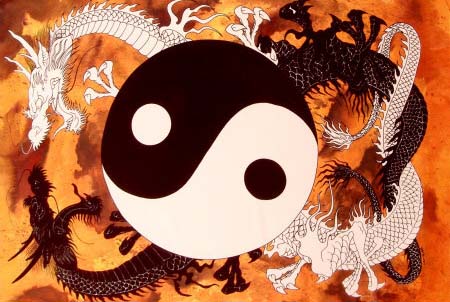
In general, the Yin Yang symbol is a Chinese representation of the entire celestial phenomenon. It contains the cycle of Sun, four seasons, 24-Segment Chi, the foundation of the I-Ching and the Chinese calendar.

origin of Yin-Yang symbol
click here for more details

New Pearl, China, Yin-Yang shaped artificial island