Dynasty vs Cosmic Order
Dynasty vs Cosmic Order
THE EMPEROR IN THE COSMIC ORDER
THE OFFICIAL RITES AND DUTIES OF THE EMPEROR
The State Cult gave powerful ritual emphasis to key elements of state ideology and to the basic political organization of the state. Participants in the official rites were the emperor, his bureaucracy, and other degree-holders. The worship was guided by bureaucrats, according to government regulations, which was considered an official duty.
The prayers and rituals that accompanied the many duties of the emperor were not designed by anyone. Rather, classic ritual texts were debated and revised under every dynasty. It was incumbent upon a sitting emperor to perform these rituals in order to demonstrate that he was the rightful emperor, so as to validate his own position within the system, and at the same time, to validate the system itself. The emperor needed to express his commitment to the ideas that were behind these rituals, and so it was that every Chinese emperor worshipped Heaven and Earth at the sacred Mount Tai but mostly at the Temple of Heaven.

THE EMPEROR AT THE TEMPLE OF HEAVEN
WORSHIPPING HEAVEN, EARTH, AND THE ANCESTORS
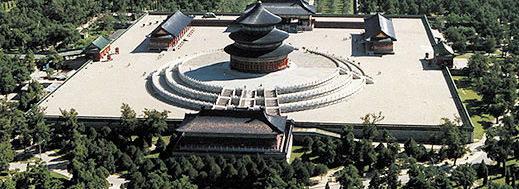
One of the emperor’s annual religious responsibilities was the ceremony at the Temple of Heaven. Since the emperor, as the Son of Heaven (Tianzi), with the Mandate of Heaven (Tianming), was to rule over human society, he had to worship Tianxia, All under Heaven and Earth, as his symbolic parents, in expression of the anciently established Chinese state ideology which held that the emperor was not divine but divinely appointed and guided to correctly interpret cosmic & stellar consciousness for harmonious earthly purposes.
The emperor’s duty was to insure that society expressed its natural order, which was an aspect of the cosmic order of humanity (society), heaven, and earth. The emperor also worshipped his own ancestors, expressing the Confucian ethic of filial loyalty, which was an obligation that all Chinese had to do, regardless of social position.
Other objects of imperial worship were the sun, the moon, Confucius, the emperors of earlier dynasties, the god of agriculture (in a ritual which included the symbolic plowing by the emperor of the first furrow of the new farming season), and other divinities representing important natural or social forces (such as the god of learning).

THE THREE PROSTRATIONS AND THE NINE KOWTOWS
FROM THE IMPERIAL COURT DOWN TO THE VILLAGE
When the emperor worshipped at the Temple of Heaven, he worshipped through a ritual called the “3 prostrations and 9 kowtows.” The emperor would be commanded by a high-ranking bureaucrat to prostrate himself, which he would do.
The word “kowtow” is an Anglicized rendering of the Chinese word ketou, meaning “to knock the head” against the ground. The emperor would then be told to arise, then to prostrate himself again and begin another cycle of this sequence, which would have to be repeated a total of 3 times — 3 successive prostrations, each with 3 kowtows, for a total of 9 kowtows.
This ritual of the 3 Prostrations and the 9 Kowtows was an important one, for it was also what an ordinary farmer would perform at the funeral of his father. Indeed, the phrase “from the imperial court down to our village” was commonly found in widely circulated documents during those days. This phrase was used to express the interconnection and commonality amongst all Chinese people, regardless of social position.
THE IMPORTANCE OF AN ENDURING BUREAUCRACY
The fact that high government officials were commanding the emperor himself to kowtow during the Prostation rituals, demonstrates how the imperial and the bureaucratic institutions were intertwined and thus, interdependent.
The governmental bureaucracy in China had already been around for hundreds of years, by the time the Qing arrived.
The ceremonies that the new Qing emperors used were ancient, and the continuity of these rituals and the traditions they expressed were in the hands of an enduring bureaucracy.
IMPERIAL LEGITIMACY AND THE COSMIC ORDER:
THE MANCHU QING AND THE “MANDATE OF HEAVEN”
In the Chinese tradition, the emperor did not necessarily have the absolute power that is associated with the traditional monarchies of Europe. The emperor’s actions had to be tempered by basic political expectations, and he had to act properly as an integral part of the cosmic order.
An emperor was expected to be an exceptional being — a sage king — and his right to rule was contingent upon his ability to skillfully mediate the cosmic forces. As mediator between Heaven and Earth, the emperor was thought to be a major participant in all cosmic actions, and as such he had to conduct himself accordingly, or the repercussions, in terms of cosmic dislocation, could be very serious.
If things went wrong — like a bad crop year — the emperor could be held responsible. He could be overthrown, and this would be considered legitimate. When such an overthrow occurred, it would be understood that the emperor had “lost” the Mandate of Heaven. In this way the notion of imperial legitimacy was fundamentally linked to the notion of maintaining the cosmic order.
The Manchus were asked by the reigning Ming emperor in 1644 to replace his dynasty. They assumed the Ming had lost the Mandate of Heaven. The Manchu-Qing worshipped the Ming emperors during their 268-year dynasty, as the Mandate of Heaven was centered on the principle of legitimacy. This means that the Ming (and all other prior dynasties) had legitimately held the Mandate at one point in time.
The Qing did assert the legitimacy of the entire system that dictated who could “rightfully” be an emperor of China, because this system allowed them to present themselves to the populace as “Sons of Heaven”, rather than as conquering Manchu foreigners who had no legitimate claim over China.
The Altar of Tang Chang’an in Xi’an, Shanxi Province

The oldest-known altar used in Chinese state religious practice was excavated in 1999 in Chang’an (former name of Xi’an). The main part of the Round Altar (Altar of Heaven) dates back to Sui and Tang dynasties (581–907 AD):

Zu Chongzhi (429–501), a Chinese philosopher and astronomer, estimated, independently, the value of the irrational and transcendental number Pi to be 355/113 = 3.14…. The altar functioned as an imperial prayer stage for only 17 Chinese emperors over a period of 314 years:

The sides and the surfaces of the altar’s platforms were covered with a layer of yellow clay, and topped off with a quarter-inch thick layer of gray-white paste, made from seed husks and straw, that gave the altar a white appearance:
.jpg)
The 4 circular platforms originally rose to 26.2 ft high. The bottom platform measured 177 ft in diameter, the top one 65 ft. It has 12 sets of equally spaced 12-step stairways, indicating the 4 seasons of the year and the 12 zodiac constellations, which match the Chou Rituals:

From paper and printing to seismographs, rockets, bridges, Chinese inventors were solving complex engineering problems thousands of years before the rest of the world caught up:
Tang dynasty Industrial Revolution
For centuries, Chinese emperors trusted a remarkable lock-mechanism to guard their vaults, gates and treasures.
One so clever, so well-engineered, that modern historians call it “puzzle engineering”, that was millennia ahead of its time, because modern security engineers still don’t fully understand how these mechanisms work.
These locks were a link between imperial China’s culture of mastery and the tech that kept emperors safe. They weren’t just about keeping thieves out — they were symbols of power, craftsmanship and ritual.
Watch how ancient Chinese padlocks & puzzle-locks worked: spring mechanisms, hidden keyholes, multi-step operations: