Palace of Tranquil Longevity
Palace of Tranquility and Longevity

The Qianlong gardens

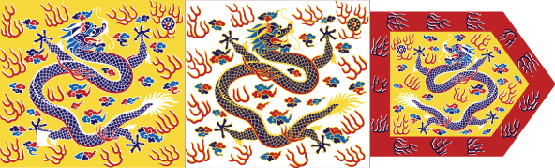
9 Dragons wall (96’x12′) Qianlong Garden (1772)
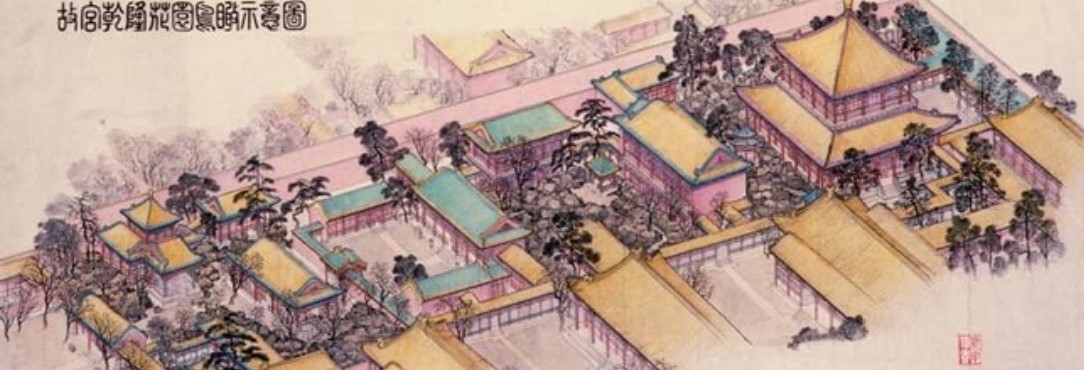
The Palace of Tranquil Longevity (Chin: 寧壽宮),literally, "peaceful old age palace," also called the Qianlong Gardens, Qianlong Palace, Qianlong District or the Palace of Tranquility and Longevity, is located in the NE corner of the Inner Court of the Forbidden City:

The secret garden, a private paradise


A superb perspective mural by G. Castiglione and friends

Detail of woman looking at her image in mirror


Couch/stool in the Xishangting (Pavilion of the Purification Ceremony),
a luohan chuan, or “arhat bed,” for sitting/napping. This root-wood bed
(size HxLxW=45x93x60”) made from naturally shaped wood, used by
Buddhists, Daoists, etc. desiring to resonate with the ways of nature.
The Qianlong Emperor was the longest-serving ruler in China. Not to out-reign his grandfather, he decided to design a garden complex for his retirement, but ultimately decided to remain behind the throne as emperor-emeritus. He very much regretted to have never really lived in it.

The Qianlong Garden was built around 1775. It reflects the emperor’s broad cultural tastes and knowledge. It included trees, bamboo and other growing things, but it was above all the emperor’s tranquil, private space: a place for reflection; a place for cultivation of the inner self; a retreat; a place for poetry and painting; and a work of art in its own right.
This private retreat, with 4 courtyards, elaborate rockeries, 27 pavilions and structures, also has a section for entertainment, named Juanqinzhai (Studio of Exhaustion from Diligent Service). Its exquisite interiors include a private theater and a receiving room:

Three other structures in the 4th courtyard include Fuwangge (Belvedere of Viewing Achievements), Zhuxiangguan (Lodge of Bamboo Fragrance), and Yucuixuan (Bower of Purest Jade).

The buildings contain decorations and furnishings of exceptional Chinese craftsmanship from a time widely considered to be representing some of the most significant, exquisitely designed interiors to have survived relatively unchanged from imperial China.

Its interiors contain the finest materials, such as large trompe l’oeil silk murals that incorporate Western artistic techniques of perspective and chiaroscuro. They are among the very few surviving examples of their genre in all of China.

During Qianlong’s reign (1735-1796), China was the world’s largest and richest civilization, and actively trading with other Asian countries. Thus, he became the world’s richest man.

While the impact of Chinese art and architecture on European art of this period is well known, the interiors of the Qianlong Garden demonstrate that this kind of impact was reciprocal, mainly thanks to Giuseppe Castiglione, a Jesuit missionary and perspective painter who settled in China around 1715.

An interpretation center is located in an existing, restored structure within the 2nd courtyard of the garden. The center is in 3 distinct halls surrounding an open pavilion, each of which will provide visitors with a unique perspective on the past and present of this remarkable complex.


Bedroom Qianlong Empress

Painted in 1737 by G. Castiglione