Patronage of the Arts
Qianlong Emperor Patronage of the Arts
The world of the Qianlong Emperor
Draped in Dragons
The dragon was considered the king of animals in Chinese culture and the symbol was often incorporated into lavish costumes brocaded and embroidered with silk and gold-metallic yarns. The jifu, or dragon robe as it became known in the West, was the most common type of dress worn by Chinese court members and officials during the Qing dynasty.
The dragon has the head of a camel, the horns of a deer, the eyes of a rabbit, and a neck like a snake. He has the claws of an eagle and the paws of a tiger. Not cloning gone awry, but these are the constitutive features of the Chinese dragon, a powerful symbol of China and Chinese history. Known as the herald of spring, the dragon may be most strongly associated with the principle of yang, and an emblem of maleness.
Court costume was based on the Confucian ideal that proper clothing identified people of virtue. At the same time, court costume helped to maintain the strict order so valued in Chinese society. The color of a robe, the number of dragon claws, the emblem depicted on an insignia badge, and the type of stone used to embellish a court hat or belt buckle all conveyed information about the wearer’s rank and position.
The Manchu rid imperial wardrobes of the full-sleeved Ming robes and tailored their dress to better suit their superb nomadic horsemanship. Robes were fitted closer to the body and sleeve cuffs were designed to be pulled over the hands for protection when riding. Forward-facing dragons were more important than sideways-facing dragons.

The artworks crafted for the Qianlong emperor reflect the refined vision of one of history’s most influential rulers, revealing his reverence for nature and his dedication to Buddhism, Confucian morals, and scholarly pursuits.
Using his imperial status to direct & redefine the efforts of artists & artisans serving in the court, the products of this direction, in their multifaceted diversity and unprecedented intricacy, bear the unmistakable mark of his era.
The Emperor also showed an abiding interest in scholarly innovation, sponsoring the first ever translation of the Buddhist canon into Manchu and taking the unconventional step of commissioning the biographies of rebellious officials.


"Seals of the Son of Heaven. Rare since Antiquity"
He concentrated on vastly increasing the scale & ostentation of works, and connecting himself to this by marking, stamping and inscribing the works of art he inherited, received, or bought, as well as having them reproduced in other materials.


His Imperial seals, their inscriptions, and other ‘conspicuous visual interventions’ showed his passion for ancient jades and bronzes, and how he revived the practice of cataloging collections of antiquities that flourished in the Song dynasty but languished under the subsequent Yuan & Ming dynasties.


Left seal shows his essay, for his 70th birthday, called "On being 70".
The center and right seals have been made for his 80th birthday.
The right seal has inscribed "Self strengthening never ceases".
The immense textual compilations made him play a pre-eminent role in preserving and transmitting the glories of China’s classic heritage.

Art Under Qianlong Emperor
Art works produced for this Emperor include works in:
- golden religious statuary;
- jade, cloisonné, & ceramic;
- armor and weapons used by him;
- dragon robes of imperial yellow silk;
- the emperor’s seals, cast in solid gold, and
- some of the most famous paintings then produced.

He personally examined various antiquities and invested considerable human and material resources in establishing the Qing court collection. Consequently, he has been viewed as the first "museum" director of the dynastic collection.
In particular, many surviving works from his collection now in the National Palace Museum, and Beijing Palace Museum along with those in the Mukden (Shenyang) and Rehe (Jehol) palace holdings, as well as the Nanjing Museum can be traced via the marks left by him, and clearly demonstrated how he collected and appreciated artwork.
Building on the foundation of his predecessors, the Qianlong Emperor expanded and utilized his vast imperial power to establish an era of thriving cultural activity.
By combining indigenous Confucian heritage and tradition with the multifaceted cultures of China’s periphery and promoting cultural exchange with the civilizations of the West, the emperor led the Qing empire through 60+ years of unprecedented artistic achievement.

By far the most impressive of his efforts was the vast and unprecedented compilation known as "Siku quanshu", the Complete Collection of the Four Treasuries.
Initiated in 1773, the project set out to organize and collate, in a comprehensive and systematic fashion, 3000 years of Chinese textual tradition. The result was a catalogued, annotated, and indexed collection of 3,450 complete works in 36,000 volumes, comprising of 1,000+ dramas and novels from around the country, containing 4.2 million pages. A task that took 300 scholars + 3,600 scribes 10 years to complete.
However, at the same time he ordered the burning of books deemed anti-imperialist or morally or politically unfit.

He painted and did calligraphy, collected jades, porcelain and bronzes, played a zitherlike instrument called the Qin and said to have written 44,444 poems and thousands of essays.
His art collection contained hundreds of thousands of paintings, sculptures and objects of art, many of which have his commentary and poems scribbled on them. His taste leaned towards the understated. He loathed ostentatious skill.

Qianlong Emperor’s Taste in Ceramics

3D-Mandala
The Qianlong Emperor’s appreciation of ceramics was based on two different types of collecting that he standardized:
1/ "Poetry as Record," with his engraved poetry;
2/ "Taste Re-Presented," porcelains illustrated in the Emperor’s albums of ceramics.
- In "Poetry as Record," imperial poetry conveys the Emperor’s historical understanding and appreciation of particular ceramics, conveying his views and ideals of imperial rule.
The external features he observed along with his understanding of kilns reveal his impressions of the various attributes of these ceramics.
In addition, most of Qianlong’s poems are on Northern Song Ru wares and Southern Song Guan and related wares, their contents dealing with praise for Song court porcelains as well as the tragic events that befell the Northern Song court.
Consequently, judging from his poetry on these porcelains, ceramics also served as a warning to himself and as something to reflect upon.
Time and again he stressed that his appreciation of ceramics was not a self-absorbing hobby that distracted him from ruling the country.
As a result, the Qianlong Emperor’s discussion of court porcelains not only treated Northern Song Ru wares as an ideal, he also took the opportunity to trace back to the story of the virtuous ancient emperor Shun making pottery on a riverbank, and linking it with the lofty ideal of ruling the land by virtue and example.
Thus, the Qianlong Emperor expressed a far-reaching idea that appreciating ceramics could serve as a model for himself in pursuit of the ideals of ancient sages.
- In "Taste Re-Presented," the focus is on the porcelains illustrated in paintings. He left illustrated albums of ceramics that he had ordered to be painted. They testify to the fact that porcelains had been personally appreciated by him and thus reflected his views.

Qianlong Emperor’s Use of Poetry on Ceramics
The Qianlong Emperor, left around 200 surviving poems that sing the praises of ceramics. Among them are many written specifically about official wares from ancient times.
In the poetry he not only studied and identified the ware and date of particular pieces, he also expressed personal views on their glaze coloring, surface coating, and traces of firing.
His connoisseurship views expressed in his poetry can be generally divided into the following key points:
- quality ceramics symbolizing the virtue of the ruler,
- different vessel shapes and glaze colors representing certain personality traits, and
- the appreciation of ceramics was not a diversion from his tasks as emperor.
Foreign Influences on the Arts

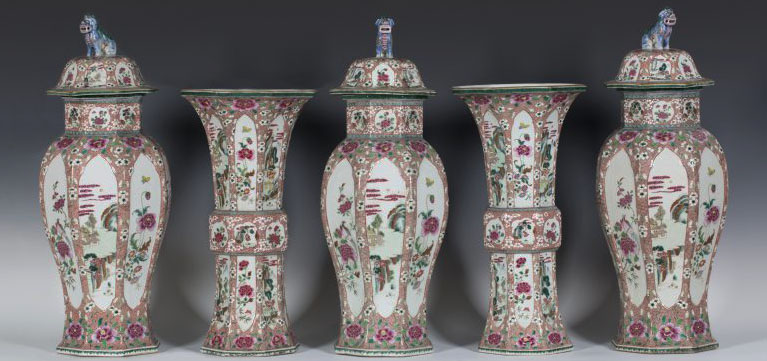
The exchange with the nations of the West and the states of the Chinese periphery led to an influx of foreign elements, such as the Western landscapes and European figures seen in enameled ceramics, the northern India Hindustan jade carvings, and the fine jade curios painstakingly fashioned in the court ateliers.
Court patronage also reached a high point in both refinement and output during this period. The finest craftsmen were recruited to serve in the palace workshops.

The European Jesuits were men of learning, and educated in astronomy, mathematics, medicine, and art. The most famous Jesuit artists active in the Qing court included Giuseppe Castiglione, Ignatius Sichelbarth, and Louis de Poirot.

These artists combined the traditional Chinese method of ink painting with Western illusionistic devices such as chiaroscuro modeling and linear perspective, thereby inspiring a new hybrid form of painting that combined Western-style realism with traditional Chinese brushwork.

The use of art to ‘brand‘ and glorify the refined grandeur and magnificence of the Qing court is also apparent in the exotic character of the glass, jade, porcelain, enamel, lacquer, and other objects crafted and packaged in the imperial workshops.
In blending the styles of Europe, the Middle East, Central Asia, and the Far East, they are a perfect embodiment of the multiculturalism that flourished under the reign of Qianlong.
The high cost of military campaigns, building projects, travel, personal luxury, and corruption in his government toward the end, left the national treasury nearly depleted.
A few decades after his death, China experienced 200 years of decline, before re-establishing itself again in the 21st century as the “Greatest Nation on Earth”.
